Statistics Korea Announces August Employment Trends
[Asia Economy Reporters Son Sun-hee (Sejong), Jang Se-hee] Last month, the number of self-employed individuals with employees hit its lowest point in 31 years, indicating that employment in face-to-face service industries has not escaped the slump caused by COVID-19. The issue of disrupted automobile production also contributed to the largest decline in manufacturing employment in eight months. However, compared to last year when the COVID-19 crisis first erupted, the recent fourth wave's impact on the overall employment market is considered limited.
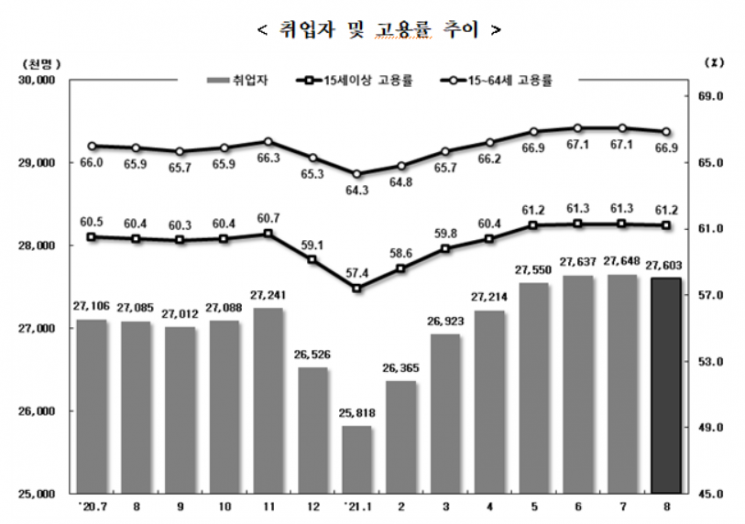
According to the 'August Employment Trends' released by Statistics Korea on the 15th, the number of employed persons last month was 27.603 million, an increase of 518,000 compared to the same month a year earlier. The employment rate (aged 15 and over) also rose by 0.8 percentage points to 61.2%. Employment numbers have been increasing for six consecutive months despite the fourth wave of COVID-19, following a turnaround in March. Jeong Dong-myung, Director of the Social Statistics Bureau at Statistics Korea, stated, "Unlike the first to third waves, the impact was limited to certain industries," adding, "The employment recovery trend continued in August."
However, in face-to-face service sectors such as wholesale and retail trade and accommodation and food services, employment damage has been concentrated since July when quarantine measures were strengthened. Last month, employment in wholesale and retail trade decreased by 113,000, the largest decline among all sectors, while accommodation and food services employment fell by 38,000. The number of self-employed individuals with employees last month was only 1.301 million, marking the lowest level for the same month since 1990, 31 years ago.
Manufacturing showed an increasing trend after the second quarter, but employment decreased by 76,000 due to some automobile production being affected by the shortage of vehicle semiconductors. Employment among workers in their 30s, who have a high proportion in manufacturing, declined by 88,000, continuing an 18-month consecutive decrease. Regarding this, Professor Park Young-beom of Hansung University’s Department of Economics analyzed, "It appears to be influenced by the full implementation of the 52-hour workweek system for workplaces with 5 to fewer than 50 employees starting in July," adding, "Workplaces with fewer than 30 employees can allow up to 60 hours of work per week through labor-management agreements until the end of next year, so they likely reduced their workforce." He continued, "It is also difficult to rule out the possibility of a worsening fourth wave of COVID-19 after Chuseok," and predicted, "The employment market this year will inevitably be fully affected by the COVID-19 situation, so uncertainty will persist."
The government is also paying attention to uncertainties in the employment market. Hong Nam-ki, Deputy Prime Minister and Minister of Economy and Finance, stated, "Since the quarantine situation remains difficult in September, we will monitor it closely," and added, "We will also carefully examine the significant decrease in manufacturing employment."
© The Asia Business Daily(www.asiae.co.kr). All rights reserved.
![Clutching a Stolen Dior Bag, Saying "I Hate Being Poor but Real"... The Grotesque Con of a "Human Knockoff" [Slate]](https://cwcontent.asiae.co.kr/asiaresize/183/2026021902243444107_1771435474.jpg)
















