Sexual Violence and Threats as Secondary Harm
Expert: "Too Much Secondary Harm Online... Punishment Also Difficult"
"Need for Social Awareness Change... Not an Individual Issue but a Collective Problem"
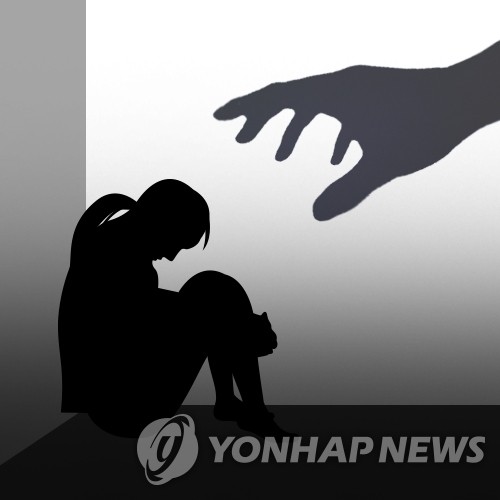
[Asia Economy Reporter Park Hyun-joo] There are growing calls for measures to prevent secondary damage suffered by sexual violence victims who are not adequately protected. Experts point out that this is due to the widespread 'victim-blaming theory,' which shifts the cause of the crime onto the victims.
Actor Ban Min-jung, who was sexually assaulted on a film set in 2015, has been complaining about secondary harm caused by the perpetrator Jo Deok-je. On the 3rd, she posted on her Facebook, saying, "I am suffering greatly from secondary damage due to Jo Deok-je's defamatory posts," and appealed, "For the sake of other cases as well, there is a need for measures to prevent the recurrence of secondary harm such as fake news, false allegations, and indiscriminate defamation against crime victims."
She continued, "People cannot know when, where, or who might become a victim," adding, "I also did not predict that I would become a victim. To prevent more victims like me from emerging, or to provide help to those who have suffered unavoidable harm, I will muster the courage to speak out."
Meanwhile, on the 10th, it was belatedly revealed that a public official A in Busan had been sexually harassed and assaulted for years by a male superior in his 50s.
The perpetrator reportedly took A to secluded places to commit sexual crimes and threatened, "If you reject me, it won't be difficult to prevent you from working as a public official." Even after A was transferred to another department in July 2019, the perpetrator continued to harass A by slapping and verbally abusing him.
What is more serious is that the perpetrator's wife repeatedly visited and spread rumors implying that "A had committed adultery," causing secondary harm. This secondary harm continued for about six months.
In response, the Busan branch of the National Public Officials Labor Union demanded a thorough investigation and measures to prevent secondary harm. They stated, "The district office only suspended the perpetrator from his position but took a passive stance on investigating the facts and preventing recurrence of secondary harm," emphasizing, "This case reflects the widespread sexual misconduct in the public sector, the organizational culture that condones it, and the lack of gender sensitivity. Drastic measures must be taken to establish sexual crime prevention policies."
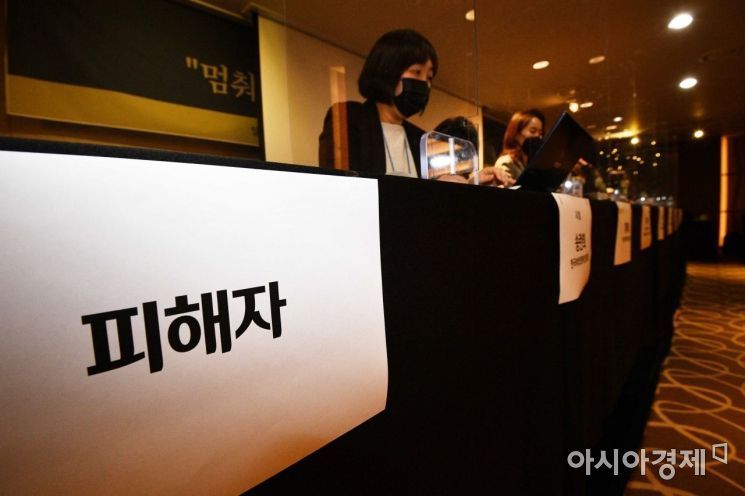 On the morning of March 17, a seat was prepared for the victim of the late former Seoul Mayor Park Won-soon's sexual violence case at a press conference titled "Speaking Together with the Victims of the Seoul Mayor's Sexual Violence Case," held at a hotel in Myeongdong, Jung-gu, Seoul. / Photo by Joint Press Corps
The issue of secondary harm online is also at a serious level. The victim of the late Park Won-soon, former Seoul mayor, who was sexually harassed, has voiced complaints about secondary damage. At a press conference held on March 17 titled 'Speaking Together with Victims of the Seoul Mayor's Power Sexual Violence Case,' the victim said, "The cruel secondary harm from supporters of former Mayor Park was the hardest," expressing, "I feel like there is no place for me as a human being."
She added, "I feel powerless at the actions of people applauding the former mayor, as if denying the victimization," and pointed out, "The designation as a victim complainant and the situation condoning severe secondary harm due to distortion of the case are all wrong from the start."
Such secondary harm against sexual violence victims calls for more proactive measures to prevent secondary damage.
Experts diagnose the cause of secondary harm against sexual violence victims as the 'victim-blaming theory.' Jang Mi-hye, Senior Researcher at the Gender Violence Research Division of the Korean Women's Development Institute, explained, "Secondary harm ultimately stems from the perception that the victim is responsible, that is, the victim-blaming theory."
She particularly noted the seriousness of online secondary harm. Researcher Jang said, "In the past, secondary harm was limited to whispers among acquaintances, but now, online, the victim's story circulates among many more people beyond spatial limits," expressing concern, "For victims, the initial sexual violence is perpetually repeated, causing fear. This means it becomes difficult to return to normal life."
Researcher Jang added, "Compared to the initial sexual violence perpetrator, there are many more and far-reaching secondary perpetrators online, making punishment difficult."
She then urged a change in societal awareness. Researcher Jang emphasized, "In fact, punishment for sexual violence perpetrators and support systems for victims are being strengthened. Nevertheless, secondary harm remains widespread due to the need for a change in societal perception," stressing, "It is necessary to change the perception and attitude to see sexual violence not just as an individual victim's problem but as an issue for the entire community."
© The Asia Business Daily(www.asiae.co.kr). All rights reserved.


















