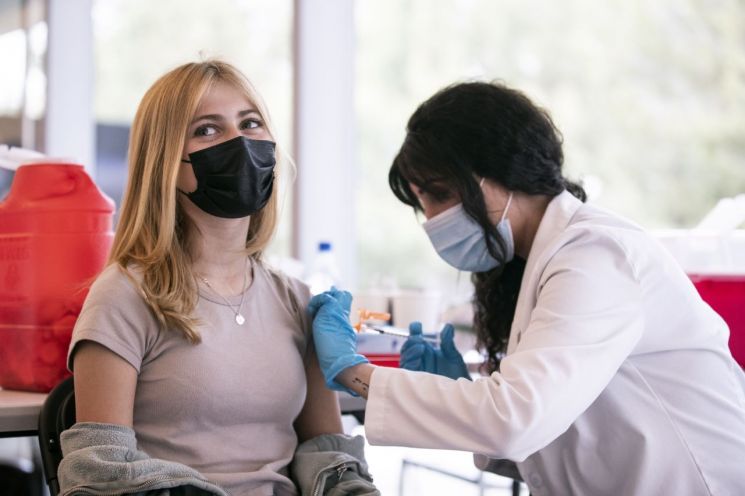
 A 12-year-old girl is receiving the Pfizer-BioNTech vaccine in California, USA, last May.
 [Image source=EPA Yonhap News]
[Asia Economy Reporter Lee Chun-hee] As the government plans to announce the fourth-quarter vaccination plan this month, which includes whether to vaccinate children and adolescents against COVID-19, authorities and experts have expressed somewhat differing opinions.
On the 14th, Hong Jeong-ik, head of the Vaccination Management Team at the COVID-19 Vaccination Response Promotion Group, stated at a COVID-19 briefing, "Generally, healthy children and adolescents are not considered a high-risk group, so we do not view vaccination as absolutely necessary." However, he added, "In cases where there are underlying health conditions, the risk of infection is naturally much higher, so vaccination is considered necessary."
Currently, vaccination for adolescents aged 12 and older is actively underway in countries such as the United States. In South Korea, the approved age for Pfizer vaccine administration has been lowered to 12 years, prompting discussions about vaccinating children and adolescents. Meanwhile, a team led by Dr. Tracy Hoag from the University of California analyzed adverse reactions following vaccination in American adolescents aged 12 to 17 and announced on the 12th (local time) that the likelihood of myocarditis diagnosis due to vaccination is 4 to 6 times higher than COVID-19 hospitalization.
Regarding this, Hong said that while decisions should be based on objective data, "we do not believe the benefits of vaccination for the 12 to 17 age group are overwhelmingly large."
Hong explained, "We will provide accurate information to parents and children and adolescents so they can make rational decisions about vaccination," adding, "We plan to provide objective and scientific information faithfully to ensure vaccination is neither forced nor induced." He also noted, "The approach is to offer the opportunity for adolescents aged 12 and older to receive vaccination."
On the other hand, Professor Choi Won-seok of the Department of Infectious Diseases at Korea University Ansan Hospital, who attended the expert briefing on adverse reactions following the COVID-19 briefing, presented a somewhat different view. Professor Choi stated, "There are many differing opinions on the benefits and risks of vaccinating adolescents," but expressed the opinion that "vaccination is viewed more positively."
Professor Choi said, "For adolescents aged 12 to 17, it is true that based on age alone, they are the group with the lowest COVID-19 risk," but added, "If there is a high number of cases, the benefits of vaccination increase." He emphasized that this was his personal opinion, stating, "If unvaccinated children gather, the incidence of COVID-19 among them is likely to be higher," and predicted, "With school reopening and increased face-to-face meetings among children, it will be difficult to protect all children."
However, he added, "There are many disagreements among experts, and it should not be approached with vaccination rate targets as with other age groups," and further commented, "It would be desirable to provide explanations about risks and benefits and allow individual choice; if vaccination is authorized, the path should be opened to enable choice."
© The Asia Business Daily(www.asiae.co.kr). All rights reserved.

















