Annual Facility Investment Up to 50 Trillion Won Needed
High Likelihood of Cost Transfer to Household Electricity Bills
Rising Electricity Prices Worsen Living Conditions for Energy-Vulnerable Groups
Europe Also 'Groans' Under High Electricity Costs
Experts: "Carbon Neutrality Costs Are High, but Climate Crisis Damage Is More Severe"
"National Consensus Needed and Welfare Policies to Support Vulnerable Groups Must Be Expanded"
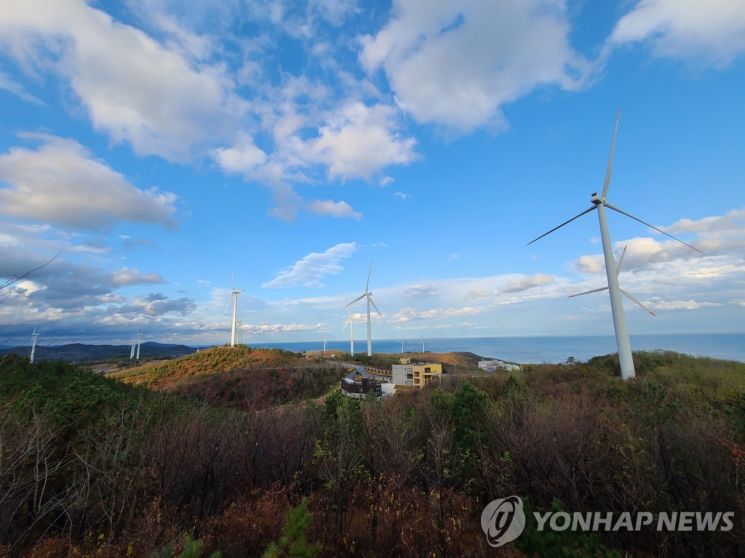 Yeongdeok Wind Power Plant located on the hill of Haemaji Park, Yeongdeok-eup, Yeongdeok-gun, Gyeongbuk / Photo by Yonhap News
[Asia Economy Reporter Lim Juhyung] From the torrential rains that poured over East Asia, including China and Korea, in July and August, to Australia's massive wildfires, natural disasters caused by climate change are threatening not only property but also human lives. In response, many countries around the world have begun building infrastructure to achieve 'carbon neutrality,' but the astronomical costs remain a significant obstacle.
Carbon neutrality refers to a state where the net emissions of greenhouse gases from human economic activities reach 'zero.' Specifically, achieving carbon neutrality involves converting fossil fuel energy facilities that emit carbon into eco-friendly renewable energy sources and eliminating exhaust gases emitted from chemical plants or factories.
The problem lies in the cost of converting existing fossil fuel power plants into eco-friendly renewable energy facilities such as solar, wind, and hydro power. The investment required for energy transition equipment is estimated to exceed hundreds of trillions of won over several decades, and if the government is to secure this level of funding, future increases in energy prices such as electricity and gas may be necessary. This could place the burden of inconvenience on the lower-income population in order to protect the environment.
Experts advise that to secure the enormous funds needed for carbon neutrality, a national consensus must be established, and welfare policies should be implemented to support energy-vulnerable groups during the transition process.
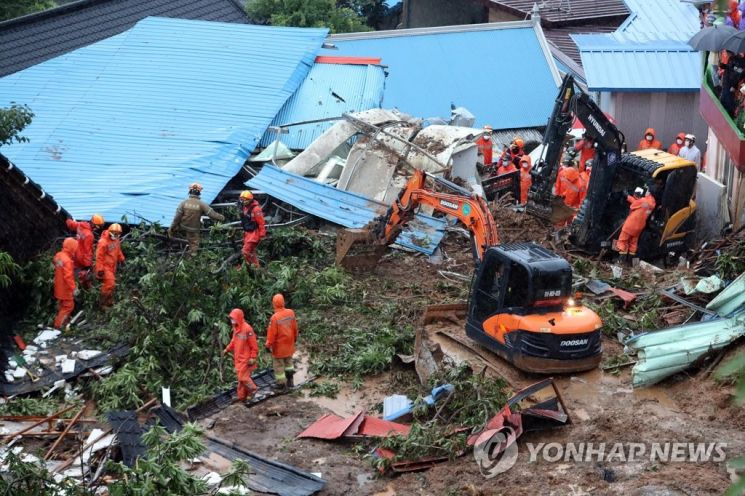 Rescue operations are underway in a village in Bipyong-ri, Jinsang-myeon, Gwangyang-si, Jeollanam-do, where a landslide occurred due to heavy rain on the morning of July 6. / Photo by Yonhap News
To prevent climate change, which is presumed to be the cause of various weather anomalies around the globe, it is essential to devise ways to drastically reduce carbon emissions. However, the amount of money that must be spent to achieve carbon neutrality is beyond imagination.
According to the 'Analysis of Power Supply Scenarios for Carbon Neutrality by 2050,' authored this year by Lee Jongho, Senior Specialist at Korea Hydro & Nuclear Power (KHNP) Central Research Institute, achieving carbon neutrality by 2050 using only renewable energy without the help of nuclear power plants will require approximately 1,394 trillion won. Including nuclear power plants currently under construction and those already built, the cost decreases to 941 trillion won, but it still involves an astronomical cost approaching 1,000 trillion won.
In other words, it means that nearly 50 trillion won per year must be invested until 2050 to realize carbon neutrality.
If the energy infrastructure construction plan for carbon neutrality is implemented, this astronomical cost is likely to directly lead to increases in energy prices.
Korea Electric Power Corporation (KEPCO) recently projected in its '2021?2025 Mid-to-Long-Term Financial Management Plan' that its net loss for this year will exceed approximately 4 trillion won. KEPCO explained in the report that the widening deficit is due to increased power purchase costs caused by rising international fuel prices and reduced coal power plant utilization as part of carbon neutrality policy implementation.
Meanwhile, for KEPCO to accelerate carbon neutrality efforts, it will need to further reduce coal power generation and expand renewable energy purchases, which could increase operating losses. Ultimately, to secure funding, raising energy prices such as electricity rates may be unavoidable.
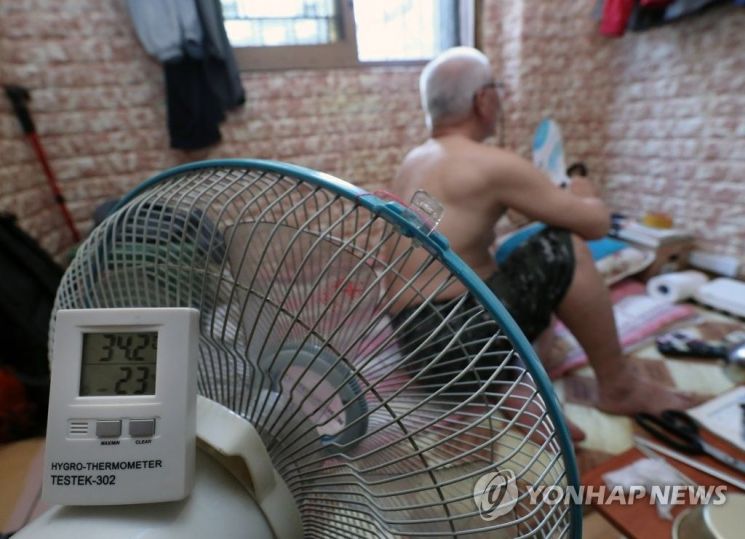 If electricity rates increase, the financial hardship faced by elderly people living alone or impoverished groups vulnerable to heatwaves and cold snaps may become even more severe. / Photo by Yonhap News
If electricity prices rise, the low-income population will suffer the most. This is especially critical for 'energy-vulnerable groups' such as impoverished households and elderly people living alone, for whom it could become a matter of life and death. Coping with summer heatwaves and winter cold spells will become even more difficult.
Concerns about the costs of transitioning to carbon neutrality are growing overseas as well. For example, European countries, which have invested much more aggressively in renewable energy than others, are currently struggling with soaring energy costs.
According to the UK media outlet 'The Telegraph' on the 13th (local time), the recent forecast for energy prices in the UK once soared to 540 pounds per megawatt (approximately 870,000 won), which is 11 times the average price. Other European countries are experiencing similar situations.
The current instability in energy prices is due to a sudden surge in natural gas prices caused by skyrocketing demand. However, the low efficiency of renewable energy has also exacerbated the problem. According to the UK media 'The Guardian,' Europe is currently experiencing relatively slow wind speeds, causing wind power facilities to operate inadequately, which increases the risk of even higher electricity prices.
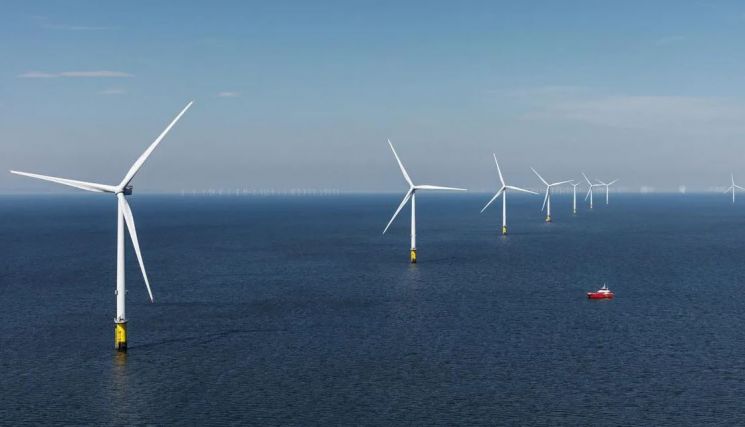 The world's largest offshore wind turbine power facility, the UK's Hornsea Wind Farm / Photo by Hornsea Project Official Website
Experts emphasize that while carbon neutrality is essential for a sustainable society, securing the necessary funds requires social consensus.
Kim Hyunwoo, Policy Team Leader at Climate Crisis Emergency Action, stated, "The annual 50 trillion won needed for carbon neutrality cannot simply be regarded as a cost. According to the 'Stern Report' published in 2005 by Nicholas Stern, an economist from the UK Treasury, the cumulative damage costs of not transitioning to carbon neutrality far exceed the transition costs. Regardless of the cost, carbon neutrality is a goal that must be achieved for a sustainable future."
However, he explained that it is necessary to lead social consensus to secure funding. Kim said, "It is true that both industries and households must bear some of the necessary costs. The government should enhance transparency while promoting the carbon neutrality roadmap to gain public support, and also consider welfare policies such as energy vouchers and basic electricity rights to support energy-vulnerable groups who may be adversely affected by price increases."
© The Asia Business Daily(www.asiae.co.kr). All rights reserved.
![Clutching a Stolen Dior Bag, Saying "I Hate Being Poor but Real"... The Grotesque Con of a "Human Knockoff" [Slate]](https://cwcontent.asiae.co.kr/asiaresize/183/2026021902243444107_1771435474.jpg)













