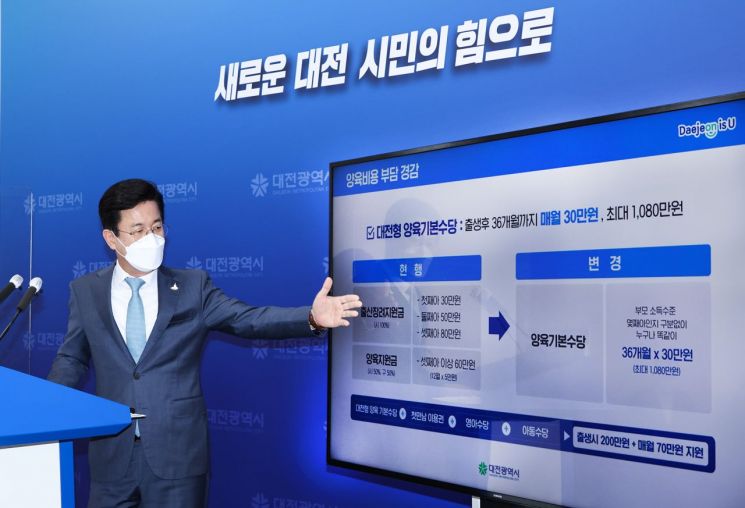
 Daejeon Mayor Heo Tae-jeong is introducing the direction of the 'Daejeon-style Basic Childcare Allowance' policy, which will be implemented from next year, at Daejeon City Hall on the 14th. Photo by Daejeon City
[Asia Economy (Daejeon) Reporter Jeong Il-woong] Starting next year, 300,000 KRW per month will be provided to families with infants and toddlers in the Daejeon area. The target is families with infants and toddlers up to 36 months old, and support is available if the parents have resided in Daejeon for more than six months.
On the 14th, Daejeon Mayor Heo Tae-jeong announced the ‘Daejeon-style Childcare Basic Allowance’ policy at a regular briefing.
The childcare basic allowance will be provided regardless of birth year, parental income level, or whether the child is the first, second, or third. Through this, if a child is born and continuously resides in Daejeon for more than three years, a total of 10.8 million KRW can be supported.
In addition, when combined with the government-provided First Meeting Voucher, infant allowance, and child allowance, families will receive 2 million KRW at birth and 700,000 KRW monthly, which the city expects will significantly reduce the initial childcare burden.
The city plans to analyze the results of the childcare basic allowance after one year of implementation and consider expanding the support period up to five years for families with a third child or more.
However, instead of the childcare basic allowance, the existing childbirth encouragement subsidy and support for raising the third child or more will be abolished starting next year.
The city will also expand the local childcare system. It plans to continuously increase public daycare centers, daycare centers exclusively for zero-year-olds, Geojom Ondol rooms, toy libraries, and newly establish a metropolitan childcare support center next year to strengthen childcare expertise and integrate childcare system management.
Additionally, measures to improve the treatment of childcare workers will be promoted, including mental health support allowances for daycare teachers, support for childcare personnel for children with disabilities in daycare centers, dispatch of substitute cooks to daycare centers, and the introduction of a seniority system for workers at small welfare facilities.
Mayor Heo Tae-jeong of Daejeon said, “The population issue will emerge as a serious social problem in the long term,” and added, “The city will strive to become ‘Daejeon, a good place to have and raise children, and a livable city where people gather’ to overcome the local population crisis.”
He also stated, “Starting in 2023, we aim to shed the stigma of Daejeon as a city with net population outflow and transform it into a city attracting population by establishing a cyclical structure where youth employment and housing stability, marriage, childbirth, childcare, education, stable employment of grown children, and settlement within the region are secured.”
Meanwhile, Daejeon’s total population has decreased annually from 1.5 million in 2014 to around 1.45 million currently. The number of births in the region has also halved, from 15,000 in 2012 to about 7,500 last year.
© The Asia Business Daily(www.asiae.co.kr). All rights reserved.

















