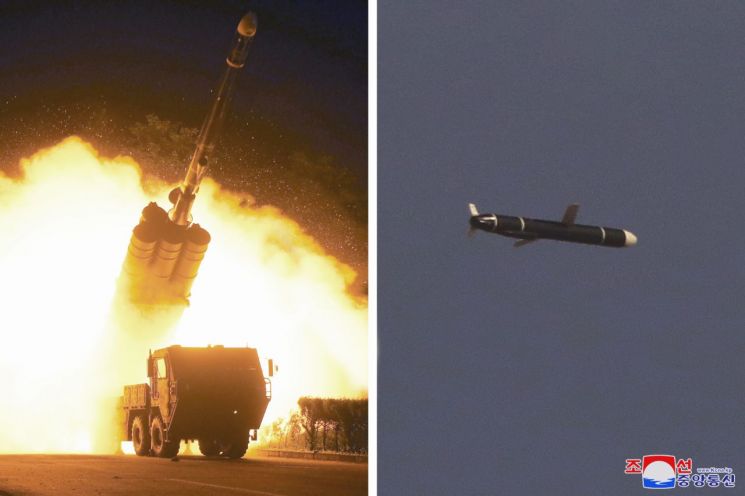
[Asia Economy Military Specialist Yang Nak-gyu, Reporter Lee Ji-eun] North Korea has test-fired a new long-range cruise missile with a range of 1,500 km. It is interpreted as a low-intensity show of force through a cruise missile launch that does not violate the UN Security Council's resolutions on North Korea.
According to a report by the Korean Central News Agency on the 13th, North Korea's National Defense Science Institute successfully conducted test launches of the new long-range cruise missile on September 11 and 12, with the missile flying for 7,580 seconds and hitting a target 1,500 km away.
Earlier in January, North Korea mentioned at the 8th Congress of the Workers' Party that it had developed a medium- to long-range cruise missile. Including these two recent tests, it is expected that final tests for operational deployment will be conducted, followed by mass production. Cruise missiles have higher accuracy than ballistic missiles and fly at lower altitudes, making detection and interception difficult.
Due to these characteristics, there have been cases where the South Korean military failed to detect several short-range cruise missile launches by North Korea. The Joint Chiefs of Staff stated, "Our military is conducting precise analysis under close cooperation with South Korean and U.S. intelligence authorities." A Blue House official also said, "We are closely monitoring the current North Korean situation and conducting detailed analysis regarding the launch."
Regarding North Korea's public cruise missile launch, Shin Jong-woo, Senior Analyst at the Korea Defense and Security Forum (KODEF), said, "It was a demonstration that not only ballistic missiles but also cruise missiles can strike Japan, Guam, and Alaska." Professor Kim Dong-yeop of the Graduate School for North Korean Studies also analyzed, "With a range of 1,500 km, it includes the U.S. military base in Okinawa, Japan," adding, "It shows an intention to increase deterrence through cruise missiles."
There is also an interpretation that this is pressure on the U.S., which calls for 'unconditional dialogue' without definite incentives. Professor Kim Yong-hyun of Dongguk University's Department of North Korean Studies pointed out, "The Biden administration said it would engage in dialogue with the North, but nothing has actually started," and added, "It was a show of force toward the U.S. to assert presence within a limited scope."
The provocation is also seen as timed to coincide with a meeting of senior South Korean, U.S., and Japanese diplomatic officials to discuss the North Korean nuclear issue. On the 14th, Noh Kyu-duk, Director of the Ministry of Foreign Affairs' Peace and Security Negotiation Division on the Korean Peninsula, Sung Kim, U.S. Special Representative for North Korea, and Takehiro Funakoshi, Director of the Asia and Oceania Bureau of Japan's Ministry of Foreign Affairs, will meet in Tokyo to discuss solutions to the North Korean issue. Additionally, on the 15th, Foreign Minister Chung Eui-yong and Chinese Foreign Minister Wang Yi will hold a foreign ministers' meeting in Seoul to discuss current issues.
It is analyzed that North Korea's missile launch will negatively affect these neighboring countries' efforts to resume dialogue. Professor Lim Eul-chul of Kyungnam University's Institute for Far Eastern Studies said, "North Korea's reactivation of the Yongbyon reactor and new missile test launches are expected to have a considerable negative impact on South Korea and the U.S.'s efforts to seek humanitarian aid for North Korea," adding, "North Korea is only adjusting the speed and level but will continue to develop stronger weapons."
Since the 'Five-Year Weapon System Development Plan' has been confirmed through this missile launch, weapon system tests are expected to continue. Professor Park Won-gon of Ewha Womans University's Department of North Korean Studies predicted, "Since it is an institutionalized plan, continuity is guaranteed," adding, "Considering the Beijing Olympics, launches may occur until the end of the year, and restraint during the period cannot be ruled out."
© The Asia Business Daily(www.asiae.co.kr). All rights reserved.
![Clutching a Stolen Dior Bag, Saying "I Hate Being Poor but Real"... The Grotesque Con of a "Human Knockoff" [Slate]](https://cwcontent.asiae.co.kr/asiaresize/183/2026021902243444107_1771435474.jpg)
















