Democratic House Members Push to Raise Corporate Tax Rate to 26%
Forecasted Lower Than White House's 28% Plan
Wealth Tax Increase Policy Maintained
Budget Bill Passage Difficult Amid Disputes
Stock Market Weakness Inevitable If Tapering Coincides with Employment Slowdown
BOA: "No Good News Left"
[Asia Economy New York=Correspondent Baek Jong-min] Concerns over the sharp decline in the New York stock market are casting a shadow over global stock markets.
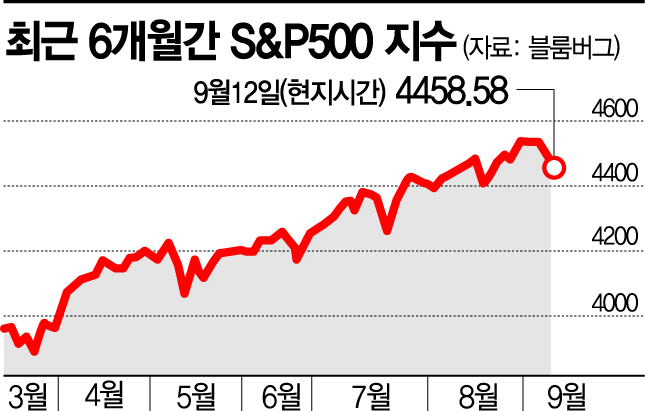
With inflation continuing to rise, the Federal Reserve (Fed) is certain to begin tapering asset purchases within the year, and worries about economic slowdown due to the spread of the Delta variant and supply chain disruptions are pressuring the market.
The expectation of declining corporate profit margins amid slowing growth is hampering risk asset investment sentiment. Meanwhile, Democratic House members in the U.S. are actively pushing for increases in corporate tax, capital gains tax, and income tax, which investors are closely monitoring.
◇ Democrats Begin 'Wealth Tax' in Earnest = According to the Wall Street Journal (WSJ) and Bloomberg on the 12th (local time), Democratic House members are pushing to raise the corporate tax rate from the current 21% to 26.5%. This marks the full-scale implementation of President Joe Biden and the Democratic Party's plan to secure funding for large-scale stimulus measures through wealth taxation.
The Democrats expect to secure about $2 trillion in tax revenue over the next decade through this measure. They also plan to raise the top capital gains tax rate from the current 20% to 25% (28.8% including the Obamacare tax). Additionally, they plan to impose a 3 percentage point surtax on individual incomes exceeding $5 million.
This corporate tax increase, which inevitably increases the burden on companies and investors, is expected to act as another variable in the market.
Although concerns about a U.S. economic slowdown persist, the $3.5 trillion budget bill necessary for economic stimulus remains in disarray.
Amid conflicts between Republicans and progressive and moderate factions within the Democratic Party, the Democrats urgently need to reach an internal agreement on budget processing. Although much of the Biden administration's original tax increase plan has been scaled back, White House Deputy Press Secretary Andrew Bates evaluated the current budget content positively, reflecting this background.
Democratic Senator Joe Manchin has expressed opposition to the budget bill. With Democrats holding half of the Senate seats, they cannot pass the budget without Manchin's support. Progressive Senator Bernie Sanders has opposed any small-scale economic support measures.
◇ S&P 500 Weakens After Setting 54 New Records? = The S&P 500 index fell for five consecutive days last week, dropping 1.7%. This five-day consecutive decline is the longest since February.
The S&P 500 set 54 new records this year, but has clearly weakened this month. The three major indices?Dow Jones, S&P 500, and Nasdaq?are all down on a monthly basis. The last time the S&P 500 declined on a monthly basis was in January.
The expectation of declining corporate profit margins amid slowing growth is hampering risk asset investment sentiment. In particular, the August employment report released on the 3rd is seen as a decisive factor. The monthly employment increase in August was only 230,000, far below the market expectation of 730,000, signaling a possible economic slowdown.
Economic indicators scheduled for this week are also likely to pressure the market. The August Consumer Price Index (CPI) released on the 14th and the retail sales index announced on the 16th are important variables showing U.S. economic trends. If the CPI rises more than expected, it could pressure the Fed to decide on tapering earlier. If retail sales fall short of expectations, concerns about economic slowdown could spread further.
With producer prices soaring, concerns about worsening corporate profits are also rising. The August Producer Price Index (PPI) released on the 10th surged 8.3% year-on-year, marking the highest increase since the index began in November 2011.
Rising producer prices inevitably lead to higher retail prices. Charlie Ripley, investment strategist at Allianz Asset Management, said, "Supply chain bottlenecks, inventory shortages, and rising goods and transportation costs are driving up production costs," warning that the PPI surge will "open the Fed's eyes," signaling not only tapering but also the possibility of early interest rate hikes.
◇ "No Good News Left" = Bank of America (BOA) recently published a report stating, "There is no good news left. Much of the optimism has already been priced in," and adjusted the S&P 500 year-end target to 4250, which is 4.7% lower than the closing price on the 10th. BOA set the S&P 500 target for next year at 4600.
Excessive optimism in the U.S. stock market is also a concern that could accelerate the decline. Citigroup noted that buy positions in the futures market outnumber sell positions by 10 to 1, and predicted that if the S&P 500 falls an additional 1%, 50% of buy positions would experience losses. This analysis suggests that large-scale forced liquidations due to market corrections could trigger a massive plunge.
© The Asia Business Daily(www.asiae.co.kr). All rights reserved.
![Clutching a Stolen Dior Bag, Saying "I Hate Being Poor but Real"... The Grotesque Con of a "Human Knockoff" [Slate]](https://cwcontent.asiae.co.kr/asiaresize/183/2026021902243444107_1771435474.jpg)
















