IBS Jo Yoon-kyung Advanced Soft Materials Research Group Leader Team
[Asia Economy Reporter Kim Bong-su] An artificial cellular organelle capable of delivering drugs deep into human cell tissues has been developed by a domestic research team, which is expected to help improve the effectiveness of existing drug therapies.
The Institute for Basic Science (IBS) announced on the 14th that the research team led by Group Leader Cho Yoon-kyung of the Center for Soft and Living Matter (Professor of Biomedical Engineering at UNIST) developed an artificial cellular organelle capable of generating energy within cells by reprogramming exosomes, the living cell-to-cell information carriers (exosome·extracellular vesicles). Exosomes can penetrate deep into tissues, suggesting a new drug delivery system that overcomes existing limitations.
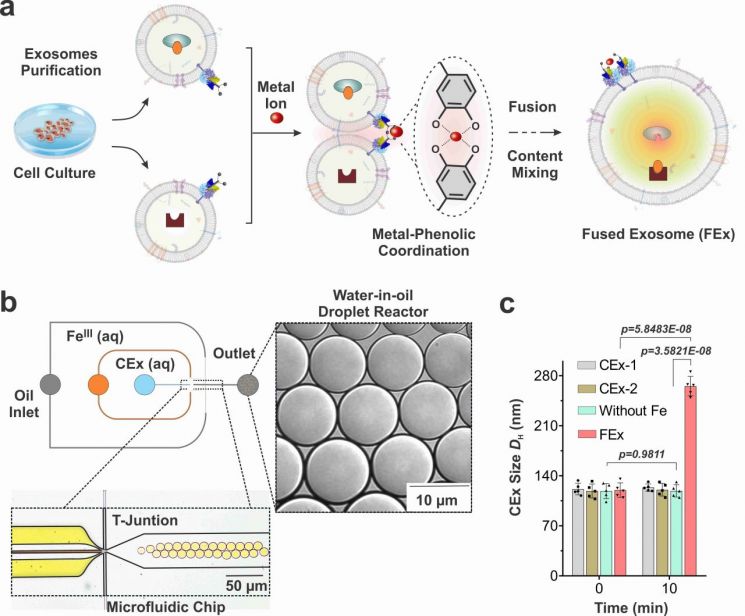
The research team focused on the fact that nano-sized exosomes are efficient information carriers between living cells. Using a droplet-based microfluidic reactor with cell-sized dimensions (diameter under 10 μm, volume under 1 picoliter), they observed that when two types of exosomes merged, chemical reactions occurred between their internal substances, resulting in fusion. Furthermore, through the fusion reaction of exosomes containing different enzymes inside and on membrane proteins, they successfully controlled biocatalytic reactions.
In particular, the artificially developed exosomes are expected to have significant medical applications. The researchers included enzymes capable of synthesizing bioenergy (ATP), the energy source of cells, in the artificial exosomes and confirmed the production of ATP within living cells by these artificial synthetic exosomes. Moreover, they demonstrated that the artificial exosomes penetrated deep inside breast cancer-mimicking spheroids. This showed the potential of artificial exosomes to serve as nano-pills supplying energy to cells damaged by hypoxia and suggested a new strategy for elucidating the ATP deficiency phenomenon in tumor cores.
In this context, as understanding of life phenomena expands, attempts at artificial reproduction beyond simple observation are gaining attention. Recently, efforts have been made to artificially create cellular organelles (artificial organelles) to mimic biocatalytic reactions. Cellular organelles can be considered the ‘organs’ of cells, with mitochondria responsible for cellular respiration and lysosomes as intracellular digestive organelles being representative examples. These organelles contain microenvironments where complex biochemical reactions occur, and inside them exist multiple enzymes that perform important cellular functions together. However, applying artificial cellular organelles to living cells involves many challenges to overcome, such as intracellular material delivery efficiency, stability, and biocompatibility.
Group Leader Cho Yoon-kyung said, “We proposed a more efficient material delivery method to living cells through artificial exosomes,” and added, “We plan to continue research to create artificial cellular organelles equipped with additional functions inside and on the surface of exosomes.”
The research results were published as the cover paper in the June 14 issue of Nature Catalysis (IF 41.813), an international journal in the field of nanoscience.
© The Asia Business Daily(www.asiae.co.kr). All rights reserved.
![Clutching a Stolen Dior Bag, Saying "I Hate Being Poor but Real"... The Grotesque Con of a "Human Knockoff" [Slate]](https://cwcontent.asiae.co.kr/asiaresize/183/2026021902243444107_1771435474.jpg)
















