Construction Technology Research Institute Develops Energy Storage System Linked to Solar Power
Integrated Solar Panel with Insulation and Blind Effects
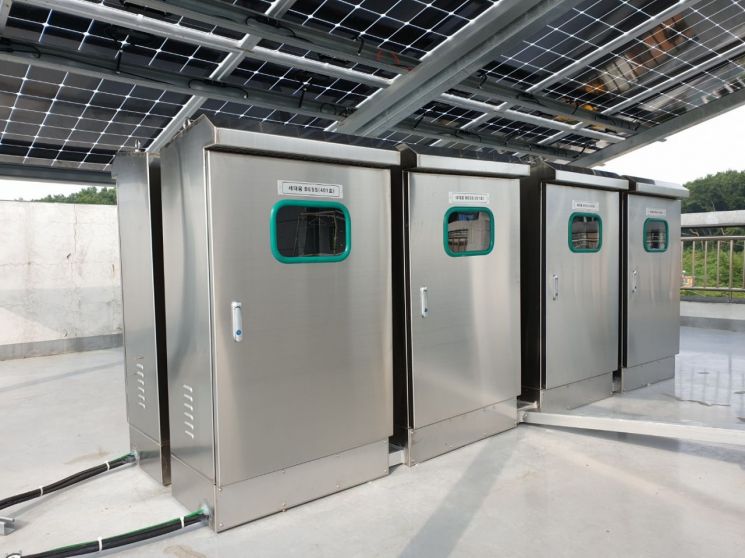
[Asia Economy Reporter Kim Bong-su] A large-scale power storage device that can reduce electricity usage by more than half using solar power installed in apartments has been developed.
On the 11th, the Korea Institute of Civil Engineering and Building Technology announced that it has developed an Energy Storage System (ESS) linked to solar power generation for multi-family housing units.
Recently, local governments such as Seoul City have been promoting the spread of renewable energy for carbon neutrality by installing mini solar power facilities in multi-family housing. The problem is that the solar power equipment installed in each unit has a small generation capacity of around 300W, which does not significantly help reduce electricity bills. Installing large-capacity solar power facilities also poses issues. In apartments, transformers are shared, so surplus electricity is not offset by the Korea Electric Power Corporation (KEPCO). The surplus power is not stored and flows into neighboring units.
The research team led by Research Fellow Kim Yong-gi at the Korea Institute of Civil Engineering and Building Technology has developed the country's first ESS for multi-family housing units that can be installed on balconies and rooftops. This device applies a control algorithm suitable for domestic residential power load patterns. It is equipped with triple safety features including lithium iron phosphate batteries with excellent fire safety performance and an automatic fire extinguishing system. It stores surplus solar power generated during the day and allows usage in the late afternoon and at night. It can reduce electric energy consumption by up to 53% over a month. It also contributes to alleviating power peaks occurring in the afternoon during summer.
In practice, prototypes were installed and tested in three high-rise apartment units in Seoul and Yongin. The balcony-type 4kWh ESS applied to the high-rise apartments was connected to a 1.2kW solar module per unit (four 300W modules), and it was confirmed that the three units reduced electricity consumption by an average of 40%.
Along with this, the institute also developed Building Integrated Photovoltaic (BIPV) systems linked with ESS. Due to the volume and scale of solar power facilities, many households hesitate to install them, but an integrated solar power generation system that can be installed on windows or railings has been developed. BIPV can be installed not only on new buildings but also on existing buildings. In the case of window-integrated BIPV, solar cells are installed on external windows and configured with triple glazing, which also enhances insulation. For railing-type BIPV, colored glass is used, allowing it to function like blinds on balconies.
© The Asia Business Daily(www.asiae.co.kr). All rights reserved.
![Clutching a Stolen Dior Bag, Saying "I Hate Being Poor but Real"... The Grotesque Con of a "Human Knockoff" [Slate]](https://cwcontent.asiae.co.kr/asiaresize/183/2026021902243444107_1771435474.jpg)











