
[Asia Economy Reporter Kim Soyoung] A Supreme Court ruling has sparked controversy by stating that if an adulterous spouse had given permission, an intruder cannot be punished for trespassing even if they secretly entered the home. In response, calls for the reinstatement of the adultery law have been growing. While there is significant moral criticism, it is pointed out that there is no appropriate law to punish such acts even if one wishes to do so.
On the 9th, the Supreme Court's full bench upheld the lower court's acquittal in the appeal trial of Mr. A, who was charged with trespassing. In 2019, Mr. A entered the home of Ms. B, with whom he was having an extramarital affair, and engaged in illicit acts, leading to a trespassing complaint filed by Ms. B's husband.
The prosecution argued that since Mr. A only obtained consent from Ms. B, one of the co-residents, and entered the home against the 'presumed will' of Ms. B's husband, it constituted trespassing. However, the courts showed differing opinions on this matter.
The first trial court stated, "Mr. A's actions led to the breakdown of Ms. B's marital relationship and caused significant mental harm," and found Mr. A guilty of trespassing, sentencing him to six months in prison with a two-year probation.
This followed precedent from similar past cases where it was judged that "even if entry was made with the consent of one resident, if it is presumed to be against the will of another resident, it disturbs the peace of the residence."
On the other hand, the second trial court overturned the first trial's decision, ruling that "since Mr. A had the consent of Ms. B's spouse when entering the home, he did not enter in a manner that disturbed the peace of the residence," and acquitted Mr. A of trespassing.
The Supreme Court ruling that confirmed the second trial's decision also reasoned that since Mr. A did not enter in a way that disturbed the peace of the residence, it did not constitute trespassing. The full bench stated, "Trespassing means entering a home in a manner that objectively and outwardly disturbs the peaceful state enjoyed by the resident," and "If entry is made with the consent of the resident in the home and by ordinary means, it does not constitute trespassing."
The reason this ruling caused a stir is that it overturned the Supreme Court's previous rulings recognizing trespassing in similar cases since 1984, changing the precedent after 37 years.
Previously, the adultery law was abolished in 2015 after the Constitutional Court ruled it unconstitutional, ending 62 years of enforcement. The main reasons were that the adultery law infringed on sexual self-determination rights and privacy freedoms, and that state power should not intervene but leave it to individual free will.
However, civil penalties are still possible through 'alienation damages claims' lawsuits, which seek compensation for mental and physical harm caused by a spouse's infidelity.
Some argue that since the abolition of the adultery law, the trespassing law, which protects the peace enjoyed by residents in their homes, has effectively taken its place. In this case, Mr. B, the husband, filed a trespassing complaint against the man who secretly entered his home for an affair with his wife, and when appropriate punishment was not enforced, strong backlash demanding the reinstatement of the adultery law erupted.
Public opinion is largely incredulous. Netizens expressed anger with comments such as, "Not only was the adultery law abolished, but now they are openly telling people to commit adultery at home," and "They say you can't punish cheating. Why abolish the adultery law and destroy families even more? He must have been desperate to file a trespassing complaint. I think the adultery law should be reinstated."
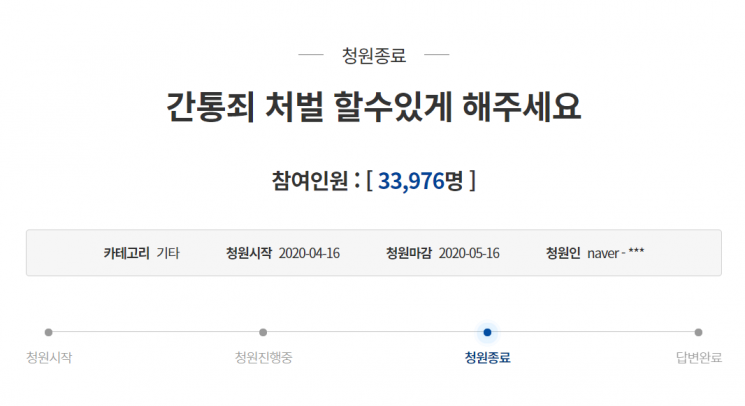 The photo is unrelated to specific expressions in the article. Photo by Cheongwadae National Petition Board
Meanwhile, since the abolition of the adultery law, petitions calling for its reinstatement have continuously appeared on the Blue House's public petition board. Most of these petitions demand strong punishment and report adulterous spouses or intruders who consistently act with impudence.
One petitioner who wrote among many adultery law reinstatement petitions stated, "(The intruder) entering the family home where the spouse and children live is a deceitful act that abandons the last duty as a human being," and expressed frustration, "Those left hurt by adulterous spouses have no place to stand anywhere in this world. I believe that at home, one should be able to live in safety, health, rest, and a healthy life."
© The Asia Business Daily(www.asiae.co.kr). All rights reserved.
![Clutching a Stolen Dior Bag, Saying "I Hate Being Poor but Real"... The Grotesque Con of a "Human Knockoff" [Slate]](https://cwcontent.asiae.co.kr/asiaresize/183/2026021902243444107_1771435474.jpg)

















