Revealed at the 2nd Housing Supply Agencies Meeting on the 9th
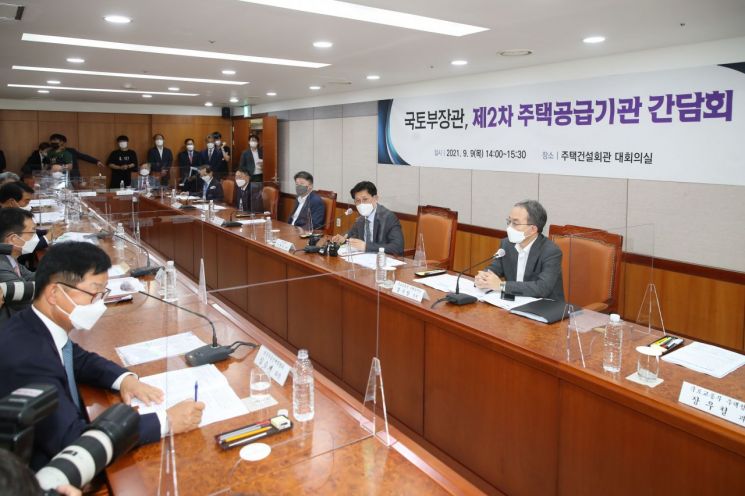 Minister of Land, Infrastructure and Transport Noh Hyung-wook is conducting the 2nd Housing Supply Agencies Meeting held at the Korea Housing Builders Association in Yeongdeungpo-gu, Seoul on the 9th. / Provided by the Ministry of Land, Infrastructure and Transport.
The government has unveiled a plan to ease construction regulations on ‘non-apartment’ housing types such as urban-style residential housing and residential officetels. This appears to be a desperate measure to supplement the stalled large-scale housing supply plans, including the 3rd New Town projects. However, criticism arises that it is a temporary fix since there is still no easing of regulations on reconstruction and redevelopment, which hold the key to urban housing supply.
According to the Ministry of Land, Infrastructure and Transport (MOLIT) and industry sources on the 10th, Minister of Land, Infrastructure and Transport Noh Hyung-wook held a public-private housing supply meeting the day before with housing-related organizations and construction companies, stating, "We plan to continuously explore ways to expand and accelerate the supply of non-apartment housing in urban areas to resolve supply-demand mismatches."
Urban-style residential housing, officetels, and multi-family housing are types of housing that can be constructed in a short period, unlike large-scale apartments. Until now, the government has pursued long-term housing supply plans such as large-scale land development in the metropolitan area and the construction of the 3rd New Town. However, as it takes up to five years from approval to occupancy and housing prices continue to rise despite multiple ‘peak warnings,’ the government is interpreted to be adopting a strategy to quickly supply alternatives to calm purchasing sentiment. Accordingly, measures such as shortening approval periods for officetels and easing parking regulations are expected to follow.
The industry welcomed the government’s progressive attitude, which had previously focused solely on ‘public housing’ and consistently implemented regulation-heavy policies on the private sector. Various regulations, such as limits on room partitions and area, and bans on floor heating installation, still fail to keep up with changes in market demand and residential conditions.
However, concerns have been raised that these products, initially introduced as ‘niche products,’ might turn into another ‘housing boom.’ This is because there was no mention at all of easing regulations related to reconstruction and redevelopment, which are considered the most crucial housing supply measures. Although some participants at the meeting raised the need for this, Minister Noh reportedly did not provide any immediate response.
In fact, recently, the popularity of alternatives with fewer regulations than apartments has been soaring, causing a frenzy of subscription despite controversies over high prices. For example, last month, the Lotte Castle Le West residential lodging facility in the Magok district of Seoul attracted over 570,000 applicants, recording an average competition rate of 657 to 1, even though the sale price for an 84㎡ unit was up to 1.61 billion KRW, more than 20% higher than the average apartment price in Magok-dong. In June, the 84㎡ officetel units at ‘Dongtan Station Dietre Prestige’ were priced at 916.6 million KRW, about twice as high as the apartment prices for the same area and unit size in the same complex (up to 488.67 million KRW).
Another obstacle is that the current administration has less than a year left in office. Since these units are not subject to price regulations and do not require noise prevention facilities or mandatory parking installations, they may harm the surrounding residential environment. Therefore, expanding supply through easing construction regulations could become a source of controversy.
© The Asia Business Daily(www.asiae.co.kr). All rights reserved.

















