According to Bank of Korea Analysis, Apartments and High-Value Homes Show Relatively Greater Interest Rate Sensitivity
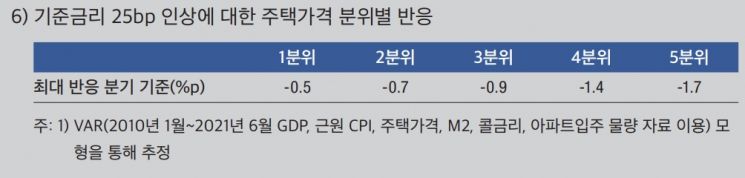
High-priced housing, housing price increase slows by 1.7%P when the base interest rate rises by 25bp
The impact of interest rates is much smaller for the group with an average house price of 120 million KRW (1st quintile)
It is uncertain whether raising interest rates can curb housing price increases and household loans
When purchasing housing in regulated areas such as the metropolitan area, individuals typically take out credit loans of around 100 million KRW
[Asia Economy Reporter Kim Eun-byeol] It has been found that when the Bank of Korea raises the base interest rate, the interest rate sensitivity of high-priced housing with an average price of about 1.1 billion KRW is much greater.
The higher the house price, the greater the suppressive effect on price increases caused by the base interest rate hike. However, even if the base interest rate is raised to reduce the rate of house price increases, the upward trend does not break, suggesting that raising interest rates is not a fundamental solution to controlling housing prices.
According to an analysis by the Bank of Korea on the 10th using data from January 2010 to June this year, when the base interest rate is raised by 25bp (1bp = 0.01 percentage points), the rate of increase in housing prices for the 5th quintile group (average house price 1.1 billion KRW) slows by 1.7 percentage points. The Bank of Korea raised the base interest rate by 0.25 percentage points at the end of last month. This means that if house prices had previously been rising by 10%, raising the base interest rate by 25bp could reduce the increase rate to a maximum of 8.3%.
On the other hand, the impact of the base interest rate on the 1st quintile group (average house price 120 million KRW) was much smaller. Even with the same 25bp increase in the base interest rate, the slowdown in house price growth for the 1st quintile was only about 0.5 percentage points. The 2nd quintile slowed by 0.7 percentage points, and the 3rd and 4th quintiles slowed by 0.9 and 1.4 percentage points respectively.
By housing type, apartment prices were found to be more sensitive than multi-family housing. For multi-family housing, the slowdown in price increase was in the 0.1 percentage point range, but for apartments, it was over 0.3 percentage points. A Bank of Korea official said, "Higher house prices mean greater volatility due to various factors. Especially for apartments, not only is the loan ratio high, but government regulations and housing supply also have a significant impact." The point at which house prices fell the most after an interest rate hike was about one and a half years after the rate increase. Previously, the Bank of Korea also estimated that raising the base interest rate by 0.25 percentage points would slow the overall housing price increase.
The Bank of Korea’s detailed analysis of the extent to which raising interest rates can curb housing price increases is related to ending the ultra-low interest rate era caused by COVID-19. Following last month’s increase of the base interest rate from a historic low of 0.50% to 0.75%, it also signaled that further rate hikes would be made if the economy supports it.
However, it remains uncertain whether raising interest rates will actually curb housing prices.
In June, the apartment sales price index rose 11.9% year-on-year, and the housing price increase rate in July reached 14.3%. Applying the Bank of Korea’s analysis, even if the base interest rate is raised by 25bp, house prices are still estimated to rise by more than 10%. Demand for purchasing homes remains strong, so it remains to be seen whether the increase in household loans can be controlled.
According to Bank of Korea monitoring, when purchasing housing in regulated areas such as the metropolitan area, individuals typically cover necessary funds through credit loans of up to 100 million KRW per person. The Bank of Korea explained, "In situations where house prices are expected to rise further, the dampening effect of interest rate hikes on housing prices may weaken."
Park Jong-seok, Deputy Governor of the Bank of Korea, said at a press briefing yesterday, "Raising the base interest rate alone cannot solve financial imbalance problems," adding, "The government’s macroprudential policies and housing supply policies must also be well implemented for the effects to appear together."
© The Asia Business Daily(www.asiae.co.kr). All rights reserved.
![From Bar Hostess to Organ Seller to High Society... The Grotesque Con of a "Human Counterfeit" [Slate]](https://cwcontent.asiae.co.kr/asiaresize/183/2026021902243444107_1771435474.jpg)

















