42 Billion to 65 Billion in Half a Year: 'Rapid Increase'
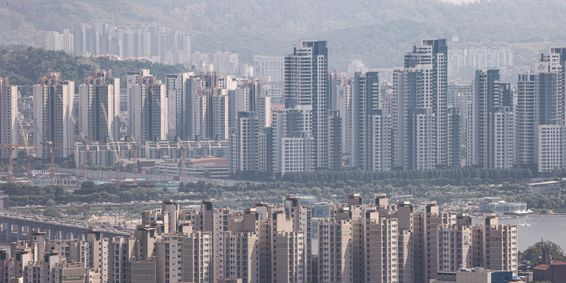
[Asia Economy Reporter Na Ye-eun] After the government’s self-assessed 'supply shock' level announcement of the '2·4 Measures,' Seoul apartment prices, which had briefly stalled, are now rising sharply again.
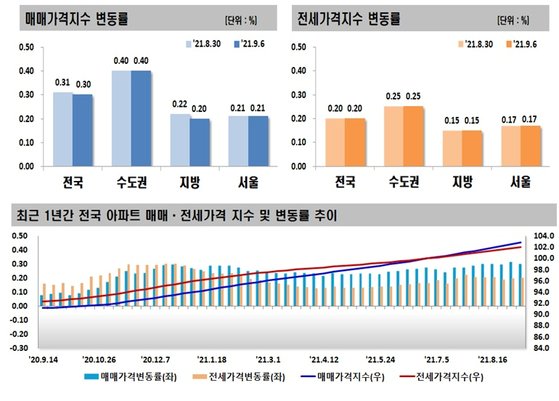
The Korea Real Estate Board announced on the 9th that Seoul apartment prices in the first week of September rose by 0.21%, the same as the previous week, marking a 0.2% range increase for six consecutive weeks.
Seoul apartment prices began to rise from the end of December last year, with weekly increases expanding from 0.06% to 0.10% from the first week of January to the first week of February this year. After the announcement of the 2·4 Measures, the rate of increase began to slow, dropping to 0.05% in the first week of April. However, during the 4·7 by-election period, expectations for the easing of reconstruction regulations grew, causing prices to rebound. Recently, the weekly increase has expanded again, maintaining a rise in the 0.2% range. This is the highest rate of increase in three and a half years since February 2018.
According to the Ministry of Land, Infrastructure and Transport’s real transaction price disclosure system, an apartment in Banpo-dong, Seocho-gu, Banpo Xi with a net area of 244㎡ (91 pyeong) was traded for 6.5 billion KRW on the 11th of last month. This is an increase of 2.253 billion KRW over eight months since it was sold for 4.247 billion KRW on December 17 last year.
Also, an 82.6㎡ unit in Jamsil Jugong Complex 5 was traded at a 'record high' price of 2.978 billion KRW on the 28th of last month, rising by more than 100 million KRW in one month, with 35-pyeong homes approaching the 3 billion KRW mark. Jang Jae-hyun, head of research at Real Today, explained, "In the Gangnam area, there is a strong perception that buying high-priced apartments is an investment that will appreciate. As a result, transactions continue to occur at record high prices."
Meanwhile, the housing price increase trend continues not only in Seoul but also in Gyeonggi Province and Incheon in the metropolitan area.
Apartment prices in Gyeonggi Province rose by 0.51% last week, maintaining the highest increase for five consecutive weeks, while Incheon’s increase expanded from 0.43% to 0.44%. Especially, at the end of last month, the government announced plans to develop new housing sites in the border areas of Uiwang, Gunpo, and Ansan, as well as Jinan and Bongdam in Hwaseong, which has further stirred housing prices due to expectations for transportation and development such as the Great Train Express (GTX).
In Gyeonggi Province, Hwaseong City (0.79%) recorded the highest increase, mainly around Bongdam-eup. Bongdam benefits from the extension of the Shinbundang Line and the government’s announcement last month of a 17,000-house development plan for Hwaseong Bongdam 3 District. In Incheon, areas such as Yeonsu (0.64%), Gyeyang (0.49%), and Bupyeong-gu (0.48%) rose mainly in complexes with transportation and development benefits like GTX.
Ham Young-jin, head of the Zigbang Big Data Lab, said, "In the metropolitan area, price gaps are steadily narrowing or rising in mid-to-low-priced areas of Gyeonggi and Incheon, as well as around GTX and 3rd New Town development zones. This trend is expected to continue until the end of the year."
Kim Hyo-seon, senior real estate advisor at NH Nonghyup Bank WM Division, stated, "Ultra-high-priced apartments such as reconstruction projects in Seoul still face a shortage of listings, causing asking prices to continue rising. It is expected that prices will maintain an upward trend amid a decrease in transactions for the time being."
© The Asia Business Daily(www.asiae.co.kr). All rights reserved.


















