Recruitment for Site No. 2 Until January Following Site No. 1
Integrated Management of Various Water Resources Tailored to Regions Using IT Technology
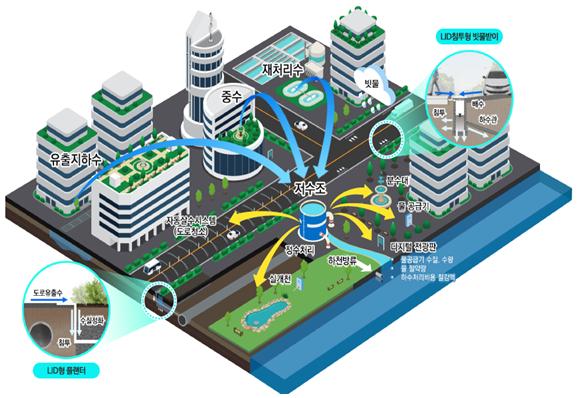
[Asia Economy Reporter Lim Cheol-young] The Seoul Metropolitan Government announced on the 9th that it will establish 10 “Smart Water Circulation Cities” by 2030 to maximize the utilization of discarded water resources through integrated management of water resources using IT technology. This is a region-customized and integrated future-oriented water circulation project.
The “Smart Water Circulation City Creation Project” involves concentrating various water circulation facilities in one place to utilize abundant water resources such as rainwater, discharged groundwater, and reclaimed water according to regional characteristics. At this time, IT technology is applied to monitor and integrate the management of the facilities, and publicity is also conducted so that citizens can experience the effects of water circulation.
The Seoul Metropolitan Government aims to maximize the utilization of water resources to reduce sewage treatment costs, restore water circulation, mitigate the heat island effect, reduce fine dust, and achieve environmental effects such as landscape improvement.
Accordingly, after selecting Sangbong-dong area in Jungnang-gu as the first project site in April, Seoul is calling for applications for the second site until November 30th. The first project site selected, Sangbong-dong area in Jungnang-gu (1 km from Jungnang Station to Sangbong Station), is currently undergoing basic design. Through the Smart Water Circulation City Creation Project, the city expects to achieve an economic saving effect of about 700 million KRW annually, including 200 million KRW in sewage fees and 500 million KRW in treatment costs at the Jungnang Water Reclamation Center.
The Seoul Metropolitan Government plans to select the second project site by the end of this year, proceed with detailed design and construction next year, and integrate water resource management using IT technology starting in 2023. The final site will be selected considering factors such as an impervious rate of over 70%, daily usage of discharged groundwater over 100 tons, intensive installation of rainwater management facilities, and provision of meaningful waterfront spaces for citizens. A project budget of 3 billion KRW will be supported for the selected sites.
The project sites must provide water circulation-related information, such as installing digital billboards so that citizens can easily access water circulation policies. Submitted project proposals will be comprehensively reviewed by a selection committee based on preliminary field survey results, evaluating the appropriateness, public interest, and feasibility of the projects. In particular, additional points will be awarded when reclaimed water and treated sewage water are utilized.
Han Yoo-seok, Director of the Water Circulation Safety Bureau of Seoul, said, “Through the ‘Smart Water Circulation City Creation Project,’ we will open the era of smart water circulation by integrating various water resources with IT technology,” and added, “Since environmental and economic effects will be maximized, we hope many autonomous districts will participate in the contest with innovative ideas.”
© The Asia Business Daily(www.asiae.co.kr). All rights reserved.

















