69.2% Internal Movement in Seoul, 30.4% Seoul-Capital Region Movement
Seoul Analyzes All Internal and External Movements by Integrating Public Big Data and KT Telecom Big Data
Used as Basic Data for Policies like Metropolitan Transportation Network and Youth Housing... Also Opened Online to Businesses and Private Sector
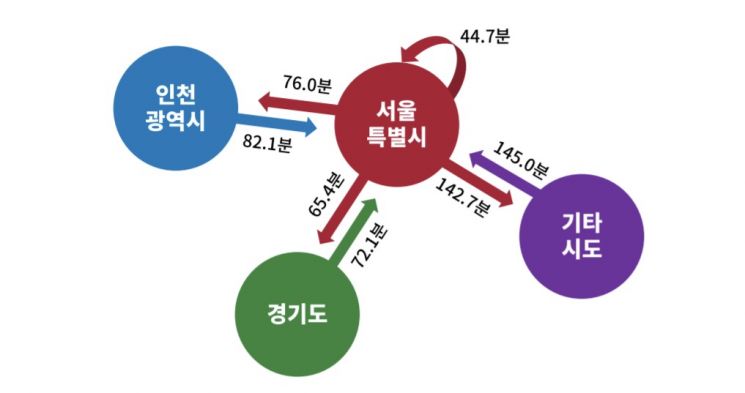
[Asia Economy Reporter Lim Cheol-young] It has been revealed that the average commuting time for those traveling within Seoul and between Seoul and its outskirts reaches 53 minutes. When a person living in Seoul commutes to Seoul, it takes an average of 44.7 minutes, whereas commuting from Gyeonggi Province to Seoul takes an average of 72.1 minutes.
On the 8th, the Seoul Metropolitan Government announced this through an analysis of the ‘Seoul Living Mobility’ data, which integrates vast telecommunications big data collected in one-minute intervals with public big data such as transportation. This data aggregates the ‘movements’ of all people traveling within Seoul, from Seoul to outside Seoul, and from outside Seoul to Seoul.
The ‘Seoul Living Mobility’ data was created by integrating and analyzing Seoul’s public transportation usage data, administrative big data such as population and business censuses, KT’s mobile phone LTE+5G signal data, and Korea Transport Institute’s origin-destination traffic volume data. Based on KT’s mobile phone communication signals, citizens’ movements were aggregated at the base station level, and movements were estimated every 20 minutes across a total of 1,831 zones, which are more detailed than the 426 administrative neighborhoods (haengjeong-dong) throughout Seoul.
Analysis results showed that among commuting and school-going movements to and from Seoul, internal movements within Seoul accounted for 69.2% of the total. Movements between Seoul and the metropolitan area accounted for 30.4%. The average commuting time was 44.7 minutes for those living in Seoul commuting to Seoul, and 72.1 minutes for those commuting from Gyeonggi Province to Seoul.
In particular, commuting from other provinces to Seoul took less time than commuting from Seoul to other provinces. The average time taken to commute from Seoul to Gyeonggi Province was 65.4 minutes, while commuting from Gyeonggi Province to Seoul took an average of 72.1 minutes. Travel between Seoul and Incheon took about 10 minutes longer on average than between Seoul and Gyeonggi.
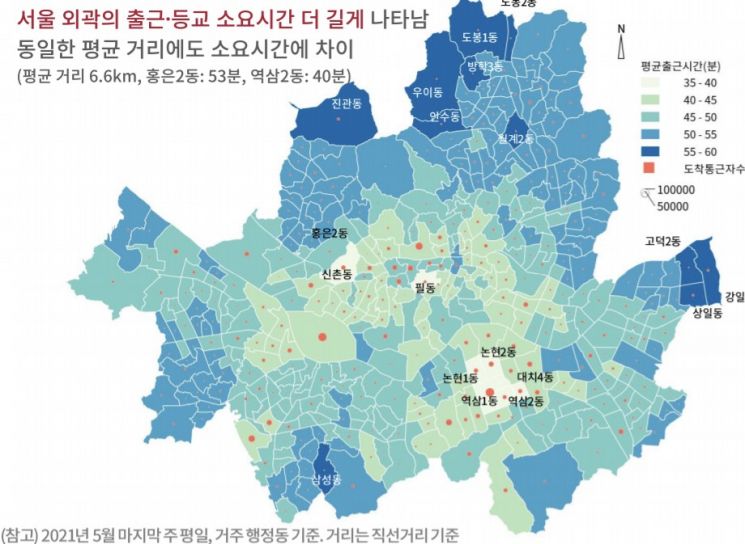
When calculating the average commuting and school-going time by administrative neighborhood, it was found that living on the outskirts of Seoul requires longer commuting times. The neighborhood with the longest average commuting time was Godeok 2-dong in Gangdong-gu (58 minutes), while the shortest was Yeoksam 1-dong in Gangnam-gu (36 minutes).
Furthermore, even if the average commuting distance (straight-line distance) was similar, the time taken varied depending on the residential area. Residents of Yeoksam 2-dong in Gangnam-gu and Hong Eun 2-dong in Seodaemun-gu both had an average commuting distance of 6.6 km, but the commuting times were 40 minutes and 53 minutes, respectively.
Changes in mobility before and after COVID-19 were also analyzed. After COVID-19, the average daily number of movements to and from Seoul was 18.67 million, an 18% decrease compared to just before the outbreak. Examining changes in movement volume during the analysis period showed a tendency for movement volume to sharply decrease during each wave when the number of new COVID-19 cases increased. The largest decrease in movement volume occurred during the third wave, with nearly a 30% reduction compared to before the COVID-19 outbreak.
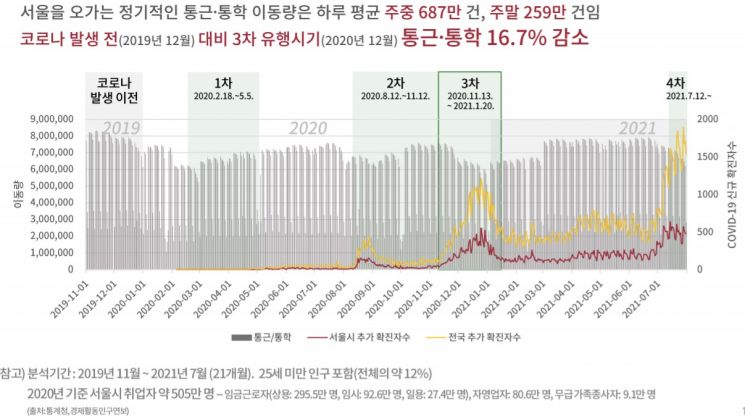
By age group, the movement volume of children, adolescents, and young adults under 25 decreased by 55.8%, showing the largest decline. The population aged 25-64 decreased by 28.1%, and those aged 65 and over decreased by 26.2%, showing differences in movement volume changes by generation. Additionally, late-night commuting decreased, and commuting times changed according to social distancing policies. During the third wave, late-night commuting movement volume decreased by 48.4% compared to before the COVID-19 outbreak, and commuting movement at 10 p.m. in December last year decreased by about 50% compared to the same month the previous year.
The Seoul Metropolitan Government plans to use the newly developed ‘Seoul Living Mobility’ data as basic data for transportation and housing policies, such as metropolitan transportation networks and public transportation policies to improve commuting times directly related to citizens’ quality of life, and for selecting locations for youth housing. In areas where public transportation infrastructure is insufficient and travel times are relatively long compared to distance, bus routes can be newly established or intervals adjusted, and when selecting locations for public housing such as youth housing, areas with many commuters and students in their 20s and 30s can be prioritized to enhance the effect of proximity between residence and workplace.
Additionally, it is expected to be used to analyze and predict infection routes of infectious diseases caused by physical contact during the COVID-19 situation, or to improve safety vulnerability points in areas with many nighttime travelers, thereby strengthening citizen safety.
Choi Jun-gi, Head of KT AI/BIGDATA Business Division, said, “The ‘Seoul Living Mobility Data’ is an example of achieving results through a public-private-academic cooperation model in the era of the 4th Industrial Revolution, and we hope this mobility data will be the cornerstone for realizing a smart city Seoul.” Park Jong-su, Seoul City Smart City Policy Officer, said, “The newly developed living mobility data by Seoul City is essential data for a smart city that will elevate citizens’ lives to the next level. The developed data will be made public to citizens to contribute to the activation of the data economy.”
© The Asia Business Daily(www.asiae.co.kr). All rights reserved.
!["The Woman Who Threw Herself into the Water Clutching a Stolen Dior Bag"...A Grotesque Success Story That Shakes the Korean Psyche [Slate]](https://cwcontent.asiae.co.kr/asiaresize/183/2026021902243444107_1771435474.jpg)


















