Gift and Holding Over Selling
Tax Burden Passed on to Transaction Price
[Asia Economy Reporter Kangwook Cho] "Since the capital gains tax on multi-homeowners was increased, there are no listings at all." (Representative of A Real Estate Agency in Daechi-dong, Gangnam-gu, Seoul)
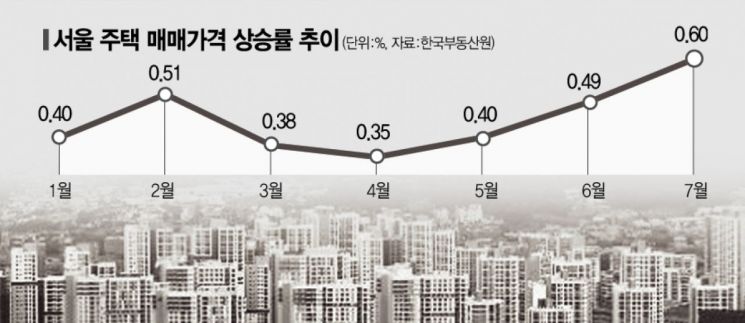
Recently, the 'transaction cliff' in the housing market has been worsening, and housing prices are hardly stabilizing. After the government implemented additional capital gains tax surcharges on multi-homeowners, nationwide housing sales volume sharply declined for two consecutive months, while an unusual phenomenon of record-high prices continues to emerge. This is why there is a diagnosis that the policy aimed at increasing tax burdens on multi-homeowners to encourage them to put their properties on the market has so far ended in failure. The listings on the market are minimal, and it is becoming increasingly clear that owners are opting to hold on through means such as gifting. Cases of passing the tax burden onto the sale price are also on the rise.
According to the Construction Industry Research Institute and others, the Moon Jae-in administration used capital gains tax surcharges as a key economic adjustment tool. This was based on the judgment that multi-homeowners were the main culprits driving up housing prices and disrupting the housing market. However, the government's expectations were off the mark. Instead of selling their properties, multi-homeowners chose gifting or holding on, leading to an increasingly severe shortage of listings in the market, and the transaction cliff phenomenon has yet to be resolved. Contrary to government expectations, listings have not increased, and housing prices continue to rise.
The first capital gains tax rate for multi-homeowners was implemented through the August 2, 2017 measures. At that time, from April 2018, a surcharge of 10-20 percentage points was added to the basic tax rate for designated adjustment areas. From 2012, long-term holding special deductions of up to 80% were available for multi-homeowners, but these were excluded with the announcement of the tax rate increase for multi-homeowners in the August 2, 2017 measures. During the eight months between the announcement and implementation, the average monthly number of registrations for apartment buildings in Seoul increased by 20% compared to the five-year average (January 2017 to July 2021). However, after the deduction ended in April 2018, the number of registrations decreased, and in August and September 2018, housing prices actually surged. Analysts suggest this was due to growing dissatisfaction among multi-homeowners who sold their homes during the first deduction period, trusting the government's commitment to stabilizing housing prices.
Through the December 16, 2019 measures, the government announced a temporary deduction policy for homes held for more than 10 years. Accordingly, from December 17, 2019, to June 30, 2020, capital gains tax surcharges were excluded, and long-term holding special deductions were applied for transfers. However, the number of ownership transfer registrations from December 2019 to June 2020 increased by only 7% compared to the five-year average, and housing prices surged from June to July, near the end of the policy period.
Just over two months after the capital gains tax surcharge on multi-homeowners was implemented in June this year, apartment listings in Seoul sharply declined. According to the real estate big data company Asil, the number of apartment listings in Seoul currently stands at about 39,000, down approximately 14.0% from early June (about 46,000 listings). Despite the transaction cliff, housing prices are on the rise. According to the Korea Real Estate Board, in the fifth week of August (as of the 30th), apartment sale prices in the metropolitan area rose 0.40% compared to the previous week, maintaining the same level for three consecutive weeks. Metropolitan area apartment prices have maintained the highest rate of increase for seven consecutive weeks since mid-last month (0.36%→0.36%→0.37%→0.39%→0.40%→0.40%→0.40%).
Additionally, new supply volume will decrease in the second half of the year. According to Real Estate 114, the number of apartments scheduled for occupancy in Seoul in the second half of this year is 13,023 units. This is a decrease of more than 10,000 units compared to the second half of 2019 (23,989 units) and 2020 (22,786 units).
© The Asia Business Daily(www.asiae.co.kr). All rights reserved.
![Clutching a Stolen Dior Bag, Saying "I Hate Being Poor but Real"... The Grotesque Con of a "Human Knockoff" [Slate]](https://cwcontent.asiae.co.kr/asiaresize/183/2026021902243444107_1771435474.jpg)











