Cooperation for Ultra-Low Latency
Continuous Love Calls to AWS
Initiating Cloud Infrastructure Construction
Faster Transition in Domestic Public Sector
Positive Impact Expected for Telecom Companies
Increased 5G Service Demand Due to Contactless Trends
[Asia Economy Reporter Cha Min-young] To strengthen the ultra-low latency, one of the three key elements of 5G, the three mobile carriers are enhancing their cloud infrastructure cooperation with Amazon in the United States. It is expected that competition among telecom companies will intensify in the era of great transformation, including the expansion of public sector cloud services.
Three Mobile Carriers Send Love Calls to AWS
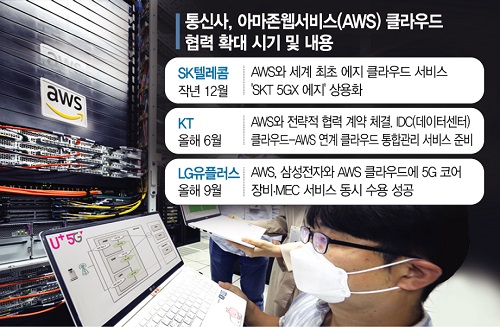
According to the telecommunications industry on the 7th, SK Telecom, KT, and LG Uplus are increasing cooperation with Amazon Web Services (AWS) to build cloud infrastructure. AWS is specialized not only in cloud but also in artificial intelligence (AI) and machine learning, making it a spotlight as a cooperation partner applicable to various industrial fields in the future.
LG Uplus announced on the same day that it simultaneously accommodated 5G core network and MEC (Multi-access Edge Computing) services on AWS cloud together with AWS and Samsung Electronics. It is significant that LG Uplus was selected as a demonstration partner related to the core network of Amazon, the world’s No. 1 cloud company, and achieved results first among the three mobile carriers. The core network is considered the core of the communication network because it stores important customer personal information such as subscriber information. It processes signals sent from individual devices or base stations in real time and is sometimes compared to the brain or heart.
Earlier, SK Telecom introduced the 5G edge cloud service for the first time in Korea in December last year. To implement the ‘SKT 5GX Edge’ service, SK Telecom applied AWS Wavelength to the 5G mobile edge computing (MEC) infrastructure. Using this, client companies can build ultra-low latency mobile applications (apps).
In June, KT signed a strategic cooperation agreement (SCA) with Amazon in the fields of cloud, artificial intelligence (AI), and media. KT plans to launch a cloud integrated management service linking its own IDC (data center) and cloud with AWS.
Great Transformation in Domestic Cloud Adoption
The increase in cloud adoption in the domestic public sector is also positive for mobile carriers. The government announced the 3rd Basic Plan for Cloud Computing (2022?2024) yesterday, which includes three major strategies: prioritizing the use of private cloud in the public sector, strengthening cloud industry competitiveness, and creating an ecosystem for sustainable growth of the cloud industry. In particular, KT is expected to benefit as it holds a 70% market share in the domestic public and financial cloud sectors.
As online transactions increase due to non-face-to-face trends, demand for 5G services is also rising. Professor Son Seung-woo of the Department of Industrial Security at Chung-Ang University diagnosed, "A business model (BM) transformation that requires active use of cloud services is taking place, so telecom companies have no choice but to expand cooperation with cloud providers."
Regarding concerns about personal information leakage raised by some, Professor Son drew a clear line. He added, "Although there have been cases of leakage, personal information is the most critical security issue in cloud services, so while there are concerns, there is no need to be overly worried."
© The Asia Business Daily(www.asiae.co.kr). All rights reserved.

















