Hong Jun-pyo, Popular from 'Muya Hong', Tops Support Among 2030 Generation
Advanced Democracies US and UK Already Engage in Intense 'Meme Election Campaigns'
Experts: "Influence Grows with Internet Spread"
"Sincerity and Interactive Communication Are Key"
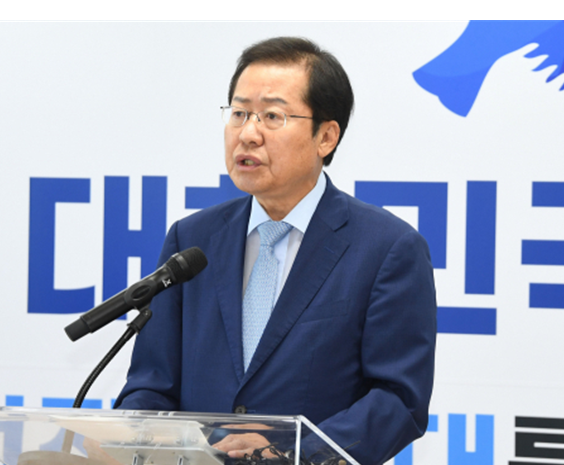
[Asia Economy Reporter Lim Juhyung] From 'Muyahong' to 'Mint Choco Mukbang,' the political sphere is pouring efforts into seizing the so-called 'meme' dominance. Memes are a type of trend popular on online communities and social networking services (SNS), especially among the 20s and 30s age group. A few years ago, memes were merely an internet cultural phenomenon, but recently, they have exerted significant influence, being widely used in election campaigns in advanced countries like the United States and the United Kingdom.
In South Korea, presidential candidates appear on broadcasts mentioning internet buzzwords and attempt memes through SNS by trying 'mukbang' (eating broadcasts). Some predict that the next Korean presidential election might also feature a campaign centered around memes.
◆Muyahong, Mint Choco Mukbang... Presidential Candidates Enter Meme Competition
Hong Joon-pyo, a presidential candidate from the People Power Party, appeared on CBS Radio's 'Kim Hyun-jung's News Show' on the 25th of last month and explained, "The younger generation created the term 'Muyahong,' which means that the opposition candidate is definitely Hong Joon-pyo."
He added, "'Mudaehong,' meaning the president is definitely Hong Joon-pyo, is also possible," and claimed, "Recently, not only the 20s and 30s but also the 40s age group shows decent support."
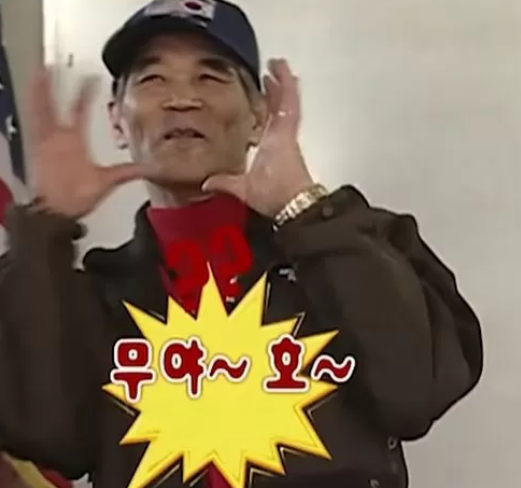 The so-called 'Muyaho meme' became famous through Kim Sang-deok's "Muyaho" remark on the MBC entertainment program 'Infinite Challenge'. / Photo by MBC Broadcast Capture
Muyahong originated from the meme 'Muyaho,' which started on the video platform YouTube. The video features a Korean-American elderly man shouting "Muyaho," and it gained cult popularity mainly among the 20s and 30s, becoming a recent buzzword. Some conservative-leaning online communities began calling this meme 'Muyahong.'
As the Muyahong meme gained popularity, Hong recorded the highest support rate among the 20s and 30s age group among presidential candidates from both ruling and opposition parties.
According to a survey conducted by polling firms Embrain Public, K-Stat Research, Korea Research, and Hankook Research from the 30th of last month to the 1st of this month, targeting 1,012 adults nationwide, Hong secured 15% support in the 18-29 age group, ranking first, ahead of Gyeonggi Province Governor Lee Jae-myung (11%) and former Prosecutor General Yoon Seok-youl (8%).
Hong is not the only presidential candidate trying to secure support from the 20s and 30s through memes. Earlier, former Prosecutor General Yoon also tried to create a friendly image through the so-called 'Mint Choco (Mint Chocolate) Mukbang.'
Last month, Yoon posted a video on his Instagram account eating mint chocolate ice cream, leaving a caption, "Guys, actually, I like mint choco." Mint chocolate ice cream is known for its distinctive flavor and scent, which divides opinions sharply, and the debate over it has become a famous meme among young people.
◆Intense 'Meme Election' in Political Advanced Countries like the US and UK
The meme phenomenon in politics is not limited to South Korea. In advanced political countries like the United States and the United Kingdom, memes have already started to be used extensively in major election campaigns.
The first to introduce a 'meme campaign' was former US President Donald Trump. In the 2016 US presidential election, Trump's campaign actively used memes popular in conservative communities to gain popularity.
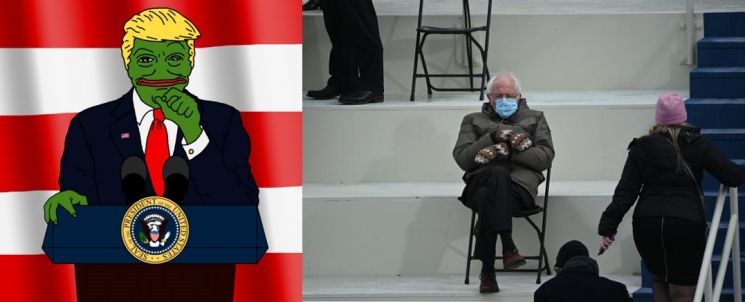 An image comparing former U.S. President Donald Trump to the popular overseas character 'Pepe' (left) and Senator Bernie Sanders at the presidential inauguration last January / Photo by Twitter
It was not only the right-wing that conducted meme campaigns. Senator Bernie Sanders, known as a 'socialist politician' in the US, also gained fame through memes.
At President Joe Biden's inauguration ceremony last January, Sanders appeared wearing casual outdoor clothes and handmade mittens, unlike others dressed in formal suits, which excited voters in their 20s and 30s. At that time, the US media 'The Washington Post' evaluated the so-called 'Sanders meme' phenomenon, stating, "His attire, in stark contrast to other politicians and celebrities, reaffirmed the virtues of American democracy regained after four years."
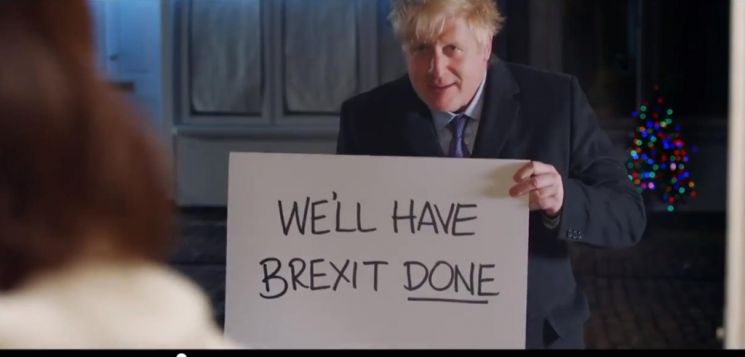 A scene from Prime Minister Boris Johnson's election campaign during the 2019 UK general election. It became a hot topic for parodying the British film "Love Actually." / Photo by YouTube Capture
The 2019 UK general election also showed a pattern close to a 'meme war.' The Conservative Party led by Prime Minister Boris Johnson focused on 'memefication' by promoting Johnson's comical and humorous image instead of conducting typical election campaigns like TV debates, which drew great responses.
Political science expert Dr. Chris Tenove wrote in an article for the research and analysis online media 'The Conversation' that memes have "the ability to determine the tone and direction of political agendas or campaigns," describing them as "a new genre of political communication."
He added, "The characteristic of memes is that they spread very quickly through online and popular culture and can be easily created and consumed. Those who want to recreate and use memes for their purposes must first have a thorough understanding of the meme and the digital space."
The expert analyzed that as the base of internet culture expands, meme culture is also influencing the political sphere.
Political commentator Lee Jong-hoon said, "Election campaigns using SNS or the internet have been continuously attempted before. In the US, progressive politicians like former President Barack Obama mainly utilized them, and in Korea, it was mostly through article comments," explaining, "Now that the internet is widespread across all generations, the areas where election campaigns take place have greatly expanded."
He continued, "Election campaigns through memes or SNS can be a great advantage for presidential candidates in the digital age," but pointed out, "The internet is a medium where sincerity and two-way communication are important, so if the candidate does not have a deep understanding of internet culture, it could backfire."
© The Asia Business Daily(www.asiae.co.kr). All rights reserved.