Ministry of Gender Equality and Family Releases 2021 Statistics on Women's Lives
Female Household Heads and Single Women Households Increased 2.5 Times Compared to 20 Years Ago
Reported Cases of Domestic Violence Increased 7.3 Times Compared to 10 Years Ago
Sexual Violence Reports 1.7 Times Higher Than 14 Years Ago, Dating Violence and Stalking Also Increased
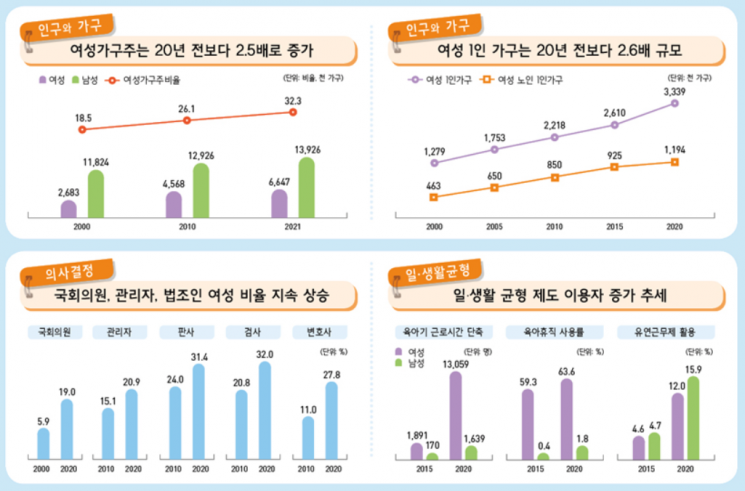 Infographic on Women's Lives Based on 2021 Statistics, Including the Proportion of Female Household Heads and Single Female Households
[Asia Economy Reporter Han Jinju] The number of female household heads and single-person female households has increased more than 2.5 times compared to 20 years ago. Although the gender gap in employment has narrowed due to higher female employment rates, women's safety is still under threat. The number of reported cases of violence against women, including domestic violence, sexual violence, and dating violence, has significantly increased over the past decade.
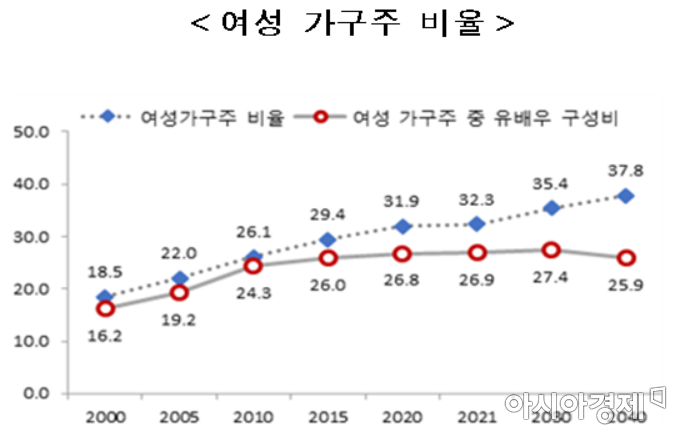
According to the status revealed in the "2021 Statistics on Women's Lives" released by the Ministry of Gender Equality and Family on the 5th, the proportion of female household heads rose to 32.3%, a 2.5-fold increase from 2000. The number of single-person female households (3,339,000 households) increased 2.6 times during the same period. As of 2021, the female population was 25.86 million, accounting for 49.9% of the total population (51.82 million).
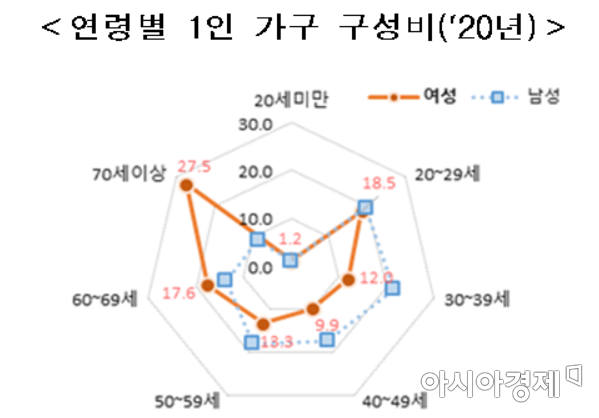
The number of single-person female households exceeded 3 million in 2020. About one-third of these are elderly single-person female households (1,194,000). By age group, the largest proportions are those aged 70 and over (27.5%), followed by those in their 20s (18.5%) and 60s (17.6%).
The proportion of single-person female households with spouses increased from 16.2% twenty years ago to 26.9% this year. As of 2020, single-parent female households numbered 1,152,000, accounting for 75.2% of the total.
With the delay in marriage age, the number of first marriages decreased by 38.6% compared to 20 years ago as of 2020. The average age at first marriage was 30.8 years for women and 33.2 years for men, rising by 4.3 and 3.2 years respectively compared to 20 years ago. The number of divorces was 107,000, a 10.8% decrease. The proportion of divorces among couples who lived together for more than 20 years rose significantly to 37.2%.
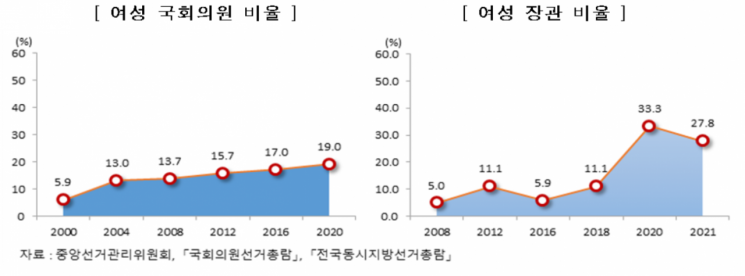 The proportion of female members of the National Assembly over the past 20 years, and the proportion of female ministers from 2008 to 2021
The proportion of women in positions such as members of the National Assembly, managers, and legal professionals has also increased compared to 20 years ago. The share of female members of the National Assembly rose from 5.9% to 19.0%, and female ministers currently account for 27.8%, up 22.8% from 2008.
The proportion of female managers in public institutions subject to proactive employment improvement measures and private enterprises with 500 or more employees was 20.9%, an increase of 5.8 percentage points compared to 10 years ago. Among general civil servants at grade 4 or higher, the proportion of women was 17.8%, and the proportion of female lawyers increased from 11.0% to 27.8%.
The female employment rate was 50.7% last year, up 3.7 percentage points from 2000 but down 0.9 percentage points from the previous year. Meanwhile, the male employment rate (69.8%) fell by 1.0 percentage point over the same period and decreased by 0.9 percentage points from the previous year. As female employment rates increased, the gender employment gap narrowed from 23.8 percentage points to 19.1 percentage points. Among non-regular workers, the proportion of women was 45.0%, higher than men at 29.4%.
The number of women with career interruptions was 1,506,000 last year, a decrease of 567,000 (27.4%) compared to 2015. The rate of career interruption among married women was 17.6%, down 4.4 percentage points during the same period.
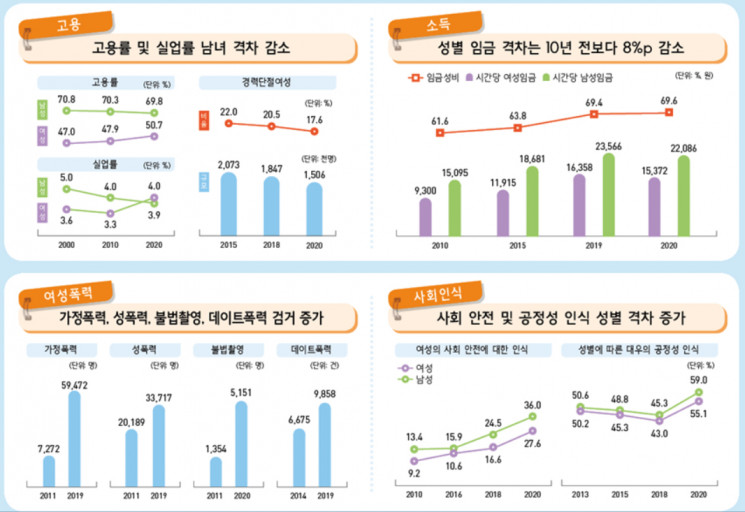
Although the gender wage gap has improved over the long term, there is still a difference of over 30% between men and women. As of last year, the hourly wage for men was 22,086 won, and for women, it was 15,372 won, representing a wage gap of 69.6%. Compared to 10 years ago as of 2020, this decreased by 8 percentage points and by 0.2 percentage points from last year.
While indicators such as female employment and representation have improved, violence targeting women has increased significantly. In 2019, the number of reported domestic violence cases was 50,277, 7.3 times higher than in 2011 and 20 percentage points higher than the previous year.
The number of reported sexual violence cases in 2019 was 33,717, 1.7 times higher than in 2010. Last year, the number of arrests for illegal filming was 5,151, a 3.8-fold increase compared to 2011. The number of reported cases of dating violence and stalking (2019) were 9,858 and 581 respectively, increasing 1.4 times and 1.9 times compared to 2013. The proportion of women who perceive themselves as safe from crime is 21.6%, 10.5 percentage points lower than men (32.1%).
Satisfaction with women's lives increased by 2.1 percentage points from 60.0% in 2017 to 62.1% in 2020. Although women generally had a higher perception of social fairness than men, 59.0% of men and 55.1% of women responded that treatment according to gender was fair.
© The Asia Business Daily(www.asiae.co.kr). All rights reserved.
![Clutching a Stolen Dior Bag, Saying "I Hate Being Poor but Real"... The Grotesque Con of a "Human Knockoff" [Slate]](https://cwcontent.asiae.co.kr/asiaresize/183/2026021902243444107_1771435474.jpg)


















