Finance Management Strategy Committee's 'Core Project Evaluation' 8 Tasks Reflected in Next Year's Budget
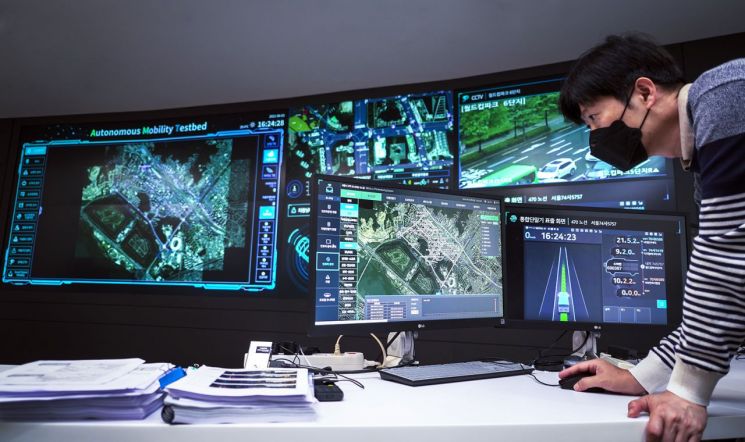
[Sejong=Asia Economy Reporter Moon Chaeseok] The government, together with private-public experts and research institutes, has selected eight recently expanded policies and established a system to allocate support budgets for next year. Among the achievements is the allocation of a budget of 12.6 billion KRW next year to build the next-generation intelligent transportation system (C-ITS) for the world's first full autonomous driving commercialization by 2027. Conversely, budget adjustments were made by streamlining projects such as the job package project of the employment crisis local government consortium and the capital contribution system of COVID-19 policy financial institutions.
The government announced on the 5th that it reflected the results of the eight core project evaluations announced at the '5th Fiscal Operation Strategy Committee' chaired by Ando Geol, Vice Minister of Strategy and Finance, on June 23.
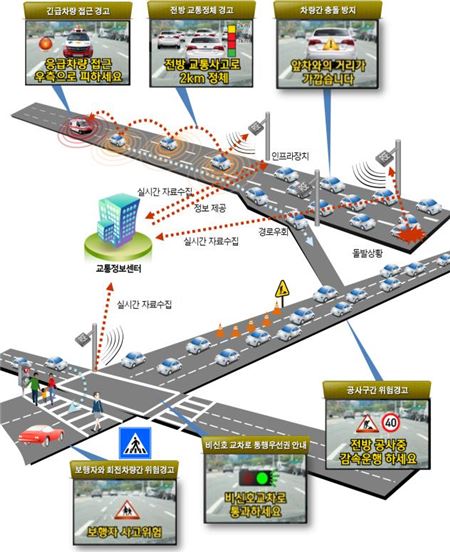 C-ITS Basic Concept Diagram. (Source=Asia Economy DB)
The eight projects are ▲government-wide cloud transition ▲advanced road traffic system construction ▲preemptive employment stability response package ▲promotion of high school graduate employment ▲industrial complex environmental improvement ▲smart factory dissemination and expansion ▲regulatory free zone support ▲crisis overcoming policy financial support. These eight projects were selected in April by an evaluation team composed of the Ministry of Strategy and Finance, private experts, and the Korea Institute of Public Finance. They were chosen as strategic fiscal investment tasks among newly introduced policies in each field.
First, the incentive of 5 million KRW, which was given as a lump sum when a high school graduate worker was employed, will be changed to installment payments starting in 2023. For example, 2 million KRW (40%) will be paid upfront at hiring, followed by 1.5 million KRW (30%) six months after hiring, and another 1.5 million KRW (30%) after one year, applying a method where the balance is paid as the employment period extends. This aims to encourage long-term employment of high school graduate workers.
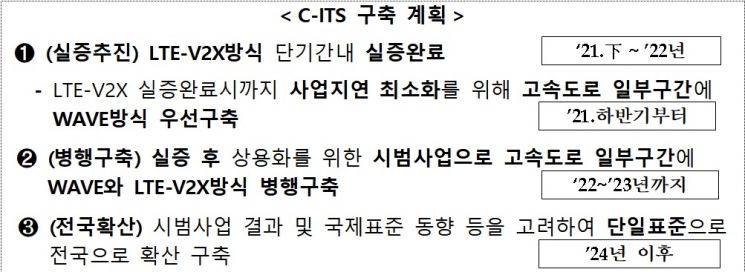
To commercialize full autonomous driving, a budget of 12.6 billion KRW will be invested next year for the communication demonstration project necessary for building C-ITS. C-ITS refers to the communication system between vehicles or between vehicles and traffic infrastructure. There has been disagreement between the Ministry of Science and ICT (LTE-V2X) and the Ministry of Land, Infrastructure and Transport (WAVE) on which system to build, as LTE-V2X, a technology with higher technical level but less verification, is less costly than the existing short-range wireless communication technologies (DSRC·WAVE). For now, LTE-V2X will be demonstrated next year and then compared to decide. Subsequently, in 2024, one of the two will be selected as the single standard and the system will be expanded nationwide.
Among the 14 regulatory free zones whose two-year fiscal support ends this year, only seven with excellent performance will be selected to receive 3.2 billion KRW in new technology and new service commercialization funds. In the second half of the year, the Ministry of SMEs and Startups will prepare 'Guidelines for Fiscal Support for High-Performing Free Zones' and select high-performing zones for support in March next year. To additionally disseminate 5,000 IoT-based infrastructure and equipment pilot models for smart factory construction by next year, 354.3 billion KRW will be invested. This is to achieve the target of 30,000 by next year. Subsequently, the main investment demand of SMEs for smart factory construction will be supported through low-interest policy financing, with 600 billion KRW invested next year.
Additionally, ▲support for transitioning 2,194 public sector information systems to the cloud (240.2 billion KRW) ▲support for developing software as a service available for public sector use by the private sector (8 billion KRW) ▲inducing the employment crisis local government consortium job package project to convert into direct employment projects ▲simplification of industrial complex environmental improvement projects (from 18 to 13 projects) ▲stopping new capital contributions related to COVID-19 policy financial institutions and utilizing unexecuted capital contributions will be carried out.
Jicheol Bae, Director of Fiscal Performance Review at the Ministry of Strategy and Finance, said, "Through this year's core project evaluation, we checked the execution performance and results of major fiscal projects expanded during the COVID-19 crisis response process and achieved results by appropriately reducing and adjusting next year's budget." He added, "We will continue to strive to link the results of core project evaluations to budget formulation in the future."
© The Asia Business Daily(www.asiae.co.kr). All rights reserved.
![Clutching a Stolen Dior Bag, Saying "I Hate Being Poor but Real"... The Grotesque Con of a "Human Knockoff" [Slate]](https://cwcontent.asiae.co.kr/asiaresize/183/2026021902243444107_1771435474.jpg)












