Possessing Secondary Battery Activation Technology... First Domestic Mass Production of High-Temperature High-Pressure Charge-Discharge Equipment
Long-Term Supply to LG Energy Solution... Approximately 95% Sales Share
Used Battery Market to Reach '20 Trillion' by 2030... Development of Capacity and Lifespan Measurement Equipment
[Asia Economy Reporter Junhyung Lee] As the adoption of electric vehicles expands, spent batteries are gaining attention as a new energy source. Lithium-ion batteries used in electric vehicles typically undergo about 3,500 charge-discharge cycles, and when their capacity drops to around 70-80%, they are considered to have reached the end of their life as vehicle batteries. Used batteries can be reused as energy storage systems (ESS) or recycled by extracting raw materials. Battery Material Recycling (BMR) is especially suitable for ESG (Environmental, Social, and Governance) management. It also reduces waste disposal costs. Accordingly, major domestic companies such as SK and POSCO have announced plans to develop BMR as a core business.
20 Years of Expertise in Secondary Battery Charge-Discharge Equipment
Apro has also identified secondary battery recycling as a future growth engine. Apro is a company that manufactures activation equipment, which is part of the secondary battery post-processing stage. The secondary battery production process is broadly divided into 'electrode-assembly-activation.' In the final activation stage, electrical characteristics are imparted to the secondary battery through charge-discharge cycles. Since 2000, Apro has developed and mass-produced charge-discharge equipment supplied to LG Energy Solution. They were the first in Korea to mass-produce a high-temperature pressurized charge-discharge device that maximizes charge-discharge efficiency, boosting battery performance by up to 20%.
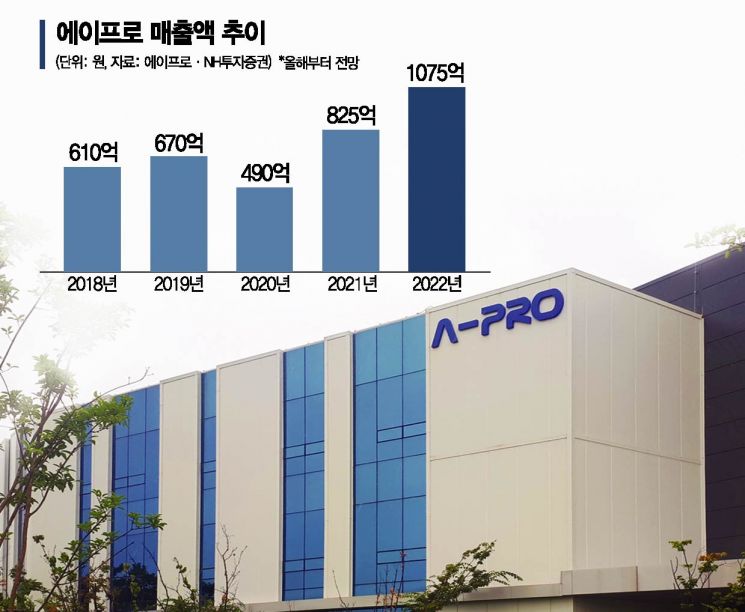
The outlook for their flagship charge-discharge equipment is promising. The secondary battery market is rapidly expanding every year, and activation equipment such as charge-discharge devices is considered essential in battery manufacturing processes. Considering that LG Energy Solution is significantly increasing its battery production capacity annually, industry experts view the expansion of Apro’s charge-discharge equipment supply as a natural progression. LG Energy Solution plans to increase its battery production capacity to 155 GWh this year and aims to secure 260 GWh by 2023 through joint ventures such as the one with General Motors (GM) in the United States. NH Investment & Securities forecasts Apro’s sales to reach 82.5 billion KRW this year, a 68.4% increase from 49 billion KRW last year.
The challenge lies in dependency. According to the industry, secondary battery activation equipment accounted for about 98% of Apro’s sales last year. The supply contract with LG Energy Solution represents approximately 95% of sales revenue. This high dependency on specific equipment and customers means performance volatility is inevitable. This is why Apro has set 'securing new businesses' as a new vision for this year.
 LG Energy Solution and GM Joint Venture Begin Recycling Used Batteries
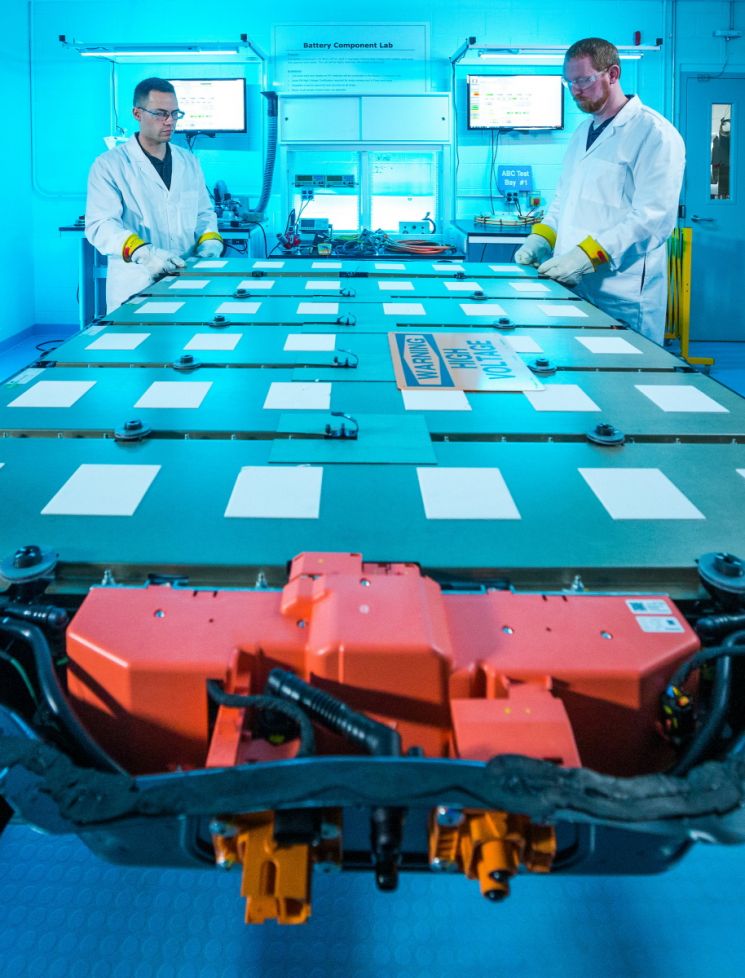
(Seoul=Yonhap News) LG Energy Solution announced on the 12th that Ultium Cells, its joint venture with General Motors (GM), has signed a contract with Li-Cycle, the largest battery recycling company in North America, to recycle used batteries. The photo shows an electric vehicle battery pack from Ultium Cells, the LG Energy Solution and GM joint venture. 2021.5.12
[Provided by LG Energy Solution. Redistribution and DB prohibited]
photo@yna.co.kr
(End)
<Copyright(c) Yonhap News Agency, Unauthorized reproduction and redistribution prohibited>
Development of Used Battery Inspection Equipment
The company sees potential in the rapidly growing BMR market. According to the Korea Energy Economics Institute and others, the number of used batteries generated domestically will increase more than 500 times from 159 units last year to 78,981 units by 2029. The global BMR market is expected to grow from 20 trillion KRW in 2030 to 600 trillion KRW by 2050.
The area of focus for the company is equipment that measures the remaining capacity and lifespan of used batteries. Even spent batteries require quality verification processes for recycling, so demand for used battery inspection equipment is expected to steadily increase. Choo Yeon-woong, head of Apro’s Technology Research Center, explained, "Currently, equipment that measures the remaining life of batteries is neither highly accurate nor standardized. Since specifications vary by manufacturer, it is necessary to determine which cells separated from battery packs can be recycled."
Choo expressed confidence, stating, "Our related technology is already at the top domestic level." The company already supplies ‘cyclers,’ inspection equipment that tests battery performance and lifespan at the final stage of secondary battery production, to LG Energy Solution and others. Choo added, "We are developing used battery measurement equipment by advancing existing inspection devices. Our goal is to provide diagnostic solutions for battery recycling businesses."
The company is also considering entering the electric vehicle charger market. They believe that the technology accumulated over the past 20 years can significantly improve charging stability. According to the company, the next-generation power semiconductor devices developed recently by its subsidiary Apro Semiconductor can also be utilized to enhance charging efficiency.
© The Asia Business Daily(www.asiae.co.kr). All rights reserved.
![Clutching a Stolen Dior Bag, Saying "I Hate Being Poor but Real"... The Grotesque Con of a "Human Knockoff" [Slate]](https://cwcontent.asiae.co.kr/asiaresize/183/2026021902243444107_1771435474.jpg)

















