UNIST Professor Son Jaesung's Team Fabricates High-Power Micro Thermoelectric Modules via 3D Direct Ink Writing
Self-Powering Ultra-Small Electronic Devices with Waste Heat and Utilizing Thermoelectric Cooling
Published as Cover Paper in International Journal 'Nature Electronics'
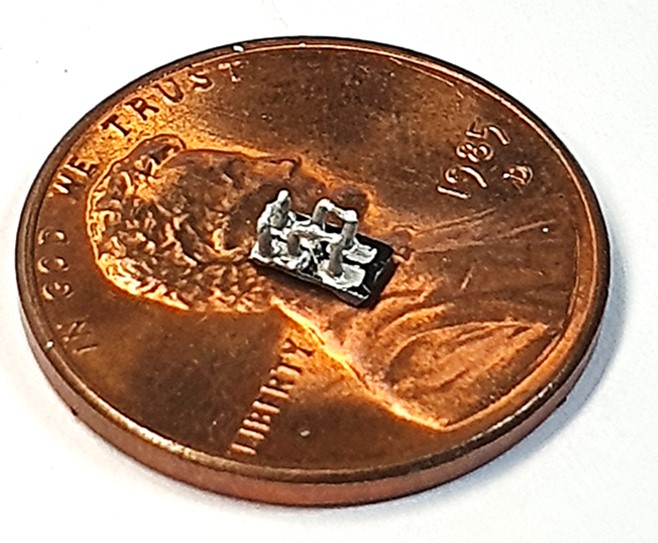
[Asia Economy Reporter Kim Bong-su] A power generator smaller than a fingernail that converts heat generated by electronic devices back into electricity has been developed. It can operate independently without a separate power supply, making it highly applicable for the Internet of Things, wireless sensors, and wearable ICT devices.
The Ulsan National Institute of Science and Technology (UNIST) announced on the 1st that a research team led by Professors Son Jae-sung and Chae Han-gi from the Department of Materials Science and Engineering succeeded in miniaturizing the thermoelectric module inside the thermoelectric generator to a size of several hundred micrometers (10-6 m, μm). This was made possible by developing thermoelectric material ink suitable for 3D direct ink writing. By simply extruding the developed ink through a tube (nozzle), an ultra-small filament-shaped thermoelectric module is completed.
Compared to flat film-type thermoelectric modules, filament-shaped modules that are narrow in width and long in length are better. This is because the maximum output of the generator is proportional to the temperature difference inside the module. However, until now, there was no technology to fabricate filament-shaped 3D structures at the micrometer scale.
The research team focused on 3D direct ink writing technology. This technology allows for precise and fine three-dimensional structures to be created as if writing by hand. The key was developing thermoelectric material ink suitable for 3D direct ink writing. By controlling the particle size and distribution of the thermoelectric material, they were able to produce high-viscosity ink. Additionally, by adjusting the surface charge of the particles, there was no viscosity reduction even after adding binders. Binders, which are added to enhance strength, typically reduce viscosity. High viscosity is necessary to maintain shape during printing.
The power density of the generator made with the developed micro thermoelectric module reaches 479 μW (microwatts) per unit volume (1㎤), and it can maintain a temperature difference of up to 82.9 °C. This is the largest temperature difference reported so far among micro thermoelectric modules.
This thermoelectric module can also be used to solve heat generation problems in sealed ultra-small electronic devices. Thermoelectric materials not only generate electricity from heat but also have thermoelectric cooling functions that absorb heat using electricity. Moreover, existing ultra-fine film-type thermoelectric modules can only be manufactured through microelectromechanical systems (MEMS) processes, which are costly, but the 3D direct ink writing technology enables cost reduction.
The developed thermoelectric ink can create complex shapes such as arch forms and 3D lattice structures, in addition to filament shapes. The size of the thermoelectric filaments can be adjusted from 180 micrometers to 810 micrometers depending on the 3D printer nozzle size and application pressure, and can be produced with an aspect ratio (width-to-height ratio) of up to 9.4.
Professor Son said, “Using the developed technology, it is possible to cheaply produce 3D-shaped ultra-small thermoelectric modules, breaking away from the existing 2D-type ultra-small thermoelectric modules. Effective heat energy harvesting and cooling will enable applications in various fields including electronic devices.” Professor Chae explained, “It is impossible to manufacture thermoelectric modules with such a large aspect ratio using existing fabrication processes. The uniqueness of the developed 3D printing technology lies in its ability to create advanced materials into desired ultra-fine structures without degrading material properties.”
The research results were published as the cover paper in the August issue of the international journal Nature Electronics.
© The Asia Business Daily(www.asiae.co.kr). All rights reserved.
![Clutching a Stolen Dior Bag, Saying "I Hate Being Poor but Real"... The Grotesque Con of a "Human Knockoff" [Slate]](https://cwcontent.asiae.co.kr/asiaresize/183/2026021902243444107_1771435474.jpg)
















