Solar Power Plant Complex Replaces
Shinan Salt Fields: 14 Sites in One Year
Sea Salt Production Drops by 67%
[Asia Economy Reporter Lim Hye-seon] The price of solar salt is becoming unusual. Although the prolonged rainy season last year and the hoarding effect following the discharge of contaminated water from the Fukushima nuclear power plant in Japan this year have had a significant impact, the fundamental cause lies elsewhere. Since the government's expansion of solar power plants, the pace of abandoning salt fields and converting them into solar power plants has accelerated. If this situation continues, there are concerns that domestically produced solar salt will eventually disappear.
Solar Salt Production Down 67% Due to Solar Power
According to Statistics Korea on the 3rd, the area of salt fields decreased from 3,772 hectares in 2016 to 3,055 hectares last year. The reduced salt fields have been converted into solar power plants. As solar salt producers age, the trend of converting salt fields into more profitable solar power plants is accelerating. In Sinan, 14 salt fields have been converted into solar power plants in the past year. According to Statistics Korea, solar salt production last year was 176,247 tons, down 67.2% from the previous year (261,970 tons).
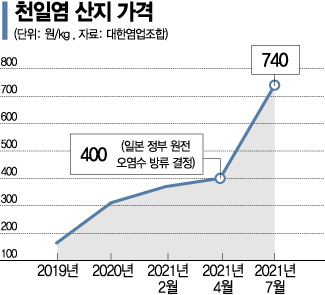
According to the Korea Salt Industry Cooperative, the producer price index for solar salt in July (2015 base 100) was 250.74, more than three times higher than the same period last year (74.23). The actual price of solar salt also surged from maintaining 160-180 KRW per kilogram until 2019 to 740 KRW per kilogram (14,800 KRW for 20 kg) currently. This is nearly a fivefold increase compared to 2019.
Price Surge Since 2020
The abnormal rise in solar salt prices began last year. Continuous rainy seasons and typhoons significantly reduced production, and the expansion of solar power projects further decreased the area of salt fields. In just the past year, the average annual price of solar salt doubled to 311 KRW (6,218 KRW). Although production slightly increased this year compared to last year, the prospect that salt fields will be contaminated 4-5 years later due to the discharge from the Japanese nuclear power plant has increased 'hoarding demand.' Domestic consumption until June this year was 107,553 tons, a 30.2% increase from the same period last year (82,555 tons), but prices continue to rise.
Salt prices are expected to rise further. Although the government released 4,763 tons of reserved solar salt, the scale is insufficient to stabilize prices. Solar salt prices are highest during the kimchi-making season from October to December. A Sinan County official analyzed, "Although the price increase has slowed due to increased production from the heatwave, the late rainy season continues, and with the kimchi-making season approaching, prices are likely to rise again."
Fortunately, the cost of kimchi ingredients is expected to remain similar to previous years. The price of napa cabbage is lower than last year, which is expected to offset the high salt prices. According to the Korea Agro-Fisheries & Food Trade Corporation (aT), as of the 27th of last month, the wholesale price of napa cabbage (10 kg) was 9,404 KRW, 63% lower than last year (25,396 KRW).
Signs of Retail Price Increase for the First Time in 10 Years
Kimchi manufacturers, who use large amounts of salt, are also closely monitoring the situation. Companies such as Daesang and CJ CheilJedang, which produce kimchi using domestic ingredients, operate subsidiaries related to solar salt. A company official explained, "We have a comprehensive processing center for solar salt in Sinan, so there is no supply issue," but added, "However, if the price of solar salt in production areas rises, the cost of kimchi raw materials may increase."
The price of solar salt products sold by food companies is expected to rise. CJ CheilJedang already raised the price of Baeksul domestic flower salt 200g from 1,100 KRW to 1,200 KRW, a 9% increase, in March. This is the first salt price increase in 10 years since April 2011. Daesang's Chungjungwon is also expected to implement price increases in the second half of the year. A food industry official said, "Prices of raw products, unlike processed foods, are aligned with local market prices, so price adjustments are inevitable," adding, "We are coordinating the timing of the increase internally."
© The Asia Business Daily(www.asiae.co.kr). All rights reserved.

















