Korea Electrotechnology Research Institute Develops Anode Material Manufacturing Technology Adding Graphene to Silicon
Increases Electric Vehicle Battery Capacity by 20% and Enhances Market Competitiveness with Lower Cost
Technology Transfer Contract Signed with HNS Co., Ltd. for 1.1 Billion KRW
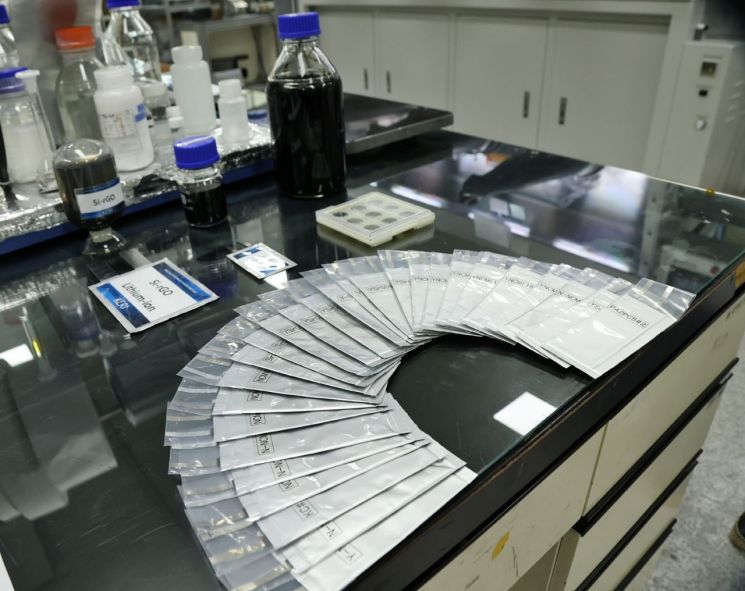
[Asia Economy Reporter Kim Bong-su] Interest is growing as next-generation battery technology developed by domestic public research institutes was sold immediately after development for a technology transfer fee of 1.1 billion KRW.
The Korea Electrotechnology Research Institute (KERI) announced on the 30th that a joint team of Dr. Geon-woong Lee and Dr. Seung-yeol Jung from the Nano Convergence Research Center, and Dr. Ik-jun Kim and Dr. Sun-hye Yang from the Next-Generation Battery Research Center developed the "mass production technology for silicon-graphene composite anode materials for high-capacity lithium-ion batteries," which was recently sold to HNS Co., Ltd., a specialized company in electric and electronic materials and components, for 1.1 billion KRW.
◆Extends Electric Vehicle Driving Range by 20%
This technology is, in short, a method of mixing silicon (Si) and metamaterial graphene to be used as electric battery materials. Silicon is attracting attention as the next-generation anode material for lithium-ion batteries. It has an energy density 10 times higher and faster charge/discharge speed than graphite, which is currently used. The problem is that its volume expands about three times during charging or discharging, and it has low electrical conductivity. Another issue is that battery performance rapidly deteriorates due to silicon particles breaking, electrode delamination, and continuous electrolyte decomposition reactions.
The KERI research team succeeded in complementing the disadvantages of silicon while preserving its advantages by adding 'graphene,' a new metamaterial (a material designed to have properties not found in nature) with strength 200 times that of steel and electrical conductivity 100 times that of copper.
Leveraging over 10 years of research experience on graphene, the team manufactured highly crystalline and electrically conductive 'oxidized and reduced graphene (GO, rGO)'. They also developed a ‘graphene aqueous dispersion technology’ in a high-concentration paste form that facilitates easy bonding with other materials. Furthermore, they secured a mass production process technology that can be integrated with existing lithium secondary battery active material manufacturing processes, enabling commercialization. Through this, they increased the silicon content (additive amount) in the anode of existing lithium secondary batteries from the previous level of within 5% to 20%, achieving stable manufacturing of high-capacity and high-quality anodes.
◆Outstanding Price Competitiveness
Above all, the greatest strength of this technology is its excellent price competitiveness, making it easily accessible even for small and medium-sized enterprises. It utilizes inexpensive micron (μm)-sized silicon instead of costly nano silicon. By applying high-crystallinity graphene dispersion technology, they succeeded in developing a technology to mass-produce composite anode materials with a core-shell structure (where silicon, the core, is wrapped like a shell by graphene). Subsequently, the research team produced a prototype ‘pouch-type full cell’ based on the silicon-graphene composite anode material, completed electrochemical characteristic tests, and registered domestic and international fundamental patents for the technology.
The KERI research team expects that commercialization through this technology transfer will enable the production of silicon/graphene composite powder in monthly ton (t) units. In terms of energy density, this corresponds to approximately 36,000 smartphone batteries or electric vehicle batteries with a capacity of 600 MWh.
Dr. Geon-woong Lee stated, “The silicon-graphene composite anode material technology can dramatically improve the performance of high-capacity lithium-ion batteries used in various fields such as eco-friendly electric vehicles, energy storage systems (ESS), defense industry, and aerospace. In particular, when applied to electric vehicles, it is expected to increase battery performance and extend driving range by about 20% or more.”
According to market research firm SNE Research, the global demand for anode active materials for lithium secondary batteries is expected to grow at an average annual rate of 39%, reaching 1.36 million tons by 2025. Among them, silicon anode materials are expected to occupy 11% and grow rapidly at an average annual rate of over 70%. The global market size for lithium secondary battery anode materials is projected to grow at an average annual rate of 30%, reaching 5.4 billion USD by 2023.
© The Asia Business Daily(www.asiae.co.kr). All rights reserved.

















