Largest Year-on-Year Increase Among Oyster Products
Exports Reach 2.5 Billion USD by July
[Asia Economy Reporter Choi Dae-yeol] It has been revealed that the overseas export value of synthetic rubber from the beginning of this year until last month has surpassed the total export value for the entire previous year. Synthetic rubber is a raw material used in the production of tires and sanitary products, and among petrochemical products driving South Korea's recent export growth, it has shown the largest year-on-year increase. Previously, in 2011, global supply shortages caused prices to surge, resulting in record-high exports, and there is growing interest in whether a new record can be set this year.
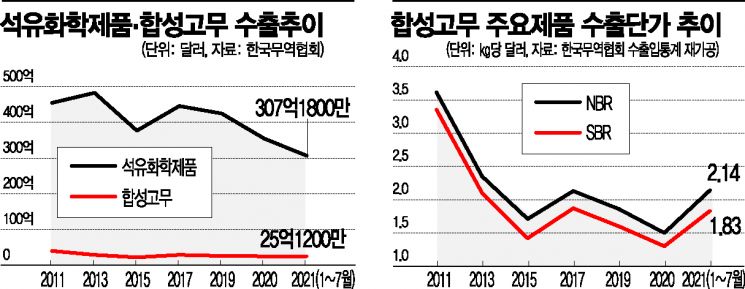
According to export-import statistics from the Korea International Trade Association on the 30th, synthetic rubber exports amounted to $2.512 billion from January to July this year. This figure represents a 96% increase compared to the same period last year, surpassing the total export value for the entire previous year ($2.51 billion) in just over half a year.
Synthetic rubber refers to styrene-butadiene rubber (SBR), used in tire manufacturing, and acrylonitrile-butadiene rubber (NBR), used in medical gloves, hoses, and insulation materials. Domestically, Kumho Petrochemical, LG Chem, and Lotte Versalis?a joint venture between Lotte Chemical and an Italian company?primarily produce synthetic rubber and supply it both domestically and internationally. A significant portion is exported to countries with rubber product factories, mainly Malaysia, China, Indonesia, and Thailand.
Petrochemical products have increased exports by about 60% compared to last year, playing a leading role in South Korea achieving its highest-ever export performance this year. Among the 15 major export items tracked by the government, synthetic rubber shows the largest year-on-year increase. In terms of total export volume, it ranks second only to semiconductors. Even considering the base effect caused by the global economic downturn due to COVID-19 last year, the increase is notably significant, with synthetic rubber performance standing out in particular.
Supply Shortage Mainly Due to Reflected Economic Recovery Expectations and Reduced Factory Operations
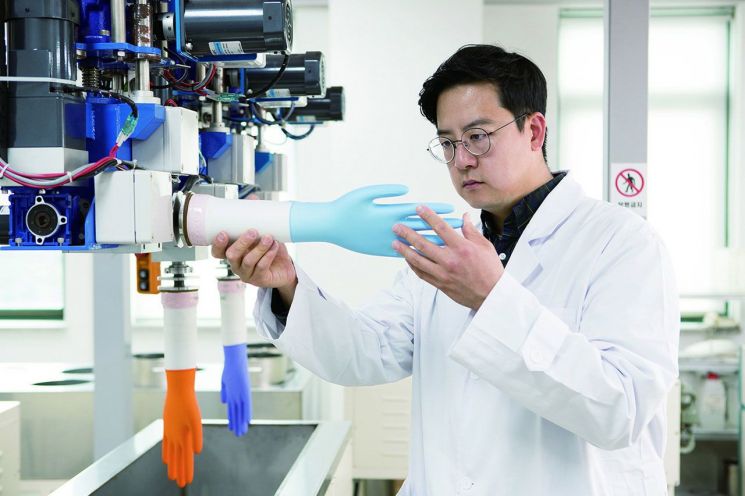
The recent surge in demand for synthetic rubber, used as a basic material across various industries, is interpreted as reflecting expectations of economic recovery. There is also the aspect of supply shortages caused by reduced factory operations due to COVID-19 last year. Demand for sanitary products such as latex gloves had already significantly increased since last year. SBR is considered a general-purpose synthetic rubber widely used in tires, footwear, and industrial materials. As automotive demand and tire replacement demand, which had contracted last year, revived this year, global demand has sharply increased.
If the current trend continues, the annual export value could exceed $4 billion, potentially setting a new record. The highest export value for South Korean synthetic rubber was in 2011, when $4.046 billion worth was exported overseas. The strong performance at that time was due to a sharp rise in major synthetic rubber prices. Flooding in Southeast Asia disrupted the supply of natural rubber, a substitute for synthetic rubber, and an earthquake in Japan, one of the major producing countries, halted factory operations, causing a shortage of synthetic rubber.
Estimating the average export price shows a clear recovery trend. Based on export volume and value, the average export price of NBR last month was $2.3 per kilogram, about 20% higher than at the beginning of this year. Compared to the mid-$1 range last year, it has increased by more than 50%. The SBR export price also rose about 40% compared to last year's average. Although the average export price is still lower than in 2011, production capacity has expanded and technology improved since then. Kumho Petrochemical plans to nearly double its production capacity of S-SBR, which has better performance than existing SBR, by next year, and increase NB latex production by nearly 50% to about 950,000 tons by 2023.
© The Asia Business Daily(www.asiae.co.kr). All rights reserved.
![Clutching a Stolen Dior Bag, Saying "I Hate Being Poor but Real"... The Grotesque Con of a "Human Knockoff" [Slate]](https://cwcontent.asiae.co.kr/asiaresize/183/2026021902243444107_1771435474.jpg)

















