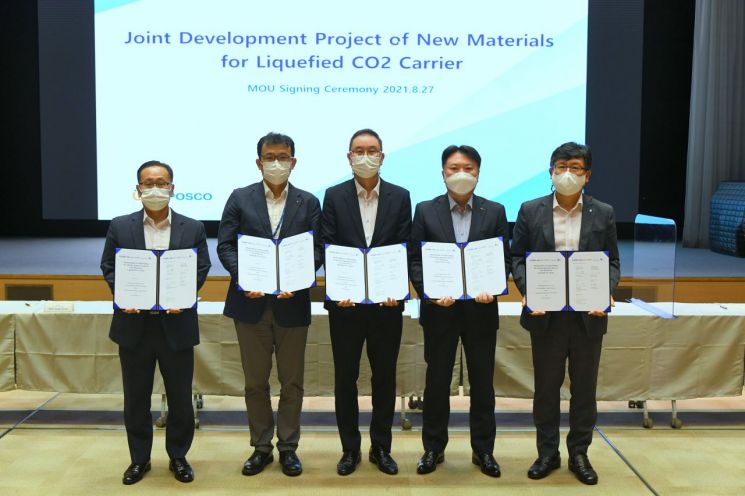
 Kim Jeongsik, Liberia Korean Representative (from left), Shin Sangbeom, Head of Production Technology Research Institute at Korea Shipbuilding & Offshore Engineering, Nam Youngjun, Head of Design Division at Hyundai Mipo Dockyard, Kim Sangcheol, Head of Energy Shipbuilding Marketing at POSCO, and Kim Youngdu, Vice President and Chief Technology Officer for Far East Asia at Lloyd's Register, are posing for a commemorative photo after signing a joint technology development agreement for liquefied carbon dioxide carriers on the 27th.
 [Asia Economy Reporter Choi Dae-yeol] POSCO, Korea Shipbuilding & Offshore Engineering, Hyundai Mipo Dockyard, Lloyd's Register, and the Liberian Registry have agreed to jointly develop liquefied carbon dioxide (LCO₂) carriers. This initiative aims to secure a leading position in the carbon capture, utilization, and storage (CCUS) market amid the transition to carbon neutrality and a hydrogen society.
On the 27th, the four companies signed a joint technology development agreement outlining this collaboration. According to the agreement, they plan to develop large-scale liquefied carbon dioxide carriers with a capacity of over 20,000 CBM in phases by 2025 and establish international standards and directions. POSCO will develop steel materials and utilization technologies for storage tanks, which are the core components of large LCO₂ carriers. Hyundai Mipo Dockyard and Korea Shipbuilding & Offshore Engineering will be responsible for welding technologies required for the design and construction of the carriers.
Lloyd's Register will conduct technical reviews for steel certification and storage tank design and manufacturing, as well as draft and revise related regulations. The Liberian Registry will handle ship registration and all approval procedures related to the flag state. A classification society certifies the safety of ships technically from materials to design, with Lloyd's Register based in the UK. The flag state manages registration procedures related to ship nationality, which the Liberian Registry handles on behalf of Liberia.
As technologies for capturing, utilizing, and storing carbon become increasingly important for carbon neutrality, the four companies have joined forces to develop and apply these technologies together. According to the International Energy Agency, approximately 40 million tons of carbon dioxide are captured and stored or used for enhanced oil recovery annually. CCUS technology is estimated to account for 15% of the global carbon dioxide reduction by 2070, equivalent to about 10 billion tons per year. Consequently, the development of large liquefied carbon dioxide carriers for transporting CO₂ to storage facilities is urgent. It is significant that all technologies, from steel for storage tanks to ship design and construction, will be domestically developed.
Kim Sang-cheol, Head of Energy Shipbuilding Marketing at POSCO, said, "By developing the world's first large liquefied carbon dioxide carrier, we will pioneer the carbon-neutral market and open an eco-friendly era." Nam Young-jun, Executive Director at Hyundai Mipo Dockyard, stated, "All participating companies will be able to solidify their positions as market leaders in this new market."
© The Asia Business Daily(www.asiae.co.kr). All rights reserved.
![Clutching a Stolen Dior Bag, Saying "I Hate Being Poor but Real"... The Grotesque Con of a "Human Knockoff" [Slate]](https://cwcontent.asiae.co.kr/asiaresize/183/2026021902243444107_1771435474.jpg)
















