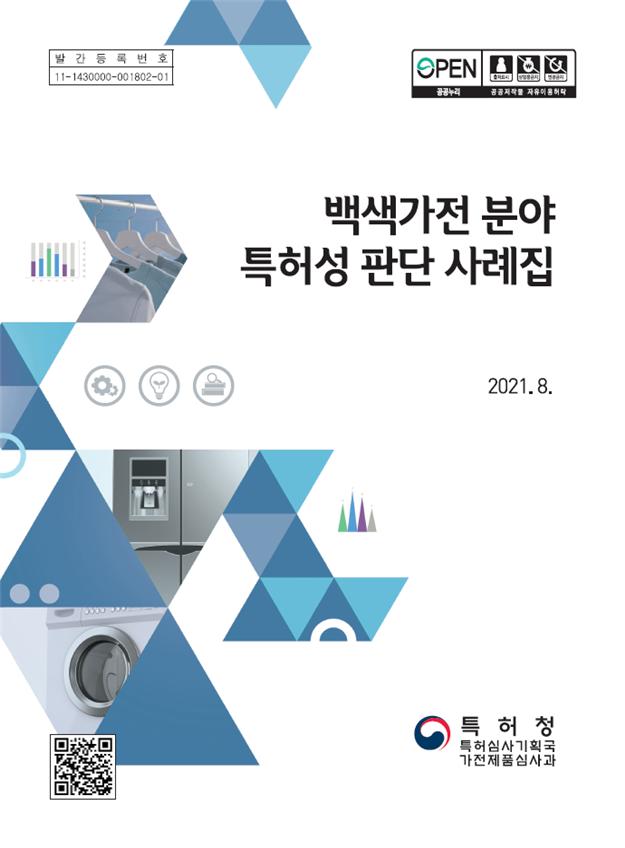
 Cover of the 'Casebook on Patentability Determination in the White Goods Sector.' Provided by the Korean Intellectual Property Office
[Asia Economy (Daejeon) Reporter Jeong Il-woong] The Korean Intellectual Property Office (KIPO) is publishing the "Casebook on Patentability Judgments in the White Goods Sector" (hereinafter referred to as the Casebook).
According to KIPO on the 26th, the Casebook is published to assist home appliance companies in establishing patent acquisition strategies by presenting actual judgment cases and guidelines on key issues in determining patentability in the white goods sector.
For example, the Casebook includes real cases where KIPO judged the patentability of home appliances with new functions such as clothing care devices with fine dust removal and sharp crease functions, pulsator washing machines equipped with pre-wash functions, and refrigerators combined with artificial intelligence and the Internet of Things that allow users to check inside the refrigerator and operate it remotely from outside the home.
By aligning the patentability judgment standards with those of the industry through the Casebook, KIPO aims to serve as a guide for companies’ technological innovation to lead to strengthened global patent competitiveness.
The publication of the Casebook also aligns with the recent situation where the domestic home appliance industry is focusing on securing technological and patent competitiveness to gain market dominance while competing with global home appliance companies in overseas markets.
For instance, in the United States, considered the most fiercely contested market in the global home appliance sector, patent applications by domestic home appliance companies in the white goods field have steadily increased over the past decade.
In the white goods category, domestic home appliance companies hold the top two positions in patent applications for washing machines and refrigerators, with Samsung ranked first and LG second, demonstrating their prominence in the market.
Strong patent competitiveness directly leads to market dominance in the white goods sector. In fact, in the first quarter of this year, Samsung Electronics held a 21.0% share of the U.S. home appliance market, and LG Electronics held 19.0%, surpassing Whirlpool, the largest global competitor, which held 16.5%.
LG Electronics also recorded sales of 13.5 trillion KRW in the first half of this year, surpassing Whirlpool’s 11.9 trillion KRW.
However, recently, Chinese home appliance companies have ranked first and second in patent applications in the white goods sector among the advanced patent countries (Korea, the United States, Europe, China, Japan; IP5), indicating that the domestic home appliance industry needs to further strengthen its global patent competitiveness to lead the world market beyond the United States, according to KIPO’s analysis.
Jang Ho-geun, an examiner at KIPO’s Home Appliance Examination Division, said, “Due to changes in climate environment and lifestyle, and the increase in remote work caused by COVID-19, technological competition in the white goods market is expected to intensify further, and related patent applications will continue to increase. KIPO will spare no effort to support the domestic white goods industry in securing patent competitiveness in response to these circumstances.”
© The Asia Business Daily(www.asiae.co.kr). All rights reserved.
!["The Woman Who Threw Herself into the Water Clutching a Stolen Dior Bag"...A Grotesque Success Story That Shakes the Korean Psyche [Slate]](https://cwcontent.asiae.co.kr/asiaresize/183/2026021902243444107_1771435474.jpg)
















