Raising Interest Rates to Curb Soaring Household Debt VS Freeze Considering 4th COVID-19 Wave
Ultra-Low Interest Rate Era Ends After 15 Months if Rates Increase
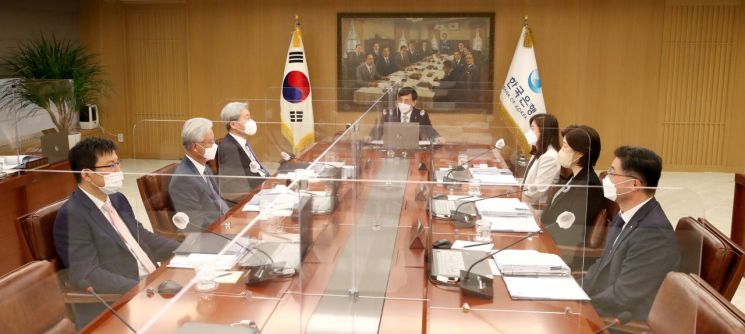
[Asia Economy Reporter Kim Eun-byeol] The Bank of Korea will hold a Monetary Policy Committee meeting on the 26th to decide whether to raise the base interest rate. Attention is focused on whether the era of the historically lowest ultra-low interest rate of 0.5% per annum, which has lasted for 15 months, will come to an end.
It is a key point whether the Bank of Korea will raise the base interest rate to curb the surge in household debt, which has grown to 1,800 trillion won, and the skyrocketing housing prices, or whether it will keep the rate unchanged considering the daily COVID-19 cases, which have increased to the highest-ever level of around 2,000 people, and the fourth wave of the pandemic.
In March last year, at the early stage of the COVID-19 crisis, the Bank of Korea held an emergency Monetary Policy Committee meeting to calm the financial market panic and implemented a big cut in the base interest rate (from 1.25% to 0.75%). Then, in May last year, it further lowered the base interest rate by 0.25 percentage points to a record low of 0.50% per annum. Since then, the base interest rate has been maintained at the historically lowest level for 15 months.
However, while maintaining the historically low interest rate, household debt has surged, and funds have flowed into real estate and stock investments. According to the Bank of Korea's 'Q2 Household Credit (provisional)' data, the household credit balance at the end of June reached 1,805.9 trillion won, marking an all-time high. Compared to the end of Q2 last year, household credit increased by 168.6 trillion won in one year, the largest scale since statistics compilation began in 2003. The Bank of Korea views that the increased debt due to low interest rates has flowed into asset markets such as stocks and real estate, causing a sharp rise in real estate prices and widening the gap with the real economy, leading to financial imbalances.
Bank of Korea Governor Lee Ju-yeol emphasized the necessity of raising interest rates during a recent National Assembly Planning and Finance Committee inquiry, stating, "Financial imbalance issues are not resolved overnight, and the later the action, the greater the cost." At last month's Monetary Policy Committee meeting, Financial Services Commission Chairman nominee Ko Seung-beom also expressed a minority opinion in favor of raising interest rates.
Earlier, a survey conducted by the Korea Financial Investment Association from the 11th to the 17th among bond experts showed that 67 out of 100 respondents expected the base interest rate to remain unchanged at this Monetary Policy Committee meeting. This figure decreased compared to the previous survey (89 respondents) conducted before last month's meeting. On the other hand, the number of experts expecting a rate hike increased by 22 to 33 compared to the previous survey.
© The Asia Business Daily(www.asiae.co.kr). All rights reserved.

















