Corruption Impact Assessment on 1,569 Regulations of 13 Public Institutions in Land and Safety... 98 Improvement Recommendations
Misconduct by Executives Leading to Resignation, Neglect of Reemployment Restrictions for Corrupt Officials Detected
11 Cases at National Institute of Ecology, 10 at Korea Land and Geospatial Informatix Corporation, 10 at Korea Environmental Industry & Technology Institute
[Sejong=Asia Economy Reporter Moon Chaeseok] From now on, public institution executives who are under indictment or investigation for misconduct will not be allowed to resign with honor. This administrative decision aims to eradicate practices such as self-resignation to avoid responsibility, "cutting tails," and parachuting into reemployment after a certain period.
The Anti-Corruption and Civil Rights Commission announced on the 25th the results of a corruption impact assessment on 1,569 internal regulations of 13 public institutions in the land and safety sectors, including the Korea National Railway Corporation and the Road Traffic Authority. They prepared 22 tasks in 3 categories and 98 improvement measures and recommended them to each institution.
The institutions with the most recommended improvements were the National Institute of Ecology (11 cases), Korea Land and Geospatial Informatix Corporation (10 cases), Korea Environmental Industry & Technology Institute (10 cases), and Korea Agency for Infrastructure Technology Advancement (9 cases). The Commission did not disclose specific cases detected by each institution.
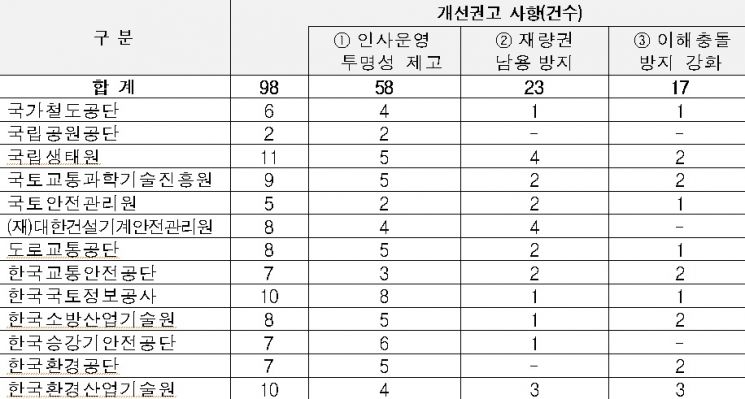
Looking at the cases, the main issues were ▲allowing executives involved in corruption to resign with honor and reemployment ▲arbitrary operation of budget execution regulations ▲neglecting conflicts of interest among members reviewing the feasibility of new projects.
For example, some institutions did not have regulations restricting executives from resigning with honor when involved in misconduct, unlike regular employees. Some institutions lacked regulations restricting reemployment of executives who were dismissed or resigned due to corruption during their tenure.
Institutions were also found to have arbitrary special expenditure regulations that allowed them to separately determine budget payment standards and methods. Some institutions operating investment and fund review committees to assess the feasibility of new projects did not have rules regarding disqualification, recusal, or avoidance of committee members with conflicts of interest.
Accordingly, the Commission recommended restricting honorable resignation for executives involved in misconduct and reflecting such dismissals as disqualifications for hiring.
They also advised revising arbitrary budget execution standards such as special expenditure regulations and establishing measures to prevent conflicted members from participating in investment and fund review committees.
Additionally, recommendations included ▲establishing disciplinary standards for drunk driving equivalent to those for public officials ▲improving regulations to prevent preferential private contracts. The regulations should include provisions preventing retired public institution employees from signing private contracts with companies where they are employed as executives for two years and require disclosure of contract status on the institution’s website.
Han Samseok, Director of the Anti-Corruption Bureau at the Commission, said, "We will continue to actively identify and improve corruption-inducing factors such as conflicts of interest and excessive discretionary power embedded in public institution regulations to create a fair and transparent society."
The Commission has been conducting a full survey of regulations in 495 public institutions since last year. Last year, they inspected regulations of 187 institutions in seven sectors including energy, airports, and ports, recommending improvements on 1,971 cases. This year, they are conducting regulatory inspections in 99 institutions across seven sectors, starting with 20 institutions in the employment and welfare sector.
© The Asia Business Daily(www.asiae.co.kr). All rights reserved.

















