 3-Month Outlook for Gwangju and Jeonnam Region. Photo by Gwangju Regional Meteorological Administration.
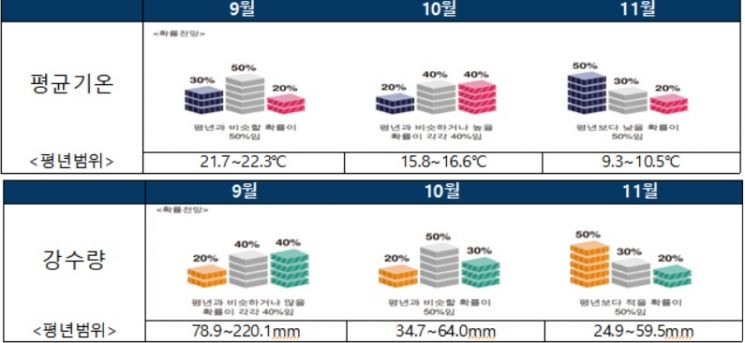
[Asia Economy Honam Reporting Headquarters Reporter Cho Hyung-joo] The temperatures in the Gwangju and Jeonnam regions this fall are expected to be similar to or higher than the average, but November is forecasted to be lower than average.
According to the "2021 Gwangju Jeonnam 3-Month Outlook (September to November)" released on the 24th by the Gwangju Jeonnam Regional Meteorological Administration, the influence of dry air approaching from inland China will cause large temperature differences between day and night on many days.
September has a 50% probability of being similar to the average, with many cloudy days as it falls on the edge of a high-pressure system.
The Meteorological Administration predicted that this month, although there will be many cloudy days due to being on the edge of a high-pressure system, the influence of dry air approaching from inland China will cause large temperature differences between day and night.
Precipitation is expected to be similar to or greater than average with a 40% probability each, and due to atmospheric instability and the influence of low pressure, there will be somewhat heavy rain with significant regional differences in precipitation.
October is analyzed to have a 40% probability each of being similar to or higher than average. Mainly influenced by dry air, the upper cold air will temporarily cause temperatures to be lower than average, resulting in many chilly days. Precipitation is expected to have a 50% probability of being similar to average.
November will experience large temperature fluctuations due to periodic influences of cold and warm air, and the Meteorological Administration expects temperatures to drop significantly at times. Precipitation is expected to be lower than average with a 50% probability.
Sea surface temperatures are expected to be somewhat lower than average, with a possibility of developing into La Ni?a again.
The higher-than-average sea surface temperatures in the North Pacific and the trend of global warming are analyzed as factors contributing to temperature increases.
Meanwhile, Gwangju and Jeonnam, which have escaped the influence of Typhoon Omais, will experience more than 200mm of rain due to the influence of low pressure approaching from the West Sea, with rain continuing until the 25th.
© The Asia Business Daily(www.asiae.co.kr). All rights reserved.
![Clutching a Stolen Dior Bag, Saying "I Hate Being Poor but Real"... The Grotesque Con of a "Human Knockoff" [Slate]](https://cwcontent.asiae.co.kr/asiaresize/183/2026021902243444107_1771435474.jpg)
















