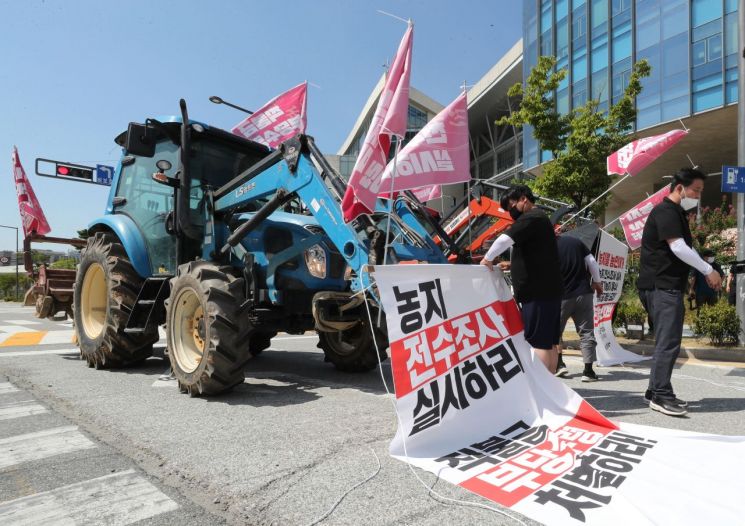
 Officials from the National Peasants' Federation held a vehicle protest on the afternoon of the 30th of last month near the Ministry of Agriculture, Food and Rural Affairs at the Government Complex Sejong in Sejong City, urging for "a full survey of farmland, confiscation of speculative farmland, and the introduction of the farmland public concept."
 The results of the Anti-Corruption and Civil Rights Commission's investigation into real estate speculation by opposition party lawmakers have once again confirmed that 'farmland' has turned into a speculation ground. Although the amendment to the Farmland Act recently passed the National Assembly following farmland speculation by employees of Korea Land and Housing Corporation (LH), concerns remain that farmland speculation will not be easily eradicated.
On the 24th, the Anti-Corruption and Civil Rights Commission announced that among the lawmakers from the People Power Party, 12 were found to have potential violations of laws during real estate transactions involving themselves or their families. The violations detected included △ six cases suspected of violating the Farmland Act, the most frequent △ four cases suspected of violating the Land Compensation Act, Building Act, and Special Act on Public Housing △ two cases suspected of tax evasion through illegal gifting △ and one case suspected of real estate name trust. Similar issues were raised in the June investigation targeting Democratic Party lawmakers, where five cases of suspected Farmland Act violations were the most common.
The recurring suspicion of Farmland Act violations in every real estate speculation investigation is attributed to structural problems within the Farmland Act. When acquiring farmland, one must obtain a farmland acquisition qualification certificate according to Article 7 of the Enforcement Decree of the Farmland Act, but the issuance of this certificate has practically been a 'free pass.' According to data obtained by Kim Eun-hye, a People Power Party member of the National Assembly Land, Infrastructure and Transport Committee, from Gyeonggi Province titled 'Annual Number of Farmland Acquisition Qualification Certificate Applications and Issuances in Gyeonggi Province over the Past Five Years,' from 2017 to March 2021, out of a total of 335,008 applications for farmland acquisition qualification certificates in 48 cities and counties of Gyeonggi Province, 329,215 certificates were issued. This corresponds to an issuance rate of 98.27%, nearly 100%. Regardless of whether for speculation or self-cultivation, it means farmland can be held irrespective of the purpose.
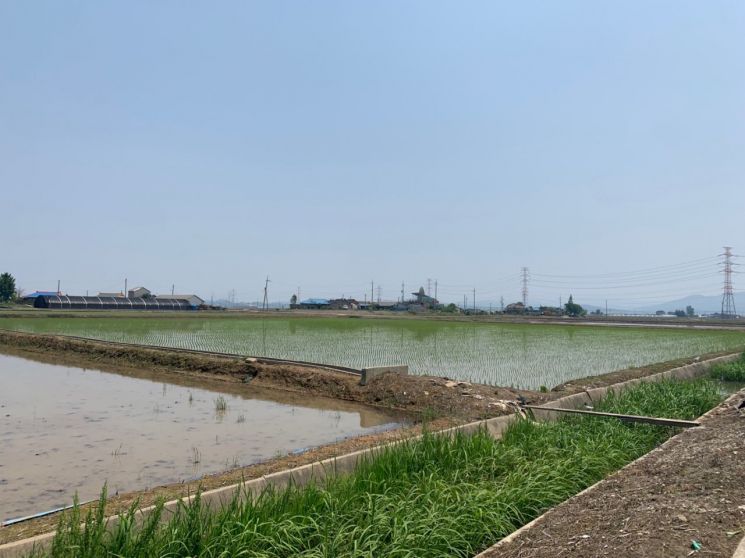 The Anti-Corruption and Economic Crime Investigation Unit of the Chungnam Provincial Police Agency announced on the 18th that a real estate developer who pocketed profits worth 10 billion won through the method of splitting shares, along with those who bought farmland aiming for price gains, were collectively caught. The photo shows the farmland in Dangjin, Chungnam, targeted for speculation.
 Following the LH scandal and the spotlight on this reality, the National Assembly passed an amendment to the Farmland Act on the 23rd of last month to prevent speculation abusing farmland. The amendment includes adding items such as occupation and farming experience to the mandatory entries in the agricultural management plan when applying for farmland acquisition qualification. However, criticism arises that this is merely a patchwork amendment that cannot fundamentally block farmland speculation.
Professor Sa Dong-cheon of the Department of Law at Hongik University said, "Despite the principle of farming by those who cultivate the land, it is currently legal to immediately lease farmland after acquisition," adding, "Although the farmland acquisition process has been tightened, this is a problem that anyone can overcome with just a little care in document preparation." He pointed out that although the threshold for farmland has been raised, many loopholes still remain.
Professor Sa suggested, "To fundamentally block farmland speculation, it is necessary to restrict profit realization through farmland," proposing a rent ceiling system. Currently, in agricultural fields, the owner and the cultivator of farmland are often different, and there exists a rent structure close to exploitation. He said, "There are many cases where huge rents are collected through leasing after acquiring farmland, which keeps farmland speculation forces continuously interested in farmland," and added, "It is necessary to set a ceiling on rent to lower expected profits at a level that does not hinder agricultural productivity."
© The Asia Business Daily(www.asiae.co.kr). All rights reserved.


















