10 Out of 16 Newly Listed Stocks
Downward Trend Since Listing Date
Foreign Investors Withdraw 7 Trillion Won from KOSPI Amid US Tapering and China Risks
IPO Investment Enthusiasm Also Cooling
Closing Price Returns on Listing Day
Maxst 73% · Curacle 49%
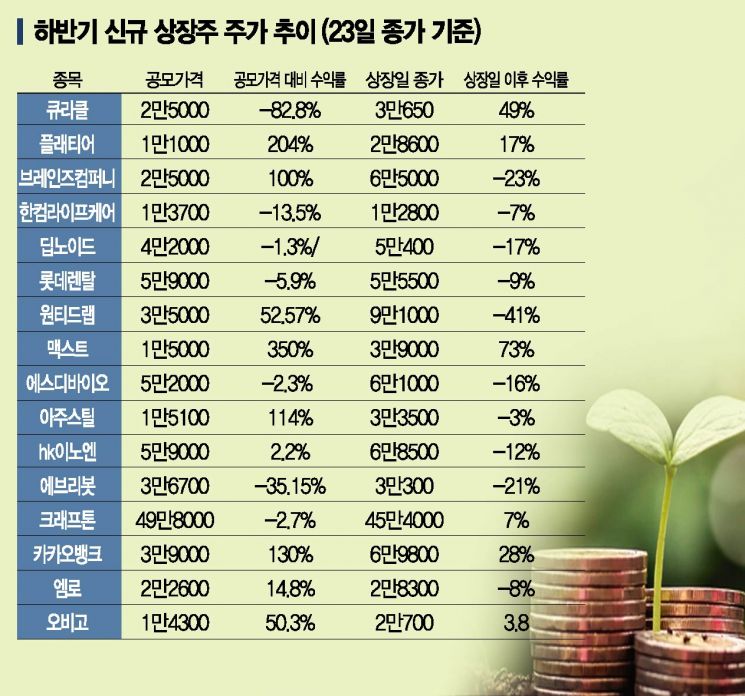
[Asia Economy Reporter Minji Lee] Newly listed stocks that entered the stock market in the second half of the year are struggling in the stock market. Among the 16 newly listed stocks (excluding SPACs) in the second half, only 6 stocks have shown an upward trend since their listing date, while about two-thirds have all shown a downward trend. Amid the overall weakness in the domestic stock market due to the tightening policies pursued by the US and China, it is interpreted that the high valuations set during the listing process have burdened the stock prices of some stocks.
According to the Korea Exchange on the 24th, Curacle, a new drug company related to vascular diseases, rose 49% based on the closing price on the listing day until the previous day. The public offering price was 20,500 KRW, and it is estimated that public offering investors earned an 83% profit after listing, while investors who bought on the listing day gained nearly 50% profit. In addition, Metaverse-related stock Maxst (73%), platform solution company Platier (17%), game company Krafton (7%), financial platform KakaoBank (28%), and smart car platform specialist Obigo (3.8%) also showed an upward trend since their listing date. In the case of Krafton, although it traded at 405,000 KRW, down 19.6% from the public offering price (498,000 KRW) on the listing day, it is showing an upward trend thanks to strong performance.
The remaining companies have been increasing their stock price declines after listing. There were cases where the stock price fell even after successfully achieving "ttasang" (when a newly listed stock's opening price on the first trading day is twice the public offering price and closes at the upper price limit). Recruitment platform company WantedLab and IT infrastructure integrated management solution company Brains Company fell 41% and 23%, respectively, compared to their first-day prices of 91,000 KRW and 65,000 KRW.
Many stocks traded below their public offering prices, causing losses to public offering investors. Except for KakaoBank and AJU Steel, most listed companies on the KOSPI did not reach their public offering prices. SD Biosensor, an in vitro diagnostic company, recorded a competition rate of 1144 to 1 in institutional investor demand forecasting and set the public offering price at the upper limit of 52,000 KRW, but it is currently trading 2.3% lower at 50,800 KRW. Comparing the upper limit of the expected public offering price band (85,000 KRW) before the price correction with the recent trading price shows a significant difference.
Companies such as Lotte Rental (-5.9%), safety equipment manufacturer Hancom Lifecare (-13.5%), and Krafton (-2.7%), which were decided at the highest expected public offering price in demand forecasting, also delivered poor returns to investors who invested in public offerings. On the KOSDAQ market, robot vacuum cleaner specialist Everybot (-35%) and AI company Deepnoid (-1.31%) are also trading below their public offering prices, with declines of 21% and 17%, respectively, since their listing dates.
The market evaluates that negative investment sentiment toward risky assets, triggered by concerns over liquidity tightening due to the US Federal Reserve's tapering initiation, China's tightening monetary policy moves, and sudden regulations, has led to the poor performance of public offerings. This is closely related to foreign investors withdrawing about 7 trillion KRW from the KOSPI market alone. The cooling of enthusiasm for public offering investments due to poor returns is also analyzed to have had an impact. Choi Jong-kyung, a researcher at Heungkuk Securities, said, "As the stock market adjustment is also affecting the IPO market, seeing KOSPI-listed companies closing with negative stock returns compared to the public offering price on the new listing day suggests that the overheated IPO market atmosphere at the beginning of the year has entered a cooling phase."
Meanwhile, with the listings of large companies such as Iljin Highsolus and Hyundai Heavy Industries, as well as small and medium-sized enterprises continuing in the second half, the success results are expected to vary significantly depending on growth momentum. Na Seung-doo, a researcher at SK Securities, analyzed, "As the proportion of general investors gradually increases, the atmosphere has cooled down temporarily after controversies over overvaluation of public offering prices due to overheating. Nevertheless, considering that a rich liquidity environment will be maintained, the selection between good and bad companies will intensify further depending on the business conditions of companies and the growth momentum of the upstream industries."
© The Asia Business Daily(www.asiae.co.kr). All rights reserved.
![Clutching a Stolen Dior Bag, Saying "I Hate Being Poor but Real"... The Grotesque Con of a "Human Knockoff" [Slate]](https://cwcontent.asiae.co.kr/asiaresize/183/2026021902243444107_1771435474.jpg)











