KOSPI Stretches
Foreigners Slowly Comeback
USD-KRW Exchange Rate Drops
Tapering Speed Adjustment
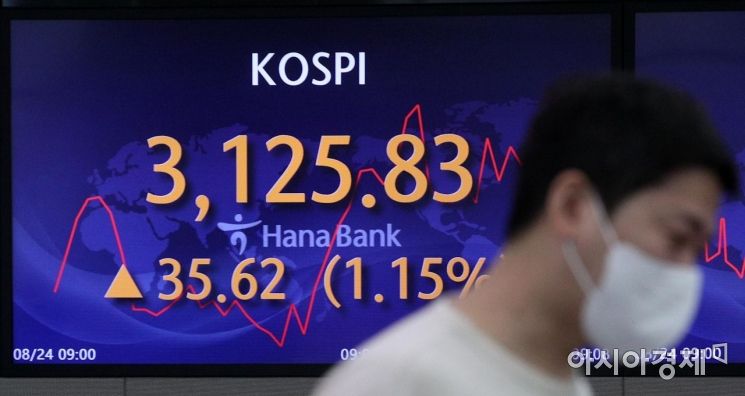 On the 24th, the KOSPI opened at 3,119.70, up 29.49 points (0.95%) from the previous trading day, at the Hana Bank dealing room in Jung-gu, Seoul. The KOSDAQ opened at 1,002.19, up 9.01 points (0.91%) from the previous trading day, and the won-dollar exchange rate started at 1,171.3 won, down 2.4 won from the previous trading day (1,173.7 won). Photo by Kim Hyun-min kimhyun81@
[Asia Economy Reporter Hwang Junho] The KOSPI, which had been sluggish over the past 10 trading days, is now stretching its legs. The combined effects of expectations for a slowdown in the US tapering (reduction of quantitative easing), the weakening of the Korean won, and a weakening of foreign selling pressure have led to a market reversal. The securities industry expects an influx of buying, especially in stocks that have seen significant declines.
As of 9:25 a.m. on the 24th, foreigners recorded a net sale of 40.8 billion KRW. Foreigners had net sold 40.8 billion KRW the previous day as well. Although selling still dominates, this is the smallest net selling volume among the 10 trading days since foreigners began selling on the 9th. Over the past 10 trading days, foreigners have sold up to 2.6675 trillion KRW in a single day (on the 13th), with an average daily withdrawal of 842.4 billion KRW from the KOSPI.
Notably, on this day, foreigners are buying 59.7 billion KRW in the electrical and electronics sector, including semiconductors, which had been a major selling sector, while selling 88.2 billion KRW in the chemical sector, which is shaken by the recall shock.
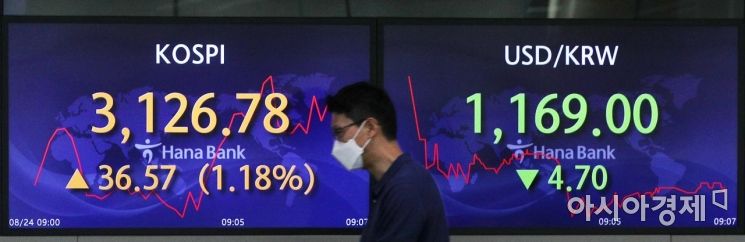 On the 24th, the KOSPI opened at 3119.70, up 29.49 points (0.95%) from the previous trading day, at the Hana Bank dealing room in Jung-gu, Seoul. The KOSDAQ opened at 1002.19, up 9.01 points (0.91%) from the previous trading day, and the won-dollar exchange rate started at 1171.3 won, down 2.4 won from the previous trading day (1173.7 won). Photo by Kim Hyun-min kimhyun81@
With the reduction in foreigners' net selling, the KOSPI is on the rise. On the morning of this day, the KOSPI recovered to the 3130 level with a strong gain of around 1.4%. The KOSPI also rose 0.97% the previous day, closing at 3090.21. After falling to the 3060 level on the 22nd, raising concerns about breaking below 3000, the market has shown a clear recovery in just two days.
The weakening of the Korean won, which was a major cause of foreign capital outflow, has settled for now, resulting in renewed preference for risk assets. The won-dollar exchange rate closed at 1173.70 on the 23rd, down 0.50% from the previous day. The won-dollar exchange rate, like the KOSPI's downward trend, had been rising from the 9th to the 23rd except for the 18th and 23rd.
The reversal in the exchange rate is significantly influenced by the possibility of a slowdown in the US's early tapering. Last month, the Federal Open Market Committee (FOMC), which sets US interest rates and monetary policy direction, judged that starting tapering within the year might be appropriate. However, the recent weekly average of new COVID-19 cases in the US has risen to the 150,000 range, similar to levels seen in January. Accordingly, members of the Federal Reserve (Fed), the US central bank, have expressed concerns about early tapering. The market is closely watching the speech of Fed Chair Jerome Powell scheduled for the 27th.
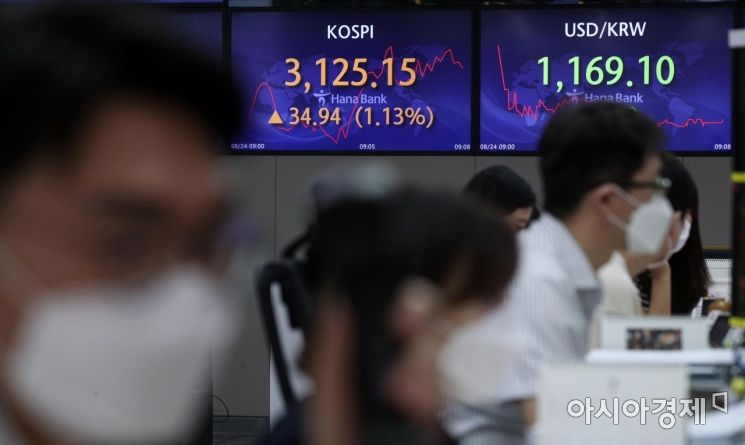 On the 24th, the KOSPI opened at 3119.70, up 29.49 points (0.95%) from the previous trading day, at the Hana Bank dealing room in Jung-gu, Seoul. The KOSDAQ opened at 1002.19, up 9.01 points (0.91%) from the previous trading day, and the won-dollar exchange rate started at 1171.3 won, down 2.4 won from the previous trading day (1173.7 won). Photo by Kim Hyun-min kimhyun81@
Seosangyoung, a researcher at Mirae Asset Securities, said, "The news of the Chinese government's approval of M&A for semiconductor-related companies and positive individual corporate developments, along with the 2.63% rise in the US Philadelphia Semiconductor Index and the sharp rise due to active buying in international oil prices, could have a favorable impact on foreign capital flows, supporting continued strength in the Korean stock market."
Lee Jaeseon, a researcher at Hana Financial Investment, said, "If there is no strong will for early tapering, it may be a good time to expect an influx of bargain buying in emerging market stocks." He added, "The valuation gap between developed and emerging market stocks has widened to about -35% and -29%, respectively, after hitting a low in March," and explained, "It is necessary to pay attention to sectors that have experienced excessive declines."
© The Asia Business Daily(www.asiae.co.kr). All rights reserved.
![Clutching a Stolen Dior Bag, Saying "I Hate Being Poor but Real"... The Grotesque Con of a "Human Knockoff" [Slate]](https://cwcontent.asiae.co.kr/asiaresize/183/2026021902243444107_1771435474.jpg)


















