Interview with Lee Ki-chang, CEO of Welcron Hantec Plant Division
Significant Cost Reduction Compared to Aerobic Wastewater Treatment by Securing Healthy Anaerobic Microorganisms
Utilizing Eco-Friendly Method for Wastewater Purification with Specialized Equipment
Technology Recognized through 2014 Export of Equipment to Iraq Kabat Thermal Power Plant
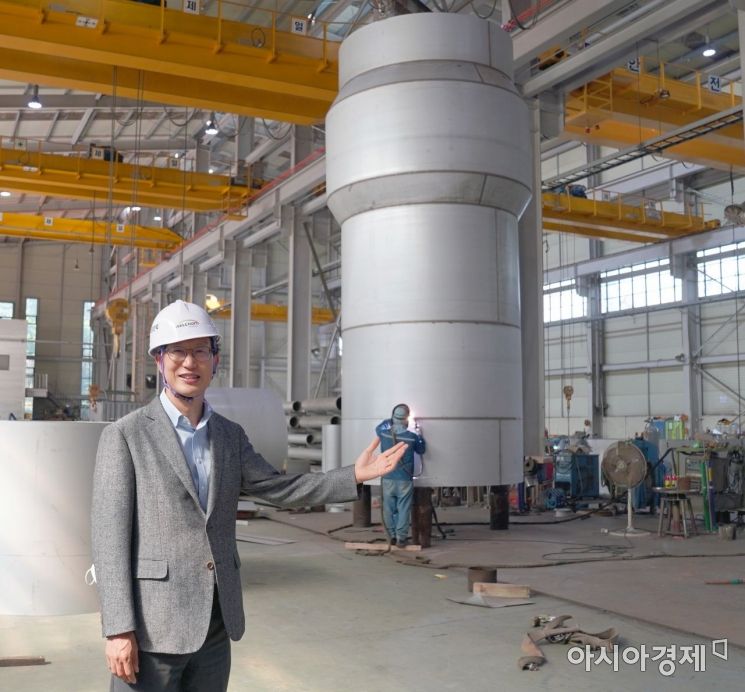 Lee Ki-chang, Head of the Plant Division at Welcron Hantec, is explaining the cathode material extraction equipment for secondary batteries. Photo by Welcron Hantec
[Hwaseong, Gyeonggi Province=Asia Economy Reporter Kim Heeyoon] "The anaerobic wastewater treatment method using microorganisms involves microorganisms consuming and decomposing pollutants in the wastewater, recycling the water, and refining the gas generated during the process for utilization or installing boilers to produce electricity."
As ESG management has become a key issue across industries, the 'anaerobic wastewater treatment method' is gaining attention, especially among many food and beverage, pharmaceutical, and paper companies that handle high-concentration organic wastewater. On the 23rd, at the headquarters in Hyangnam-eup, Hwaseong-si, Gyeonggi Province, Lee Gichang, CEO of Welcron Hantec's Plant Division, explained, "Until now, marine dumping accounted for most waste disposal in Korea, but it was completely banned by the 2016 London Convention, making water reuse and wastewater treatment methods a critical issue for industrial facilities. As a result, attention has shifted to adopting technologies that treat wastewater efficiently to reduce costs."
The anaerobic wastewater treatment method involves anaerobic microorganisms, called the black diamond inside the digester, consuming organic matter in the wastewater to purify it, generating biogas and leaving sludge (residue). Compared to aerobic wastewater treatment, which uses oxygen as a nutrient, this method can reduce the site area by nearly 80%, making it recognized as a high-efficiency facility. CEO Lee said, "Welcron Hantec exclusively holds the Dutch 'Paques' method, which cultivates healthier microorganisms than competitors to improve wastewater treatment efficiency, and this is our technological strength. Recently, as microbial loss has increased in competitor facilities and there is a global shortage of anaerobic microorganisms, the price has soared to 400,000 KRW per ton, and customers possessing healthy microorganisms are earning hundreds of millions of KRW solely from microorganism sales."
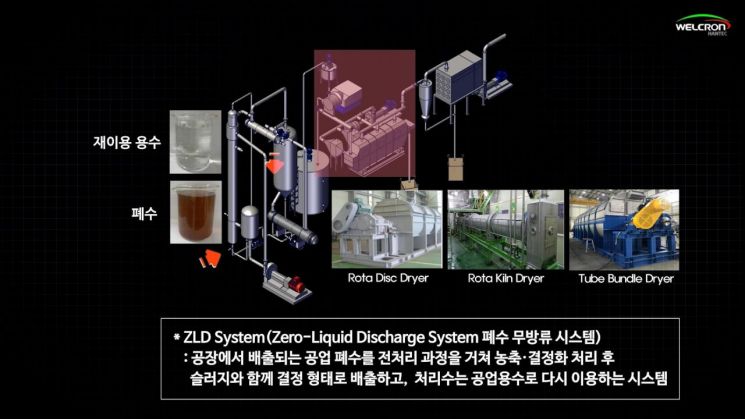
Application of ZDL Method Reduces Factory Wastewater from 100t to 3t
The 'Zero Liquid Discharge (ZLD)' method, which recycles wastewater to eliminate discharge, is also a specialty of Welcron Hantec. The ZLD method involves flowing wastewater between hot pipes to boil it, distilling the steam into clean water for reuse as industrial water in factories, and compressing and disposing of the remaining residue. The ZLD equipment consists of three machines: an evaporator concentrator, a crystallizer, and a sludge (residue) dryer, with one machine capable of purifying 5 tons of wastewater per hour.
Welcron Hantec internalized the ZLD technology, previously only owned by global companies including German firms, by importing and establishing the equipment domestically. In 2014, it supplied ZLD equipment to the Kabat thermal power plant facility in Iraq, gaining recognition for its technological capabilities. CEO Lee explained, "Last year, we installed wastewater treatment equipment at a factory in Asan, boiling 100 tons of wastewater and recycling 97 tons as industrial water for the factory." He added that the final sludge generated at the factory is 3 tons, with no factory wastewater discharged, attracting significant interest from other companies.
Welcron Hantec, which has taken on the challenge of energy-saving equipment in the secondary battery sector expanded by the growth of the electric vehicle market, secured orders for secondary battery separator manufacturing process equipment from a Chinese company in 2015, achieving new orders exceeding 10 billion KRW annually. The solvent recovery equipment built by Welcron Hantec separates pure MC (Methylene Chloride) from waste MC aqueous solution mixed with oil during the wet manufacturing process of secondary battery separators for reuse. CEO Lee emphasized, "Solvent recovery equipment plays a key role in reducing manufacturing costs. Especially, its high recovery rate and small equipment size relative to processing capacity make installation easy and space-efficient, enhancing site utilization efficiency."
Recently, Welcron Hantec has also begun constructing secondary battery cathode material extraction equipment, recording 98.2 billion KRW in orders for the plant division last year, nearly doubling from 48.7 billion KRW in 2019. CEO Lee stated, "With the spread of ESG management, demand for eco-friendly wastewater treatment facilities is increasing, and we are focusing on enhancing economic efficiency. As companies that hesitated to adopt due to initial equipment investment costs gradually show interest, we will strive to lead eco-friendly management and carbon emission reduction with advanced technology."
© The Asia Business Daily(www.asiae.co.kr). All rights reserved.
![Clutching a Stolen Dior Bag, Saying "I Hate Being Poor but Real"... The Grotesque Con of a "Human Knockoff" [Slate]](https://cwcontent.asiae.co.kr/asiaresize/183/2026021902243444107_1771435474.jpg)

















