UNIST Professor Junwoo Jeong's Team Analyzes Defects in Twisted Liquid Crystals Using Topology
Helps Understand Topological Defects in Various Chiral Materials Like DNA
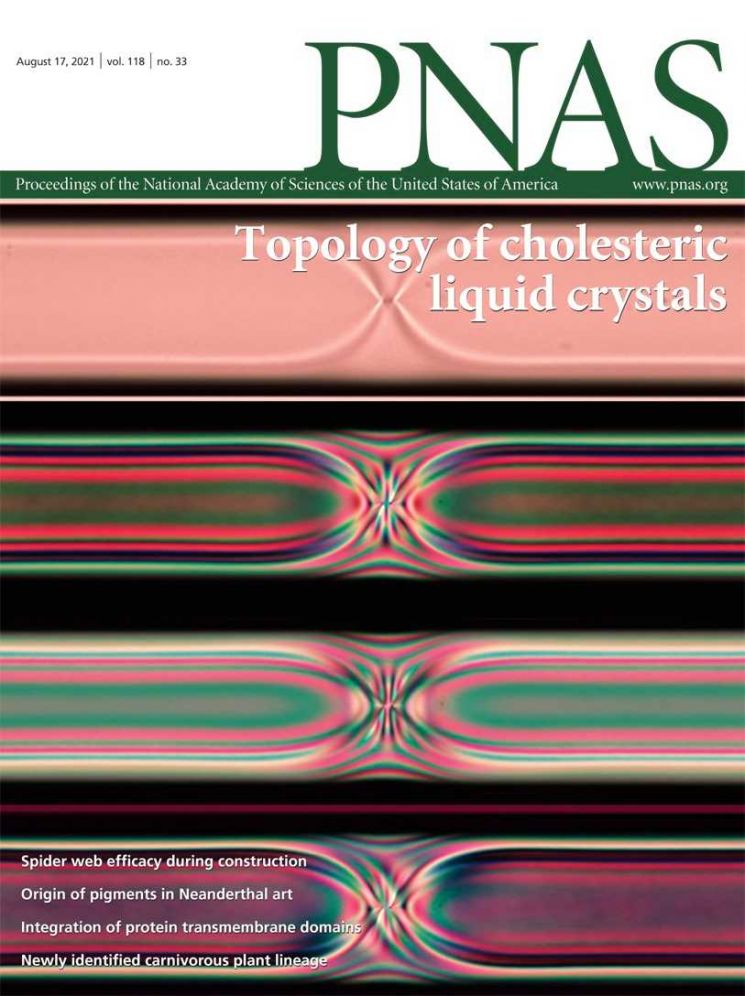
[Asia Economy Reporter Kim Bong-su] Ulsan National Institute of Science and Technology (UNIST) announced on the 23rd that Professor Junwoo Jeong's physics research team discovered a new defect structure in liquid crystals (chiral liquid crystals) and successfully interpreted it using topology. The existing topological theories used in liquid crystal research could not explain the topological defects found in the liquid crystals.
The research team newly proposed a "chiral topological invariant" to explain the topological form of the discovered defect. They also revealed that this topological defect occurs due to the special elasticity of the chiral liquid crystal used in the experiment.
Topology is a field that studies properties that are preserved or change discontinuously when the geometric shape of a material changes. Since it expresses the shape of materials as mathematical data, it is used in various fields such as astrophysics and artificial intelligence. Research explaining physical phenomena such as magnetism and conductivity changes of materials through topology won the Nobel Prize in Physics in 2016.
The chiral cholesteric liquid crystal used in the experiment has the characteristic that when placed inside a very thin cylindrical tube, the liquid crystal molecules twist and arrange themselves like a helical staircase. At this time, they have either a left-handed or right-handed twist direction (chirality), and since the probability is equal, structures (domains) with each twist direction coexist within a single cylinder. When chiral materials are added in this state, the twist direction of the liquid crystal unifies according to the twist direction of the added chiral material.
The research team discovered that when more chiral material is added in this state, an unexpected form of topological defect appears in the liquid crystal. The defect was formed where two structures with the same twist direction but different rotation angles of 90 degrees and 270 degrees meet. The existing topological theories used in liquid crystal research could not distinguish between the 90-degree rotated structure and the 270-degree rotated structure, so although the defect was experimentally observed, it could not be expressed in the language of topology.
Jonghee Eun, the first author and a researcher in the Department of Physics at UNIST, said, "Thanks to the persistent joint efforts between the experimental and theoretical groups, a chance observation led to a new scientific discovery," adding, "This discovery will help enhance understanding of various chiral materials not only in liquid crystal research but also in medical and bio fields."
Professor Junwoo Jeong explained, "Explaining material properties through topology is a recent trend in physics research," and added, "Understanding defects in materials through topology will help artificially design defects necessary to impart specific functions to materials."
This research was conducted in collaboration with Durham University and the University of Bristol in the UK. It was published as a cover paper in the Proceedings of the National Academy of Sciences (PNAS) on the 17th.
▲Cholesteric liquid crystal = A substance that spontaneously forms a liquid crystal phase when a certain concentration or more of polycyclic aromatic compounds is dissolved in water. Plate-shaped molecules stack neatly by non-covalent forces to form rod-shaped aggregates, and these aggregates orient to form the liquid crystal phase. It uses water as a solvent and is biocompatible, attracting great attention for its potential applications in the biomedical field. It is also noted in liquid crystal physics for its unique elastic properties.
▲Chirality = A term referring to structural properties that do not coincide with their mirror image, an important research topic in various fields such as physics, chemistry, and biology. A representative example of a chiral structure is DNA, which contains genetic information. DNA has a double helix structure mostly with right-handed twists, and its mirror image, the left-handed double helix, is similar but different. That is, although the chemical composition is the same, the two cannot be superimposed.
▲Topological defect = In structures with order, defects where the order is not maintained can exist. For example, impurities labeled B entering a structure made only of A. Unlike such impurity defects, there are defects generated by boundary conditions of the system, which must exist topologically due to these boundary conditions, called topological defects. In other words, impurity defects disappear when impurities are removed, but topological defects always exist unless the boundary conditions are completely changed. Dislocations in crystal structures are examples of topological defects. In liquid crystals, topological defects occur at singular points where the alignment direction of liquid crystal molecules cannot be defined due to boundary conditions. Liquid crystal defects are widely used as model systems to study topological defects in various condensed matter and can be used in various optical and chemical applications by controlling these defects.
© The Asia Business Daily(www.asiae.co.kr). All rights reserved.
![Clutching a Stolen Dior Bag, Saying "I Hate Being Poor but Real"... The Grotesque Con of a "Human Knockoff" [Slate]](https://cwcontent.asiae.co.kr/asiaresize/183/2026021902243444107_1771435474.jpg)
















