International Finance Center 'Recent Overseas Perspectives on Foreigners' Semiconductor Stock Selling'
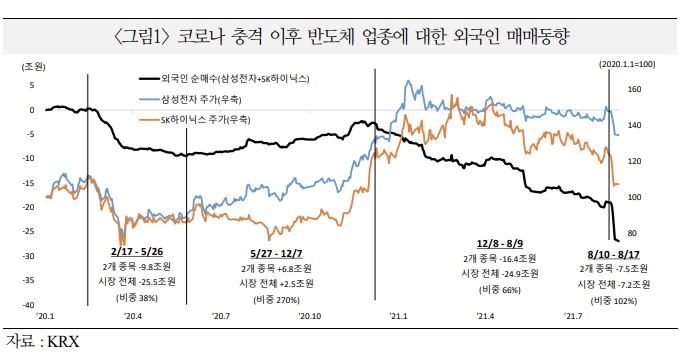
[Asia Economy Reporter Kim Eunbyeol] As foreign investors are massively selling domestic semiconductor-related stocks, there is a forecast that volatility is likely to remain high for the time being.
On the 21st, the International Financial Center stated in its "Recent Overseas Perspectives on Foreigners' Semiconductor Stock Sales" report, "Large-scale foreign selling has emerged recently as the outlook for the semiconductor industry has worsened," adding, "Due to the significant difference in views between pessimism and optimism regarding the semiconductor industry outlook, volatility in foreign trading and stock prices is likely to be high during the process of consensus convergence."
From the 10th to the 17th of this month, foreign investors net sold 7.3 trillion KRW over five trading days, including the KOSDAQ. The net foreign selling was concentrated in the semiconductor sector, with two stocks, Samsung Electronics (-5.9 trillion KRW) and SK Hynix (-1.9 trillion KRW), accounting for 108% of the total net selling. Consequently, Samsung Electronics' stock price fell by 9.0%, while SK Hynix (-12.5%) and the KOSPI (-3.6%) also showed downward trends.
This concentrated selling of domestic semiconductor stocks by foreigners is influenced not only by the possibility of tightening measures such as the US tapering (asset purchase reduction) but also by recent investment banks (IBs) forecasting a memory semiconductor downcycle.
The International Financial Center explained, "Some IBs have significantly lowered earnings forecasts for domestic semiconductor companies based on the memory semiconductor downcycle outlook," but added, "However, there is also a growing view that DRAM price declines are limited due to steady demand from servers, and that the stock price drop is excessive."
CLSA, Morgan Stanley, and others recently diagnosed in their reports that memory inventory levels at set manufacturers such as PCs and smartphones are sufficient, anticipating price declines due to memory oversupply.
This suggests a forecast of a semiconductor downcycle.
On the other hand, some IBs still expect a robust cycle, including improvements in memory margins. Goldman Sachs assessed, "Demand from servers in the second half of the year remains strong, and concerns among some investors about a sharp drop in memory prices are excessive." Bank of America (BofA) stated, "Although DRAM spot prices have been declining recently, there is a possibility of a rebound in September to October," and predicted, "Considering inventory levels and supply-demand conditions, the 2021-2022 memory cycle will be much better than the 2018-2019 cycle."
Citigroup also expects the semiconductor cycle to be maintained. Citigroup forecasted, "Inventory at large-scale data center companies is at 8-10 weeks, which is better compared to the end of 2018, and meaningful memory orders will begin from early next year."
Because of the large disparity in semiconductor cycle forecasts among IBs, the International Financial Center predicts that investors' selling pressure and stock price volatility may increase for the time being. The center stated, "During the process of reaching consensus on the semiconductor industry cycle, volatility in foreign trading and stock prices is likely to be high."
© The Asia Business Daily(www.asiae.co.kr). All rights reserved.
![Clutching a Stolen Dior Bag, Saying "I Hate Being Poor but Real"... The Grotesque Con of a "Human Knockoff" [Slate]](https://cwcontent.asiae.co.kr/asiaresize/183/2026021902243444107_1771435474.jpg)











