Curly, Krafton, Woowa Brothers, and Others Significantly Increase Hiring
Ministry of SMEs and Startups Announces '2021 First Half Innovative Venture Startup Employment Trends'
Professor Bae Jong-tae: "Domestic Corporate Environment Changing More Dynamically"
[Asia Economy Reporters Heeyoon Kim and Junhyung Lee] #Newbility, a startup developing artificial intelligence (AI) delivery robots, recently recruited a former administrative officer from the Ministry of the Interior and Safety as its government relations manager. The company has been actively hiring developers lately, with the tens of billions of won investment secured last month from Kakao Investment serving as the ‘seed money’ for talent acquisition. CEO Lee Sang-min said, "This second half of the year is a crucial period for growth, with plans to raise Series A funding worth 10 to 20 billion won," adding, "The annual salaries for key personnel such as AI developers are 1.5 to 2 times higher than those at large corporations."
Although the employment market has contracted due to the prolonged COVID-19 pandemic, the situation in the venture and startup sectors is quite different. In particular, the job expansion by domestic unicorn companies (unlisted companies valued at over 1 trillion won) is strikingly noticeable.
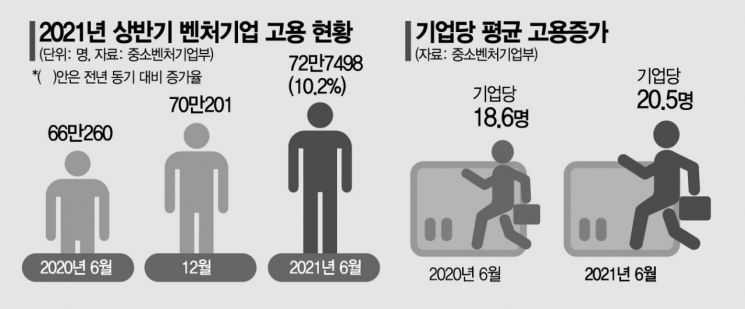
According to the ‘2021 First Half Innovation Venture Startup Employment Trends’ announced by the Ministry of SMEs and Startups on the 19th, eight domestic unicorn companies increased their average employment by 265 employees per company compared to the end of June last year. This figure is approximately 139 times higher than the average increase of 1.9 employees per company across all venture firms over the same period. Among unicorn companies, the one that increased jobs the most in one year was the online fresh food delivery company ‘Coupang’. The number of Coupang employees rose by 1,058 to 1,896 compared to June last year. The second was game company Krafton, which created 580 jobs over one year, reaching 1,298 employees.
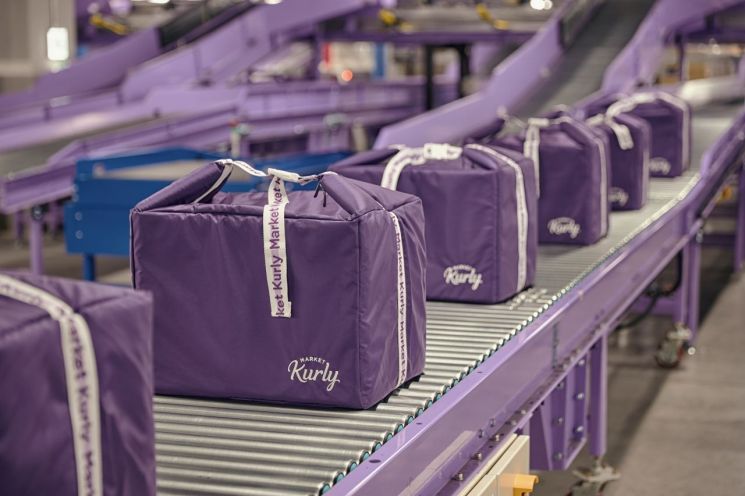 Online fresh food delivery company Market Kurly's reusable packaging 'Kurly Purple Box.' Among unicorn companies, Market Kurly was the one that increased jobs the most within a year.
 [Photo by Market Kurly]
Fourth Industrial Revolution Investment ‘Boom’... Market Size Expands
On the ground, it is analyzed that ICT-based and new technology-driven distribution and service sectors, such as Coupang and Krafton, led the job growth. Barogo, a startup operating a last-mile logistics IT platform, increased its total number of employees by 36.6% as of the end of last month compared to the same period last year. Despite developer shortages, the company explained that the number of developers increased by 35% during the same period, and non-developer positions also expanded by 26.2%.
Despite the overall decrease in total employment last year, venture companies created 53,000 new jobs. Seventy-seven newly registered venture companies in the first half of this year employed 448 people, increasing net employment by 5.8 employees per company. The top three industries with employment growth?ICT services, distribution and services, and bio-medical?are the same sectors that received the most venture investment in the first half of this year. Investment in the Fourth Industrial Revolution has thus translated into growth and job creation in venture companies.
Diversification of Talent Types Also Contributed
The diversification of talent types required by companies also played a role in job creation. As the venture and startup ecosystem reorganizes around the Fourth Industrial Revolution, demand for developers has surged significantly. In the first half of this year, a ‘talent war’ to poach developers with high salaries spread across the IT industry. As the developer shortage intensified, startups increasingly hired and trained developers regardless of age, education, or major.
Demand for non-developer positions has also steadily increased. As startups expand into new areas, they require talents in various fields such as marketers in addition to developers. MCN startup Leferi has about 70 employees, most of whom are humanities majors. Rapolabs, a startup recognized with a corporate value of about 200 billion won for its 4050 fashion application ‘Queenit,’ is actively hiring product planners (MDs).
 The office of Rapolabs, the operator of the 4050 fashion application (app) 'Queenit'. Rapolabs recently secured new investments worth 10 billion KRW, recognizing a corporate value of approximately 200 billion KRW.
 [Photo by Junhyung Lee]
Startups Become ‘Talent Black Holes’
Given this situation, cases of employees moving from large, stable companies to startups are increasing. Startups offer attractive features such as horizontal organizational culture, egalitarian decision-making structures, high salaries, and stock options. Startups have early on introduced a 35-hour workweek and unlimited vacation policies to attract young talents who value work-life balance. Moreover, startups that have secured ‘ammunition’ through large-scale investments from venture capital (VC) firms often offer salaries 150 to 200% higher than those at large corporations to talents from such companies. Industry insiders say that salaries at successful startups are generally higher than those at most large corporations.
Finda, a startup operating a comparison lending brokerage platform, saw its users and sales increase by over 1,200% and 6,200%, respectively, last year. As workload increased accordingly, the number of employees nearly increased by 1.5 times in the first half of this year alone. Many of the newly hired employees come from large corporations such as Samsung and Lotte, as well as major startups like Coupang and Woowa Brothers. Bank employees are also joining Finda as product owners (POs) overseeing the entire development process of projects. A Finda representative said, "We are hiring one to two new employees every week," adding, "Talents with experience in large corporations decided to move because they resonate with the company’s vision of creating new financial services."
Amid accelerated institutional innovation and digital transformation triggered by COVID-19, the ‘Second Venture Boom’ represented by the growth of the venture industry is gaining attention as a key to securing future growth engines and overcoming economic crises.
Professor Bae Jong-tae of KAIST Business School said, "The employment creation effect of ventures and startups is one of the outcomes of the rapid growth of the related ecosystem," adding, "It can be seen that the domestic corporate environment has become more dynamic." He further noted, "While the first venture boom was led by people from large corporations such as Samsung, the entrepreneurs leading the second venture boom come from much more diverse backgrounds," adding, "It is very encouraging that new business opportunities are increasing centered on ventures and startups."
© The Asia Business Daily(www.asiae.co.kr). All rights reserved.



















