[Asia Economy Reporter Jeong Hyunjin] Among the 30 OECD member countries, South Korea ranked high in the conflict index, indicating a serious level of conflict, but its conflict management index, which reflects the ability to manage such conflicts, was ranked low, suggesting that conflict management is not effectively carried out, according to the Federation of Korean Industries (FKI).
On the 19th, the FKI announced the results of a survey conducted on 30 OECD member countries with available data, calculating a conflict index by integrating political, economic, and social sectors. South Korea ranked 3rd in the conflict index and 27th in the conflict management index.
This FKI survey adopted the social conflict index items used in the 2014 report "International Comparison of Social Conflict Index and Its Impact on Economic Growth" by the Korea Institute for Health and Social Affairs. The conflict index is a composite result of 13 items across three sectors: ▲Political (legal restrictions on press freedom, political control over news media, etc.), ▲Economic (Gini coefficient, etc.), and ▲Social (population density, etc.). The conflict management index is a composite of four items including government effectiveness and quality of regulation.
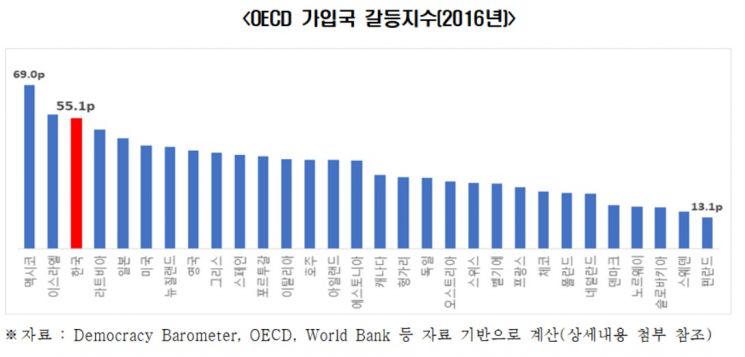
According to the survey results, South Korea's conflict index in 2016 was 55.1 points, ranking 3rd among the 30 OECD countries. This is higher than the G5 countries: France (25.8 points, 22nd), Germany (29.8 points, 18th), the United Kingdom (41.4 points, 8th), the United States (43.5 points, 6th), and Japan (46.6 points, 5th). It is the third highest score after Mexico (69.0 points, 1st) and Israel (56.5 points, 2nd).
The political sector conflict index ranked 4th. Among detailed items, legal restrictions on press freedom and political control over news media ranked 5th, while political bias in the media ranked 11th. An FKI official explained, "This suggests that strong legal and political control over the media by the political sphere and severe bias according to the ideological color of media outlets act as factors that trigger conflicts."
The economic and social sector conflict indices ranked 3rd and 2nd, respectively. In the economic sector, items indicating income inequality, such as the Gini coefficient based on disposable income, ranked high, showing that despite government efforts at income redistribution, South Korea has relatively high income inequality among OECD countries, acting as a source of conflict. Additionally, South Korea was found to have the highest population density among OECD countries due to its large population relative to its territory.
South Korea's conflict management index ranked 27th among the 30 OECD countries in 2016. This is a low ranking following Mexico (30th), Greece (29th), and Hungary (28th). South Korea's conflict index rose one rank from 4th in 2008 to 3rd in 2016, confirming a relative intensification of conflicts. An FKI official stated, "A low conflict management index, composed of government effectiveness and quality of regulation, means that the institutional and financial infrastructure for managing conflicts is at a low level."
The FKI emphasized that national conflicts generate costs and act as obstacles to economic growth. According to the Korea Institute for Health and Social Affairs, a 10% increase in the conflict management index can increase per capita GDP by up to 2.41%. Therefore, it is necessary to control conflicts in advance and enhance the government's conflict management capabilities.
© The Asia Business Daily(www.asiae.co.kr). All rights reserved.
![Clutching a Stolen Dior Bag, Saying "I Hate Being Poor but Real"... The Grotesque Con of a "Human Knockoff" [Slate]](https://cwcontent.asiae.co.kr/asiaresize/183/2026021902243444107_1771435474.jpg)
















