Condoleezza Rice "The Longest War for the US is the Korean War"
Alliance to Check China Expected to Strengthen Further
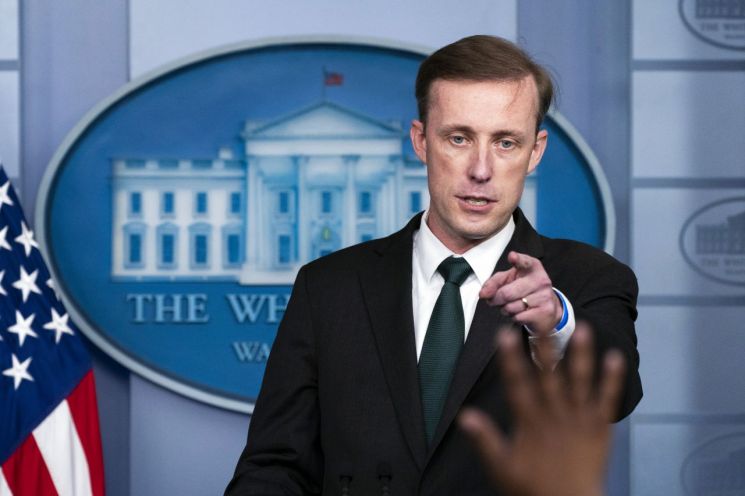
[Asia Economy New York=Correspondents Baek Jong-min and Lee Hyun-woo] On the 17th (local time), Jake Sullivan, U.S. National Security Advisor, mentioned South Korea, Taiwan, and Europe, stating that the situation is "fundamentally different from Afghanistan." This is interpreted as an effort to dispel security concerns raised by major allies following the Taliban's takeover of Afghanistan.
The Biden administration, which advocated for alliance restoration and 'value diplomacy' such as human rights, showed a tendency to prioritize 'national interests' emphasized by the previous Donald Trump administration in the Afghanistan crisis, causing allied countries to worry that U.S. foreign policy might suddenly change.
However, experts believe that since one of the reasons for the U.S. withdrawal from Afghanistan was to strengthen the economy against China, the diplomatic strategy that values South Korea, Taiwan, and Europe will remain unchanged. The strategic importance of East Asia may be emphasized according to the U.S. Asia-Pacific strengthening strategy.
On this day, Advisor Sullivan emphasized this point by stating, "South Korea and Europe have long maintained the presence of U.S. troops to protect alliances against external enemies even during times without civil war," and that "the situation is fundamentally different from the U.S. presence in Afghanistan."
On the previous day, President Biden's national statement regarding the Taliban's reoccupation of Afghanistan, saying "We will not fight where there is no U.S. interest," sparked growing security concerns among U.S. allies.
In U.S. diplomatic circles, some experts expressed concerns about the South Korea-U.S. alliance by drawing parallels with the Afghanistan situation. Former U.S. Secretary of State Condoleezza Rice, in a Washington Post (WP) op-ed, argued that the U.S. should have extended its military presence in Afghanistan and cited the South Korea-U.S. alliance as an example. Rice reminded that "the Afghanistan war lasted 20 years, but the longest war is the Korean War," noting that U.S. troops have been stationed in South Korea for 70 years. She added, "Even the sophisticated South Korean military cannot independently deter North Korea. The long-term stationing of 28,000 U.S. troops in South Korea has achieved a stable balance on the Korean Peninsula and stability in the valuable ally South Korea and the Indo-Pacific region."
Republican Congressman Steve Chabot also mentioned U.S. troops stationed in South Korea, Japan, and Germany in an interview with NPR, emphasizing, "We are not saying the U.S. should be the world's police, but we do have a role to play globally."
However, within U.S. political circles, it is widely analyzed that incidents like the Afghanistan situation are unlikely to occur in other allied countries such as South Korea, as bipartisan legislation prohibiting the reduction of U.S. troops in South Korea was passed during the previous Trump administration. According to Voice of America (VOA), in June 2019, the U.S. House Armed Services Committee passed an amendment to the National Defense Authorization Act that prohibits reducing the number of U.S. troops stationed in South Korea from the current 28,000.
Experts foresee that although the Afghanistan crisis has increased doubts about the Biden administration's foreign policy direction and ability to adjust international affairs, causing some unease among allies, there will be no change in the focus on East Asia to counter China and the policy of strengthening allied forces.
James Kim, Director of the U.S. Research Center at the Asan Institute for Policy Studies, explained, "The Biden administration's failure to resolve the Afghanistan issue may be perceived as a symbol of the weakening of the superpower U.S., and competitors like China and Russia may highlight this more. However, the Biden administration has not been in power for long, and the confusion is merely due to the lack of detailed foreign policy coordination amid the COVID-19 crisis." He added, "It is clear that the U.S. will strive to strengthen alliances and military capabilities with partner countries such as South Korea, Taiwan, Japan, and Europe to counter China, so there is no need to worry about the reduction of U.S. troops in South Korea."
© The Asia Business Daily(www.asiae.co.kr). All rights reserved.
![Clutching a Stolen Dior Bag, Saying "I Hate Being Poor but Real"... The Grotesque Con of a "Human Knockoff" [Slate]](https://cwcontent.asiae.co.kr/asiaresize/183/2026021902243444107_1771435474.jpg)
















