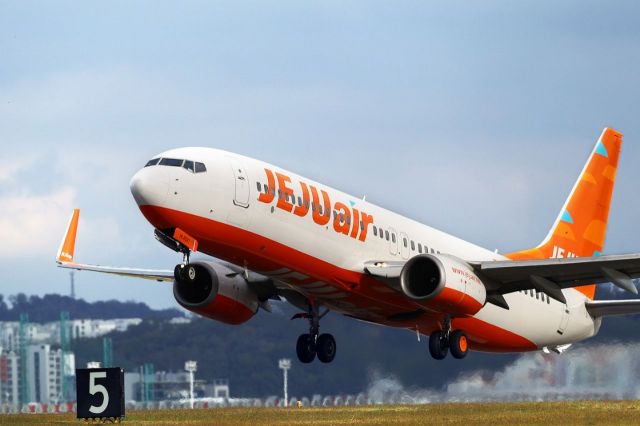
[Asia Economy Reporter Dongwoo Lee] The domestic low-cost carrier (LCC) industry is making every effort to secure funds amid worsening financial difficulties caused by the prolonged COVID-19 pandemic.
According to the industry on the 15th, Jeju Air recently announced at an extraordinary general meeting of shareholders that it decided on a capital reduction without compensation and a paid-in capital increase of approximately 210 billion KRW, along with an increase of 80 billion KRW in short-term borrowings.
Accordingly, Jeju Air reduced the par value of its common stock from 5,000 KRW to 1,000 KRW, and its capital decreased from 192.4 billion KRW to 38.4 billion KRW. With the approval of the capital reduction without compensation, Jeju Air escaped from capital erosion, a state where total equity is less than capital stock. The number of shares to be issued in the capital increase is 11,260,530 shares, and the scheduled new share issuance price will be finalized at 18,650 KRW on October 13.
Around the same time, Jin Air also held a board meeting and resolved a paid-in capital increase of 108.4 billion KRW and the issuance of 75 billion KRW in perpetual bonds.
The paid-in capital increase will proceed through a rights offering to existing shareholders followed by a general public offering of unsubscribed shares, with 7.2 million new shares issued at 15,050 KRW per share. The scheduled listing date for the new shares is November 19, and upon completion of the capital increase, Jin Air’s total issued shares will increase from the existing 45 million shares to 52.2 million shares.
On the 20th of this month, Jin Air also plans to issue 75 billion KRW in new type capital securities (perpetual bonds) with a 30-year maturity. Perpetual bonds can have their maturity extended indefinitely and are recognized as capital in accounting terms. Hanjin KAL, Jin Air’s parent company, is also expected to invest about 50 billion KRW in Jin Air’s capital increase.
The reason the LCC industry is securing funds is that the recovery of international flight demand, which had been a major cash cow, is delayed due to the prolonged COVID-19 pandemic. While Korean Air and Asiana Airlines have boosted sales through cargo transport compensating for passenger demand, LCCs lack sufficient cargo transport infrastructure.
As a result, Jeju Air posted an operating loss of 71.2 billion KRW in the second quarter, continuing its deficit. T’way Air is also estimated to have an operating loss of about 39 billion KRW in the second quarter.
Although there were expectations for international flight recovery in the second half of this year due to travel bubbles with countries like Guam and Saipan, concerns are rising due to the spread of the COVID-19 Delta variant. The LCC industry is attempting to improve performance through various methods such as no-landing sightseeing flights, in-flight meal cafes, and airline ticket discounts, but there are limits to financial recovery.
© The Asia Business Daily(www.asiae.co.kr). All rights reserved.

















