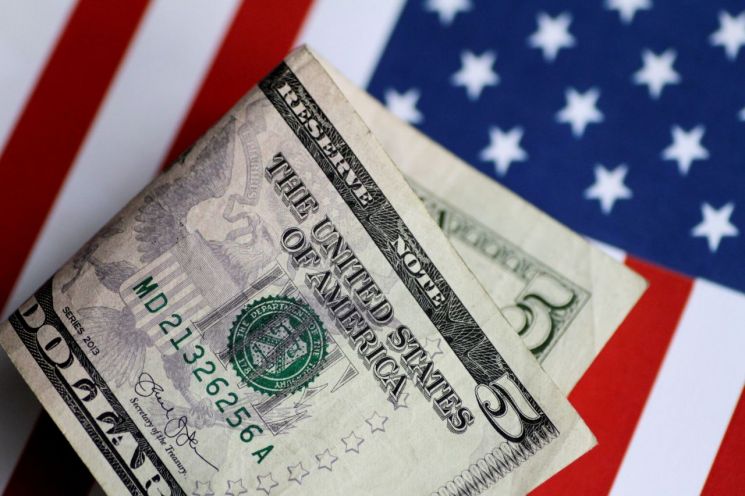
[Asia Economy Reporter Eunbyeol Kim] The Federal Reserve's (Fed) tightening signals and massive sell-offs of domestic stocks by foreign investors are exacerbating instability in the foreign exchange market. Recently, the won-dollar exchange rate has soared, surpassing 1,165 won and now eyeing 1,170 won. While the dollar's strength is having a global impact, the recent decline in the won's value is considered particularly steep compared to other currencies.
On the 13th at the Seoul foreign exchange market, the won-dollar exchange rate closed at 1,169.0 won, up 7.8 won from the previous trading day (1,161.2 won). On that day, the won-dollar rate opened at 1,163.5 won, 2.3 won higher than the previous day's closing price, and at one point surged to 1,169.5 won. The closing rate was the highest in 11 months since September 29 last year (1,169.5 won). The won-dollar exchange rate jumped 26.9 won over the past week compared to the closing price on the 6th (1,142.10 won).
The rise in the won-dollar exchange rate is due to a combination of factors: the impending tapering (asset purchase reduction) by the U.S. Federal Reserve boosting the dollar's value, foreign investors' massive sell-off of Samsung Electronics and SK Hynix stocks, and the relatively weak won caused by the persistent number of domestic COVID-19 cases.
According to the financial market, the Fed is expected to announce its tapering plan at the September Federal Open Market Committee (FOMC) meeting. Christopher Waller, a Fed governor, stated, "We should prepare to announce the tapering plan in September." Waller, originally known as a dovish figure favoring monetary easing, has now indicated the need to prepare for tightening.
As forecasts emerge that the semiconductor supercycle is coming to an end, foreign investors have sold off large amounts of related domestic stocks. Over two days, the 12th and 13th, foreign investors net sold Samsung Electronics and SK Hynix stocks, the top two by market capitalization in Korea, by 4 trillion won and 1 trillion won respectively. Global investment bank Morgan Stanley also issued a negative assessment by lowering target prices for Samsung Electronics and SK Hynix. Morgan Stanley released a report titled "Winter is Coming for Semiconductors," lowering Samsung Electronics' target price from 98,000 won to 89,000 won and SK Hynix's target price sharply from 156,000 won to 80,000 won.
Another negative factor for the exchange rate is the recent domestic COVID-19 case count hovering around 2,000. Concerns over delayed economic recovery due to the spread of the Delta variant are also causing foreign investors to sell domestic stocks. Kim Sung-taek, head of the Global Economy Department at the International Finance Center, said, "The value of the dollar is influenced by interest rates but also significantly affected by differences in economic performance between countries," adding, "The dollar may remain strong until Europe or emerging markets show prominent catch-up growth."
© The Asia Business Daily(www.asiae.co.kr). All rights reserved.
![Clutching a Stolen Dior Bag, Saying "I Hate Being Poor but Real"... The Grotesque Con of a "Human Knockoff" [Slate]](https://cwcontent.asiae.co.kr/asiaresize/183/2026021902243444107_1771435474.jpg)
















