Incidence Rate per 100,000 Reaches Jeju Level 4... Elevated from the 18th
28.9% of Cases Have Unknown Infection Routes... 48.9% of Confirmed Cases Are Individual Contacts
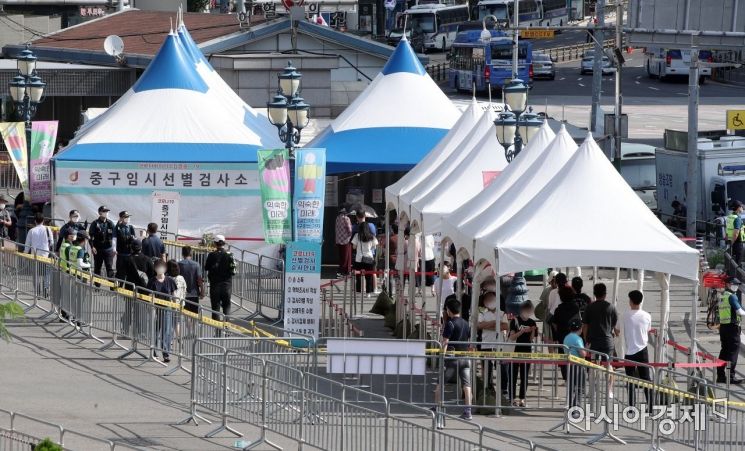 On August 15, Liberation Day, citizens lined up for testing at a temporary screening clinic set up in Seoul Station Plaza, Jung-gu, Seoul. The Central Disaster and Safety Countermeasures Headquarters announced that as of midnight, there were 1,817 new confirmed COVID-19 cases. This marked the highest number recorded for a Saturday tally. Photo by Kim Hyun-min kimhyun81@
[Asia Economy Reporter Kim Heeyoon] As the vacation season begins, the fourth wave of COVID-19 is intensifying, leading to the spread of the virus primarily at workplaces such as construction sites across the country.
On the 15th, the Central Disease Control Headquarters (CDCH) of the Korea Disease Control and Prevention Agency announced that since the 12th, a total of 14 people, including workers and their families, tested positive related to a company located in Yongsan-gu, Seoul. Among them, 12 are workers and 2 are family members.
At a construction site in Yongin-si, Gyeonggi Province, 11 workers had tested positive as of the previous day, and the infection route is under investigation.
In non-metropolitan areas, new cluster infections linked to workplaces, academies, and PC rooms have occurred consecutively. Additional confirmed cases have also followed in existing cases.
Since the 11th, six workers at a workplace in Geumsan-gun, Chungnam Province, tested positive. In a social gathering case in Asan-si, eight additional confirmed cases were reported among contacts, increasing the cumulative total to 46.
At a company in Seo-gu, Gwangju, six workers tested positive consecutively since the 13th, and in a cafe case in Jindo-gun, Jeonnam Province, five more confirmed cases were added, bringing the total to 47.
At a music academy in Pohang-si, Gyeongbuk Province, a total of 15 people, including workers and students, tested positive. Among them, three workers, including the index patient, and 12 students were confirmed.
In the Daegu and Gyeongbuk regions, additional confirmed cases occurred in cases such as a medical institution in Dong-gu, Daegu (total 15), a church in Daegu (259), a church in Gyeongsan-si (25), and a workplace in Pohang-si (22).
In Busan, new infection cases centered around medical institutions such as hospitals and nursing hospitals were confirmed. At a nursing hospital in Busan, after one worker tested positive on the 10th, the number of confirmed cases increased to a total of 15.
Following that, a total of 13 people, including workers, patients, and acquaintances, tested positive related to a general hospital in Dongnae-gu. Additionally, more confirmed cases occurred at a pub in Busanjin-gu (122) and a PC room in Seo-gu (14).
In Jeju-si, eight additional confirmed cases related to a social gathering (8th case) were reported, bringing the total to 30. At a senior day care center in Jeju-si, two more confirmed cases were added, totaling 31 positive cases.
According to the criteria for raising social distancing levels, if the daily average number of domestic confirmed cases per 100,000 people exceeds 4 for more than three consecutive days within a week, it corresponds to level 4.
Among the 17 cities and provinces nationwide, only Seoul, with more than 5 cases (5.1), and the metropolitan area have a weekly incidence rate of 4.2 per 100,000 people. Busan, which has been applying level 4 since the 10th of this month, also recorded a daily average of 4.0 cases per 100,000 people for three consecutive days starting from the 13th.
The Jeju region, where confirmed cases have recently surged, reached the level 4 threshold for the first time with an incidence rate of 4.4 per 100,000 people on this day. Accordingly, Jeju Province announced that social distancing will be raised from level 3 to level 4 from midnight on the 18th until midnight on the 29th.
Since the 1st of this month, the proportion of patients whose infection source is unknown has approached 29%. Nearly half of the confirmed cases, 48.9% (11,815 people), were infected after contact with a previously confirmed case.
Following that, 17.6% (4,257 people) were from local cluster outbreaks, 3.5% (854 people) were imported cases, 1.0% (233 people) were from hospitals and nursing hospitals, and 0.1% (14 people) were contacts of imported confirmed cases.
© The Asia Business Daily(www.asiae.co.kr). All rights reserved.

















