[Asia Economy Yang Nak-gyu, Military Specialist Reporter] In 2018, news that China had hacked 30 American companies including Apple and Amazon to steal information caused a worldwide stir. At that time, a company called 'Super Micro' supplied computer server components to major American companies, and it was reported that a chip smaller than a grain of rice was embedded in these components to carry out the hacking. The targets included procurement companies that dealt with the Department of Defense and the CIA (Central Intelligence Agency). Recently, analyses have emerged that major domestic defense companies have been victimized by hackers believed to be connected to North Korea. To understand how hacking is carried out and how far the technology to block it has advanced, we visited 'Jison' located in Guro-gu, Seoul.
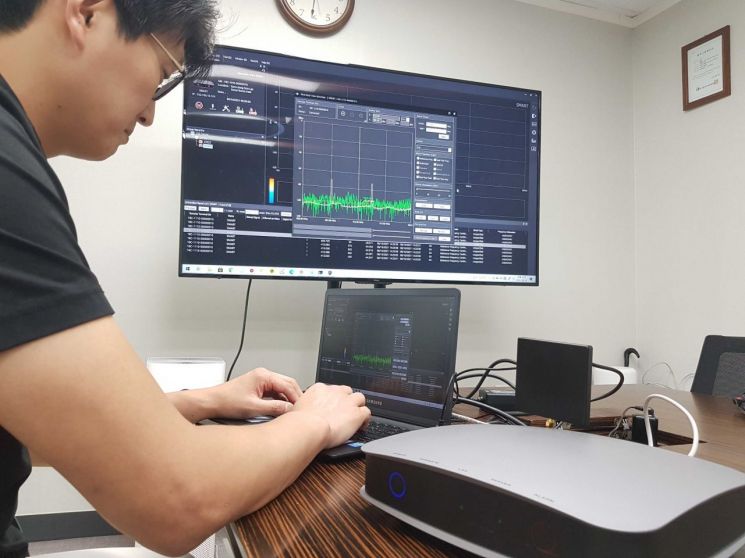
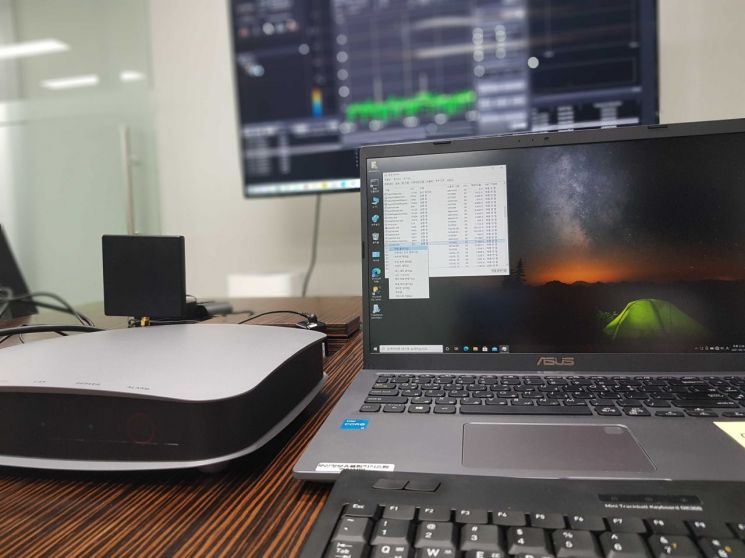
A company official introduced the basics of wireless hacking. Interestingly, the necessary equipment consisted of just a few laptops and a keyboard and mouse. There was also a terminal device that looked like a wireless internet router used in ordinary households. Director Pyo Jeong-su of Jison explained, "The hacking detection terminal detects all frequencies within 150㎡ and can check the occurrence frequency, model, and duration. Since the communication bands generated are not those of general communication systems, if there is suspicion, it can detect and notify whether hacking is occurring within one second."
We also observed the site where wireless hacking takes place. When a seemingly ordinary wired mouse was plugged into a laptop, voices of the reporter and company officials began to come from the hacker’s computer. This is a method where audio is transmitted to the hacking computer through the wired mouse. To defend against wireless hacking, a wireless radio security system that detects the entire wireless frequency band in real time is necessary. Only six countries, including the United States and Russia, possess this technology. Domestically, Jison is the only company that has this technology.
This time, the detection terminal was turned on to detect hacking. The monitor’s frequency suddenly fluctuated wildly, and a loud warning sound began to ring. The frequency bands used by communication devices for the general public range widely from 25 kHz to 6 GHz. However, hacking occurs outside the normal frequency range. Our military also planned to introduce a recording prevention device at a certain location in 2016. However, the project was canceled after the recording prevention technology was deemed insufficient. This indicates how much hacking recording and blocking technologies have evolved.
When a wireless camera capable of hacking was turned on, the reporter’s image was transmitted in video form. The hacking detection monitor showed that the frequency fluctuated with a longer wavelength, meaning that the amount of transmitted data was greater.
Wireless chips were embedded throughout the computer. This time, a wired keyboard was connected to the laptop. Although the laptop user did not operate anything, the computer displayed internal data at will. The hacking chip embedded in the wired keyboard performs such actions. Access was possible not only to the laptop’s internal data but also to the company’s internal internet network.
The company expects that such wireless hacking will increase and the scale of damage will grow amid the normalization of remote work due to the spread of COVID-19. According to analyses by global security firm Check Point and the Korea Internet & Security Agency (KISA), hacking incidents have actually surged since remote work became widespread last year.
A company official said, "Our military has focused only on blocking hacking attacks coming from outside, so it is vulnerable to hacking that enters from within. If hacking shuts down military command centers or changes missile targets, no matter how advanced the weapons deployed are, they could become useless."
© The Asia Business Daily(www.asiae.co.kr). All rights reserved.
![Clutching a Stolen Dior Bag, Saying "I Hate Being Poor but Real"... The Grotesque Con of a "Human Knockoff" [Slate]](https://cwcontent.asiae.co.kr/asiaresize/183/2026021902243444107_1771435474.jpg)

















