[Asia Economy Reporter Su-yeon Woo] Although South Korea has surpassed Japan in national competitiveness, credit ratings, and manufacturing over the past 30 years of rapid economic development, it still lags behind in terms of technological competitiveness.
On the 12th, the Federation of Korean Industries released the results of a "Comparison of Changes in Economic Competitiveness Gap between Korea and Japan" conducted on the occasion of Liberation Day. Since the 1990s, South Korea has overtaken Japan in overall national competitiveness rankings, PPP (purchasing power parity) per capita GDP, national credit ratings, and manufacturing competitiveness rankings.
First, in the IMD (International Institute for Management Development) World Competitiveness Ranking, Japan ranked 4th and South Korea 26th in 1995, but 25 years later in 2020, South Korea ranked 23rd, surpassing Japan, which was 34th. Additionally, in the national credit ratings by the three major international credit rating agencies?S&P, Moody's, and Fitch?Japan was rated higher (AAA) than South Korea (A+) in 1990, but in this year's evaluation, South Korea is rated AA, two levels higher than Japan's A+.
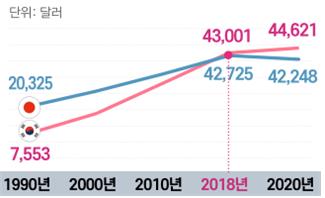
Based on PPP, which reflects each country's price and exchange rate levels to measure citizens' purchasing power, South Korea surpassed Japan in 2018 with a per capita GDP of $43,001 compared to Japan's $42,725, maintaining a favorable trend since then. In the manufacturing sector, a representative industry of both countries, according to the UN Industrial Development Organization (UNIDO) World Manufacturing Competitiveness Index (CIP), South Korea was ranked 17th in 1990 but rose to 3rd in 2018, while Japan fell from 2nd to 5th.
Various macroeconomic indicators confirm the narrowing economic gap between South Korea and Japan. South Korea's nominal GDP grew from $283 billion in 1990 to $1.631 trillion in 2020. This represents an increase from 8.9% to 32.3% of Japan's economy over 30 years, closing the gap to about one-third. In the global nominal GDP rankings, South Korea rose from 17th in 1990 to within the top 10 in 2020, while Japan dropped from 2nd to 3rd, significantly reducing the gap between the two countries.
South Korea's achievements are also prominent in external indicators. In the 1990s, South Korea's export volume was 24% and import volume 31% of Japan's, but by 2020, South Korea's exports reached 80% ($513 billion) and imports 74% ($468 billion) of Japan's levels. The gap in outward foreign direct investment, which was nearly 45 times in the 1990s, has now narrowed to 3.6 times.
The gap between South Korean and Japanese companies has also decreased in the "Fortune Global 500" ranking, reflecting the competitiveness of companies in both countries. While South Korean companies have strengthened their competitiveness, Japanese companies have weakened. The number of Japanese companies in the Fortune Global 500 dropped sharply from 149 in 1995 to 53 in 2020.
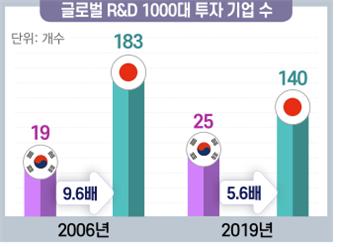 Comparison of the Number of Top 1000 Global R&D Investment Companies between Korea and Japan (Source: EC, EU R&D Scoreboard)
However, despite South Korea catching up with Japan in various economic indicators, the gap in basic technological competitiveness remains. In last year's global top 1000 R&D investing companies ranking, Japan still has five times more companies than South Korea.
In particular, South Korea's trade deficit with Japan in the materials and components sector, which reflects competitiveness, nearly doubled from $8.3 billion in 1994 to $15.4 billion last year, and its ratio to the overall trade balance with Japan also increased. This increase in deficit cannot be solely attributed to the expansion of trade volume, as the ratio to the total trade balance with Japan also slightly rose. Furthermore, in terms of basic science and foundational technology competitiveness, South Korea has no Nobel laureates in science, whereas Japan has produced 24 laureates up to last year.
Kim Bong-man, head of international cooperation at the Federation of Korean Industries, stated, "Over the past 30 years, South Korea has achieved remarkable economic success and surpassed Japan, but there remains a significant gap with Japan in overseas direct investment, global R&D investment, materials and components competitiveness, and basic science and technology investment. To ensure sustainable growth of the Korean economy, it is necessary to strengthen scientific and technological competitiveness through active and long-term government support for R&D."
© The Asia Business Daily(www.asiae.co.kr). All rights reserved.
![Clutching a Stolen Dior Bag, Saying "I Hate Being Poor but Real"... The Grotesque Con of a "Human Knockoff" [Slate]](https://cwcontent.asiae.co.kr/asiaresize/183/2026021902243444107_1771435474.jpg)

















