Publication of the '2021 Environmental Management Report'
Presenting Goals for Resource Circulation and Low Carbon Realization
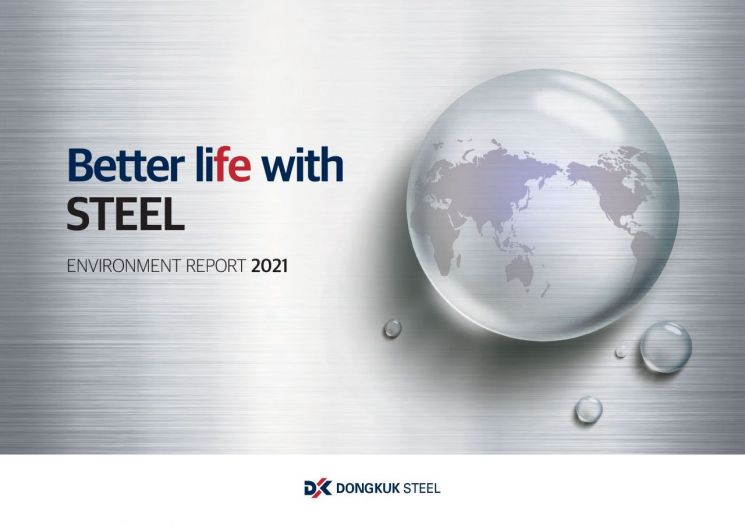
[Asia Economy Reporter Choi Dae-yeol] Dongkuk Steel reported that the greenhouse gas emissions from its domestic business sites last year amounted to 1.83 million tons, a 3% decrease compared to the previous year. The company has reduced its greenhouse gas emissions for three consecutive years.
According to the 2021 Environmental Management Report published by the company on the 10th, it reduced greenhouse gas emissions by advancing its production methods centered on electric arc furnaces. The steel industry is known as a major carbon-emitting sector, but Dongkuk Steel has a business structure focused on electric arc furnaces rather than blast furnaces, resulting in relatively lower carbon emissions. Blast furnaces produce steel using iron ore and coal, while electric arc furnaces recycle scrap steel to manufacture steel products.
Using the electric arc furnace steelmaking method at its Incheon and Pohang plants, the company recycled 3.76 million tons of steel scrap to produce 3.5 million tons of construction steel products such as rebar and structural steel. This resource circulation business directly contributes to carbon emission reduction. The company explained that compared to the blast furnace method, carbon emissions are reduced by about 75%. The company’s analysis estimates that if the same amount of steel had been produced solely using blast furnaces, the carbon dioxide reduction effect last year would have reached 5.8 million tons.
The EcoArc electric arc furnace at the Incheon plant is considered a representative facility that has advanced production methods. It was introduced in 2010 with consideration for environmentally friendly processes. The company explained that it can continuously supply scrap steel, improving energy efficiency and reducing carbon emissions. Energy was also saved through the hot charge method, which transfers heated steel products directly to the rolling process without cooling.
To practice ESG (Environmental, Social, and Governance) management, the company set its investment in eco-friendly sectors this year at 11.5 billion KRW, a 40% increase compared to last year. It plans to establish specific goals and plans such as energy saving and efficiency improvement, realization of smart factories, and development of carbon reduction processes.
© The Asia Business Daily(www.asiae.co.kr). All rights reserved.

















