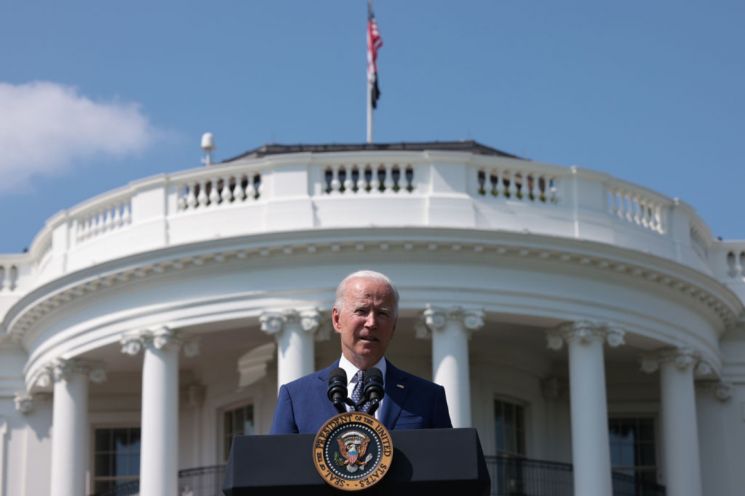
[Asia Economy Reporter Yujin Cho] The U.S. Senate is on the verge of passing President Joe Biden's $1 trillion (approximately 1,146 trillion won) infrastructure investment budget.
On the 7th (local time), the Senate decided to end the debate on the budget bill with a vote of 67 in favor and 27 against.
Previously, the budget bill was subject to the Republican Party's demand for the legitimate parliamentary obstruction procedure known as the 'filibuster.' Ending the filibuster requires the support of 60 senators, which is three-fifths of the Senate seats.
The Senate is evenly split with 50 seats each for the Democratic Party (including independents) and the Republican Party, but Republican senators who participated in the bipartisan infrastructure budget negotiations voted to end the debate, thus ending the filibuster.
For the Democrats, this result in ending the filibuster in the debate-ending vote, considered the biggest obstacle before the majority vote on the budget bill, is significant.
Since taking office, President Biden has requested a $4 trillion (approximately 4,600 trillion won) infrastructure budget from Congress, including a $2.25 trillion job plan and a $1.7 trillion family plan. This astronomical amount is about eight times South Korea's entire annual budget of 560 trillion won.
However, facing strong opposition from the Republican Party concerned about increasing national debt, higher taxpayer burdens, and reduced corporate investment incentives, President Biden and the Democrats adopted a 'two-track' strategy.
They decided to handle parts where compromise with the Republicans is possible through bipartisan agreement, while passing budget items with disagreements independently using the Democratic majority in Congress.
The $1 trillion budget bill, now close to Senate passage, was agreed upon by bipartisan Republican senators and includes items such as roads, bridges, transportation, broadband, and water systems, which Republicans generally agree are necessary.
The Democrats plan to independently process the $3.5 trillion excluded from this budget bill using the Senate's 'budget reconciliation' procedure.
Since the budget reconciliation procedure cannot be blocked by a filibuster, the Democrats, holding the majority including the vice president as the Senate president with a casting vote, can pass it on their own.
All these budgets must also pass the House of Representatives to complete the congressional process. Since the Democrats hold the majority in the House, it is expected to pass without much difficulty.
© The Asia Business Daily(www.asiae.co.kr). All rights reserved.
![Clutching a Stolen Dior Bag, Saying "I Hate Being Poor but Real"... The Grotesque Con of a "Human Knockoff" [Slate]](https://cwcontent.asiae.co.kr/asiaresize/183/2026021902243444107_1771435474.jpg)
















