Net Foreign Buying of 361.5 Billion KRW This Month
Samsung Electronics, SK Hynix Resume Investment
Reflecting Optimism for Industry Recovery in Second Half
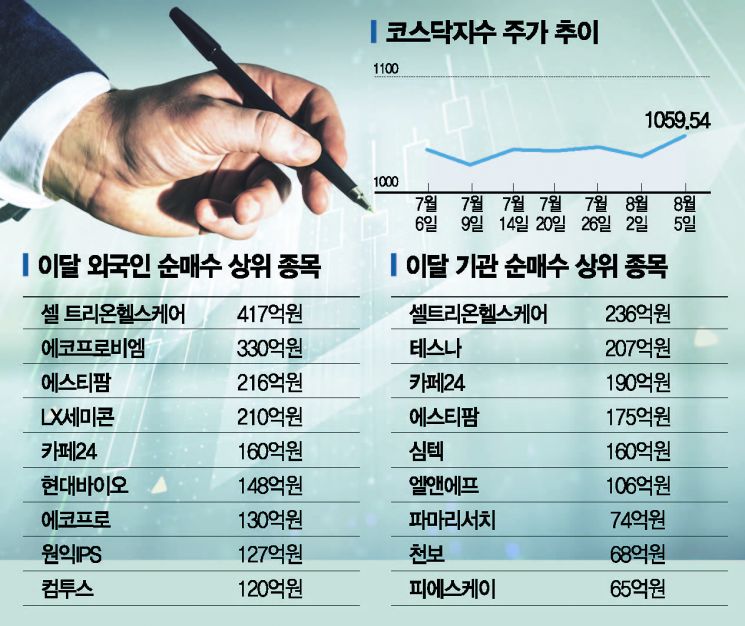
[Asia Economy Reporter Minji Lee] Since the beginning of this month, foreign investors and institutional investors have been focusing on buying semiconductor and IT sector stocks in the KOSDAQ market. This is analyzed to reflect expectations that Samsung Electronics and SK Hynix will resume full-process investments in the second half of the year amid anticipated recovery in the semiconductor industry.
According to the Korea Exchange on the 6th, the KOSDAQ index has risen 2.75% so far this month until the previous day. On the previous day, it hit the highest closing price of the year (1059.54) for the first time in nine trading days. By investor type, foreigners led the index rise by purchasing stocks worth 361.5 billion KRW. Institutions only sold 49.7 billion KRW worth of stocks, and individuals sold stocks worth 272.4 billion KRW.
Looking at the basket of stocks with the largest net purchases by foreigners, many small and mid-cap semiconductor and IT-related stocks were included. Foreigners bought KOSDAQ market leader Celltrion Healthcare (41.7 billion KRW) and EcoPro BM (33 billion KRW), a secondary battery company that significantly increased net purchases last month. They also showed net buying in semiconductor front-end equipment companies such as Wonik IPS (12.7 billion KRW), Eugene Technology (11.1 billion KRW), and packaging board-related stock Simtek (9 billion KRW). Last month, foreigners showed net buying only in secondary battery stocks (EcoPro BM, L&F), game stocks (Kakao Games), and pharmaceutical companies (DIO, Osstem Implant), but this month they have continued investing in semiconductor-related stocks. Institutional investors also bought semiconductor back-end testing company Tesna (20.7 billion KRW), Simtek (16 billion KRW), and semiconductor back-end equipment company PSK (6.5 billion KRW).
This is analyzed to reflect high expectations for a recovery in the semiconductor industry in the second half of the year, following strong performance by semiconductor companies in the first half. While the Philadelphia Semiconductor Index, which reflects the semiconductor market outlook, has been hitting new highs daily, foreign investors’ sentiment has shifted from large-cap semiconductor stocks to small and mid-cap IT hardware stocks. Since the beginning of this month, domestic semiconductor large caps Samsung Electronics and SK Hynix have risen 5% and 6.6%, respectively, recovering to 80,000 KRW and 120,000 KRW levels in three weeks, supported by improving investor sentiment.
The securities industry’s basis for expecting a semiconductor industry rebound lies in the normalization of DRAM inventory and improved performance in the non-memory business sector. Due to the resurgence of COVID-19 in Asia in the first half, demand in downstream industries slowed, causing customers’ DRAM inventory to increase significantly. It is expected that inventory will normalize as the year progresses. Additionally, as supply shortages in non-memory semiconductors gradually ease and PC demand improves, the speed of DRAM inventory normalization is expected to accelerate.
Park Yoo-ak, a researcher at Kiwoom Securities, said, "Although DRAM supply and demand are temporarily slowing, strong recovery in server and smartphone demand is expected in the second half of this year, and supply shortages in non-memory semiconductors will be resolved by the first quarter of next year. With the anticipated stock price rebound of Samsung Electronics and SK Hynix, if investments in Samsung Electronics’ P3 and SK Hynix’s M15 and M16 resume in the second half, stock prices of semiconductor equipment companies will rise sharply."
Furthermore, the fact that DRAM users are increasing replacement demand from DDR4 to DDR5 in the second half, and that active investments in non-memory semiconductors in the first half will continue to benefit semiconductor equipment companies, is also an investment point. Choi Do-yeon, a researcher at Shinhan Financial Investment, explained, "When transitioning to DDR5, changes in the back-end process are expected to be much greater than in the front-end process, so benefits will be concentrated on back-end related companies. Also, the fact that TSMC, Intel, and Samsung Electronics have actively invested in non-memory facilities until 2023 is another factor to consider for investment."
© The Asia Business Daily(www.asiae.co.kr). All rights reserved.
![Clutching a Stolen Dior Bag, Saying "I Hate Being Poor but Real"... The Grotesque Con of a "Human Knockoff" [Slate]](https://cwcontent.asiae.co.kr/asiaresize/183/2026021902243444107_1771435474.jpg)
















