Surge in Big IPO Investments Spurs Interest in Unlisted Companies
Pre-purchases of Potential IPO Stocks Increase, Cumulative Trading Volume Surpasses 4 Trillion Won in H1
Investor Protection and Information Access Difficult, High Price Volatility Poses Risks
Trading Not Easy... Possibility of Long-term Lock-up
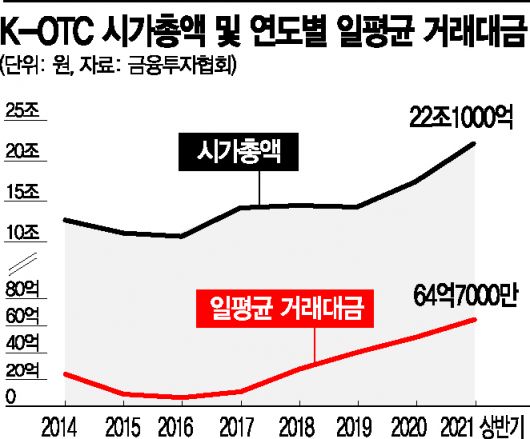
[Asia Economy Reporters Song Hwajeong and Gong Byeongseon] The influx of funds into over-the-counter (OTC) stocks is due to the initial public offering (IPO) boom. With increased liquidity, a series of major IPOs attracted investors to public offerings, and as competition intensified, investors turned their attention to the OTC market to secure major stocks more quickly. Experts warn that investing solely in pursuit of big wins in unlisted stocks carries significant risks.
OTC Stocks Also 'Warming Up' Amid Public Offering Investment Boom
According to the Korea Financial Investment Association on the 6th, the cumulative trading volume of the Korea OTC Market (K-OTC) surpassed 4 trillion won in the first half of this year. The trading volume in the first half of this year reached 795.4 billion won, bringing the cumulative trading volume to 4.5883 trillion won. The average daily trading volume increased by 50% compared to the same period last year, reaching 6.47 billion won, marking an all-time high. As of the end of June, the market capitalization stood at 22.0931 trillion won, the highest in six and a half years.
The OTC market's boom is driven by the enthusiasm for public offering investments. Since last year, a series of major IPOs including SK Biopharm, Kakao Games, HYBE, SK Bioscience, SK IE Technology, and Kakao Bank have heated up the public offering investment fever. Especially, these major IPOs recorded so-called 'ttasang' (where the opening price on the first day of listing is double the public offering price, followed by hitting the upper price limit), making public offering investments perceived as golden opportunities, and abundant market liquidity flowed into public offerings. Even just achieving 'ttasang' can yield a 160% return. SK Biopharm, for example, soared with three consecutive upper price limits after listing, achieving 'ttasangssang,' and Kakao Games recorded 'ttasangsang' with two consecutive upper price limits. SK IE Technology, which listed this year, set a record with subscription deposits reaching 80.9017 trillion won during its general public offering.
As funds poured in, competition for public offerings skyrocketed. According to Daishin Securities, the average demand forecast competition ratio in July exceeded 1000 to 1. Subscription competition ratios also rose from 1220 to 1 in the second quarter to 2046 to 1 in July. Maxst, which listed on the 27th of last month, recorded a public offering subscription competition ratio of an astonishing 6763 to 1. This surpassed the previous record of 4397.67 to 1 set by NBT in January, marking an all-time high.
With fierce competition for public offerings, investors turned to OTC stocks to preemptively secure promising prospects. Kakao Bank and Krafton, which were early considered major IPO candidates, saw their stock prices rise sharply in the OTC market. Krafton's OTC price rose to 1.2 million won in August last year and exceeded 2 million won before its face value split in May. Hwang Sewoon, a research fellow at the Korea Capital Market Institute, said, "It is natural that interest in unlisted stocks increases as IPOs gain popularity," adding, "There is growing demand to pre-purchase stocks that are likely to IPO."
High Risks in OTC Stocks Require Cautious Investment
Although interest in OTC stocks is rising amid the IPO boom, experts advise against blindly chasing IPO windfalls. Unlike listed stocks, investor protection is insufficient, and it is difficult to obtain adequate information about the companies. Due to lower liquidity, price volatility is high, and predicting the timing of listing is challenging.
Research fellow Hwang pointed out, "Listed stocks are subject to regulations related to public offerings, providing strong investor protection, but unlisted stocks have almost no such protections," adding, "Therefore, access to corporate information is relatively limited." Price liquidity is also significantly lower than that of listed stocks. There is a limitation in that transactions may not be executed quickly when investors want to buy or sell. The possibility of funds being tied up for a long period cannot be excluded. Hwang explained, "Usually, trading demand concentrates on stocks expected to be listed, but the timing of listing is uncertain," and "Investors may enter expecting a likely listing, but delays are common, so it is necessary to be aware of these risks."
There is also criticism that the mere fact that unlisted stocks are traded does not necessarily indicate a good company. Yoo Hyuksang, a professor at Soongsil University Graduate School of Small and Medium Business, said, "I view the trading of unlisted stocks itself negatively," adding, "Good startups are generally invested in by reputable venture capital (VC) or institutions, so their stocks do not usually appear on the market before listing." Professor Yoo added, "It is nonsense for institutions to split and sell shares of successful startups OTC," and "If small quantities of old shares circulate before listing, it is hard to judge, but it is rare for such companies to be good."
© The Asia Business Daily(www.asiae.co.kr). All rights reserved.

















