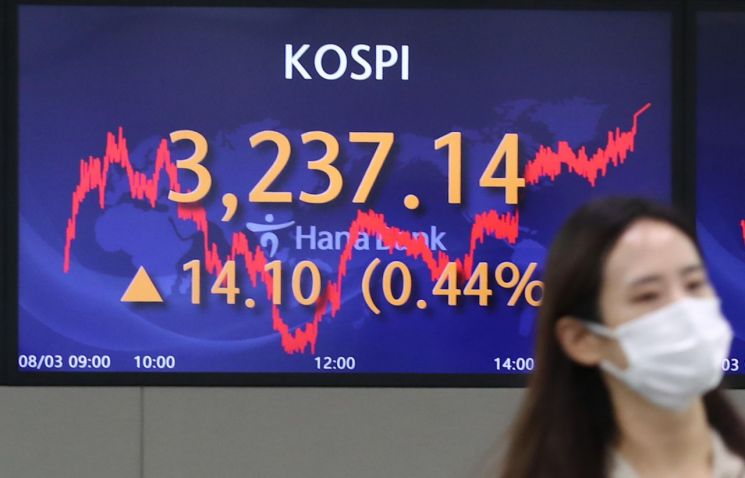
[Asia Economy Reporter Junho Hwang] On the 6th, the stock market started higher, buoyed by the strong performance of the U.S. stock market. As risk asset preference increased, foreign investors' net buying momentum revived.
On this day, the KOSPI opened at 3,277.06, up 0.93 points (0.03%). As of 9:09 a.m., foreign investors were net buyers of 186 billion KRW, pushing the index up 0.11% to 3,279.84. At the same time, individual and institutional investors were net sellers of 73.9 billion KRW and 97.8 billion KRW, respectively. Among all listed stocks, 364 stocks were rising while 396 stocks were falling.
Large-cap stocks continued to show weakness. Samsung Electronics and SK Hynix fell by 0.12% and 0.125%, respectively. The previous day’s U.S. market also saw AMD drop 5.41%, causing the Philadelphia Semiconductor Index to fall 0.36%, which is believed to have influenced the domestic market. On this day, KakaoBank was listed, but Kakao showed weakness, falling 1.34% to 167,000 KRW.
The KOSDAQ opened at 1,061.32, up 1.78 points (0.17%), but turned lower as foreign investors continued net selling, which had previously led the market. As of this time, foreign and institutional investors were net sellers of 51.2 billion KRW and 19.1 billion KRW, respectively, while individual investors were net buyers of 75.7 billion KRW.
Sangyoung Seo, a researcher at Mirae Asset Securities’ Media Content Department, analyzed, "The U.S. stock market rose the previous day, and international oil prices and market interest rates increased, which is interpreted as raising risk asset preference sentiment."
Jiyoung Han, a researcher at Kiwoom Securities, said, "The Korean stock market is expected to show an upward trend due to the recovery of expectations for economic normalization in developed countries and the continued risk asset preference sentiment following the strong U.S. stock market. The fact that the won-dollar exchange rate has fallen from the 1,150 won level to the 1,140 won level is also a factor expected to improve foreign investor supply conditions."
© The Asia Business Daily(www.asiae.co.kr). All rights reserved.

















