Average Aging Rate of Local Si/Gun/Gu at 18.7%... Entering Aging Society
Eup/Myeon/Dong Already in Super-Aged Society
[Asia Economy Reporter Hwang Yoon-joo] "Due to rapid population aging, 30% of all eup, myeon, and dong nationwide are at risk of becoming ‘population zero’."
Professor Yoo Seon-jong of the Department of Real Estate at Konkuk University said this on the 6th during an online lecture titled "How Serious Is Regional Population Decline?" held by the Korea Chamber of Commerce and Industry (KCCI) as part of the 'KCCI Insight' series.
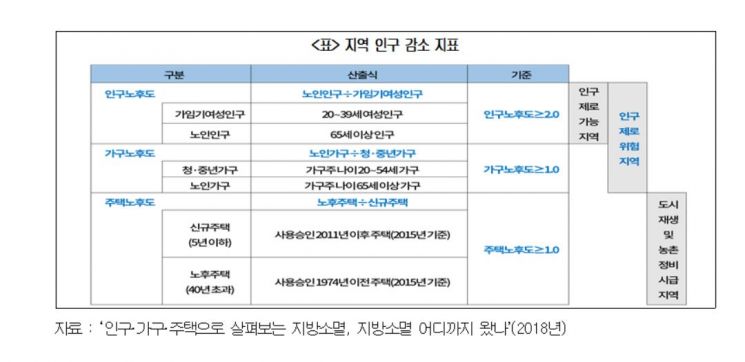
Professor Yoo stated, "Analyzing the possibility and risk of population zero in regions using three indicators?population aging index, household aging index, and housing aging index?out of 3,492 eup, myeon, and dong nationwide, 1,047 are at risk of population zero," emphasizing, "Among all eup, myeon, and dong, 1,904 urgently require urban regeneration or rural maintenance."
Professor Yoo classified areas with a population aging index of 2.0 or higher as 'potential population zero areas,' and those with a population aging index of 2.0 or higher plus a household aging index of 1.0 or higher as 'population zero risk areas.' Areas with a housing aging index of 1.0 or higher were defined as 'urgent urban regeneration and rural maintenance areas.'
Professor Yoo warned, "We must not be deceived by errors in population-related statistics," adding, "Although the overall aging rate of South Korea (the proportion of people aged 65 and over in the total population) is not yet high and young people are concentrated in cities, making it less perceptible, analyzing local statistics reveals a quite serious situation."
He explained, "As of 2015, South Korea’s aging rate was 13.2%, which does not qualify as an aged society (14%). However, when analyzed by region, the average aging rate of si, gun, and gu (cities, counties, and districts) is 18.7%, entering an aged society, and based on eup, myeon, and dong, it is 20.9%, already corresponding to a super-aged society (20%)."
In particular, he analyzed, "According to future population projections, South Korea’s aging rate will reach 35.6% by 2045. As of 2015, four si, gun, and gu and 632 eup, myeon, and dong already have aging rates exceeding 35%, which is so severe that the economic functions of cities are lost due to youth outflow and aging."
Professor Yoo advised, "While everyone agrees on the need for coexistence between the metropolitan area and other regions, budget constraints force us to prioritize and focus. It is necessary to conduct a detailed analysis of the aging status and self-sustainability of regional cities and provide systematic support accordingly."
Meanwhile, KCCI plans to hold a second lecture in September under the theme "Problems of Regional Economic and Industrial Structures." This lecture will be available for viewing from August 6 on YouTube (Korea Chamber of Commerce and Industry Insight) and the KCCI website’s 'Online Seminar' section.
© The Asia Business Daily(www.asiae.co.kr). All rights reserved.

















